
Soft Magnetic Materials Market Size Worth USD 73.77 Billion by 2035 as EV Revolution and Smart Energy Systems Accelerate Demand
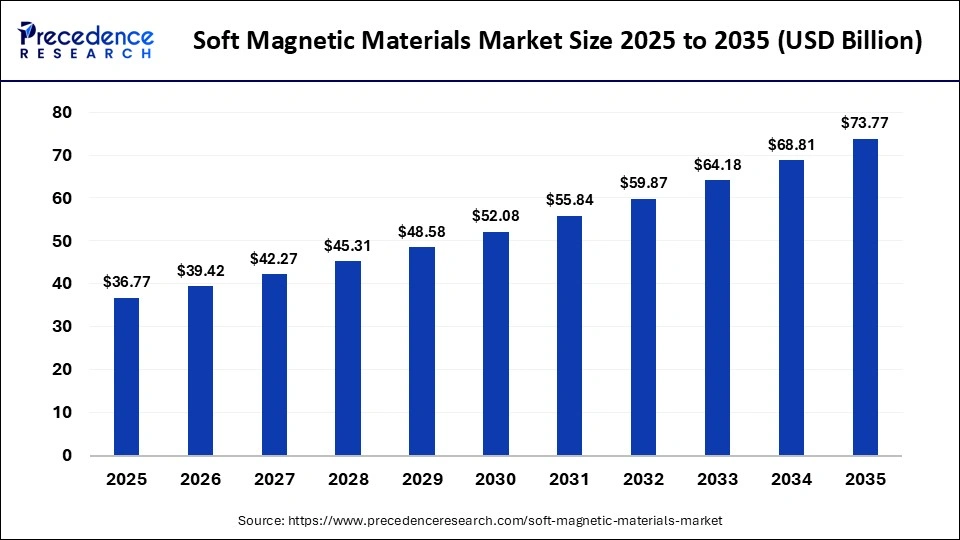
The global soft magnetic materials market is entering a transformative growth phase, fueled by rapid electrification across transportation, industrial automation, renewable energy systems, and advanced consumer electronics. The market size was valued at USD 36.77 billion in 2025 and is projected to grow from USD 39.42 billion in 2026 to approximately USD 73.77 billion by 2035, registering a CAGR of 7.21% during the forecast period from 2026 to 2035.
Soft magnetic materials are increasingly becoming the backbone of modern energy-efficient technologies due to their superior magnetic permeability, low coercivity, and ability to reduce energy loss in high-frequency applications. Their widespread adoption across electric vehicles (EVs), transformers, smart grids, inductors, and advanced motor systems is reshaping the global materials ecosystem.
The ongoing transition toward sustainable infrastructure, combined with the miniaturization of electronics and rising investments in renewable energy, is expected to significantly expand the application scope of advanced soft magnetic materials worldwide.
Soft Magnetic Materials Market Key Points
- Asia-Pacific dominated the global market in 2025 with a revenue share of approximately 48.2%, supported by strong manufacturing ecosystems and EV production leadership.
- North America is anticipated to witness the fastest growth rate of around 9.5% CAGR due to rising investments in clean manufacturing, EV supply chains, and advanced energy infrastructure.
- Electrical steel (silicon steel) emerged as the leading material segment with a 64.2% market share in 2025 owing to its cost-efficiency and superior magnetic performance.
- Electric motors accounted for nearly 48.7% of market revenue in 2025 as EV production and industrial automation continued expanding globally.
- The automotive EV/HEV segment is expected to record the fastest growth throughout the forecast period due to accelerating vehicle electrification initiatives.
- Advanced amorphous and nanocrystalline alloys are gaining momentum because of their ultra-low core loss, high thermal stability, and compact design capabilities.
What are Soft Magnetic Materials and Why are They Becoming Critical Across Industries?
Soft magnetic materials are materials that can be rapidly magnetized and demagnetized with minimal energy loss. These materials are extensively used in motors, transformers, inductors, generators, relays, and power conversion systems.
The growing demand for energy-efficient devices and high-frequency power electronics has significantly increased the need for advanced soft magnetic solutions. Industries are increasingly shifting toward materials that can improve power density, reduce thermal losses, and support compact product designs.
The global transition toward electric mobility and renewable energy integration has further accelerated the deployment of high-performance soft magnetic materials in EV drivetrains, charging systems, wind turbines, solar inverters, and smart grids.
How is Artificial Intelligence Transforming the Soft Magnetic Materials Market?
Artificial intelligence is rapidly transforming the development and commercialization of soft magnetic materials. AI-powered modeling tools are helping manufacturers discover advanced alloy compositions, optimize magnetic performance, and significantly reduce material development timelines.
Machine learning algorithms are now being used to predict magnetic properties, simulate thermal stability, and improve additive manufacturing processes for next-generation magnetic components. This is particularly valuable for EV powertrains, AI servers, renewable energy converters, and IoT-enabled devices that require highly efficient magnetic systems.
In November 2025, researchers from the University of New Hampshire developed an AI-enabled searchable database containing over 67,000 magnetic materials. The initiative aims to reduce reliance on rare-earth materials while accelerating innovation in clean energy and electric transportation systems.
AI is also helping manufacturers minimize R&D expenses, improve production precision, and accelerate commercialization cycles, creating a major competitive advantage for market participants.
Soft Magnetic Materials Market Key Attributes
| Market Metric | Value |
|---|---|
| Market Size 2025 | USD 36.77 Billion |
| Market Size 2026 | USD 39.42 Billion |
| Forecast Value 2035 | USD 73.77 Billion |
| CAGR (2026–2035) | 7.21% |
| Dominant Region | Asia-Pacific |
| Fastest Growing Region | North America |
Why is Demand for Soft Magnetic Materials Rising So Rapidly?
Electric Vehicle Expansion is Creating Massive Material Demand
The global EV industry remains one of the strongest growth engines for the soft magnetic materials market. Electric motors, charging infrastructure, battery management systems, and power electronics require advanced magnetic materials to improve efficiency and reduce energy losses.
Governments worldwide are implementing stringent carbon reduction policies, subsidies, and EV manufacturing incentives, further accelerating demand.
As automakers prioritize lighter and more compact high-performance motors, advanced nanocrystalline and amorphous alloys are becoming increasingly essential.
Renewable Energy Infrastructure is Accelerating Market Expansion
The expansion of wind farms, solar energy projects, and smart grid systems has dramatically increased the need for high-efficiency transformers and inverters.
Soft magnetic materials are critical in renewable energy systems because they help minimize transmission losses and improve energy conversion efficiency.
Countries investing heavily in grid modernization and decentralized energy systems are expected to create long-term growth opportunities for market participants.
Miniaturization of Electronics is Driving Innovation
The rapid miniaturization of smartphones, wearable devices, industrial sensors, and smart appliances has created strong demand for compact magnetic components.
Manufacturers are increasingly using high-frequency soft magnetic materials to reduce power consumption while improving operational efficiency in compact electronics.
This trend is expected to significantly boost the adoption of amorphous and nanocrystalline materials over the coming decade.
Which Emerging Opportunities are Reshaping the Market?
Can Nanocrystalline and Amorphous Alloys Become the Next Major Growth Frontier?
Nanocrystalline and amorphous alloys are expected to emerge as the fastest-growing material segment during the forecast period.
These advanced materials offer lower core losses, superior permeability, and excellent thermal performance compared to traditional electrical steel. Their lightweight structure and high-frequency capabilities make them ideal for EVs, aerospace electronics, renewable power systems, and next-generation industrial automation.
As industries increasingly seek ultra-efficient energy systems, demand for these advanced materials is expected to accelerate substantially.
Will Smart Manufacturing and Industry 4.0 Increase Material Adoption?
Absolutely. The growing implementation of Industry 4.0 technologies, robotics, AI-driven automation, and IoT-enabled production systems is increasing the deployment of sophisticated magnetic components.
Manufacturers are integrating advanced soft magnetic materials into robotic motors, industrial sensors, smart grids, and automated control systems to improve precision and reduce energy consumption.
This trend is expected to create strong long-term opportunities across industrial sectors globally.
Soft Magnetic Materials Market Segment Analysis
By Material Type
The electrical steel (silicon steel) segment accounted for approximately 64.2% of the global market share in 2025. Its dominance is attributed to high magnetic efficiency, cost-effectiveness, and widespread application in motors, transformers, and industrial power systems. Electrical steel remains a preferred choice due to its scalability and established manufacturing infrastructure. The material is extensively utilized in EV motors, renewable energy generators, and smart electrical grids.
The amorphous and nanocrystalline alloys segment is projected to witness the fastest growth through 2035. These materials provide reduced core losses, superior magnetic saturation, and enhanced thermal stability, making them highly suitable for compact, high-frequency applications in EVs and advanced electronics. Their ability to support lightweight and energy-efficient designs is driving rapid adoption across industries.
By Application
Electric motors held approximately 48.7% of the market share in 2025. The rapid global transition toward electric transportation and industrial automation has significantly boosted demand for high-performance motor systems utilizing advanced soft magnetic materials. Electric motors are central to EVs, industrial robotics, smart manufacturing equipment, and renewable energy systems. The inductors and chokes segment is expected to witness robust growth throughout the forecast period.
Increasing demand for compact power electronics, fast-charging infrastructure, and energy-efficient industrial systems is driving adoption of premium inductors and magnetic components. Modern AI systems, data centers, and smart electronics increasingly rely on high-frequency magnetic technologies for efficient power management.
By End-Use Industry
The electrical and electronics segment captured approximately 32.4% of market revenue in 2025. The segment’s growth is supported by increasing production of consumer electronics, industrial robots, smart appliances, and renewable power systems. Growing investments in intelligent grid infrastructure and automation technologies continue to strengthen market demand.
The automotive EV/HEV segment is expected to register the fastest growth during the forecast period. Soft magnetic materials are essential in EV motors, charging systems, anti-lock braking systems, and fuel injectors. Their ability to improve efficiency while reducing component size and vehicle weight is driving widespread adoption across automotive platforms. The global push toward carbon neutrality and electrified transportation is expected to further amplify demand.
Soft Magnetic Materials Market Regional Analysis
Asia-Pacific held approximately 48.2% of global market revenue in 2025 and is expected to maintain its leadership position through 2035. The region benefits from massive industrialization, strong EV manufacturing capabilities, extensive electronics production, and dominant rare-earth mining operations. Government initiatives such as China’s manufacturing policies and India’s “Make in India” campaign are accelerating investments in green energy and advanced manufacturing.
China continues to dominate global production and consumption of soft magnetic materials. According to the International Energy Agency, China accounted for nearly 60% of global rare-earth mining output in 2024 and controlled approximately 94% of global magnet manufacturing components for motors. The country’s strong supply chain ecosystem and large-scale manufacturing infrastructure continue to reinforce its market leadership.
North America is expected to register the highest CAGR of approximately 9.5% during the forecast period. The region’s rapid expansion is supported by clean energy investments, EV manufacturing growth, and modernization of electrical grids. The U.S. Inflation Reduction Act has accelerated domestic manufacturing investments, particularly across EV supply chains and clean technology sectors.
The U.S. market is witnessing strong growth due to rising electrification, industrial automation, aerospace innovation, and renewable energy deployment. In Q1 2025 alone, clean manufacturing investments linked to EV supply chains reached approximately USD 14 billion in the United States.
Europe is expected to experience considerable growth due to strong regulatory support for sustainability and electric mobility. Countries across the region are investing heavily in smart factories, renewable infrastructure, and advanced manufacturing technologies.
Germany remains Europe’s leading hub for automotive manufacturing and industrial innovation. The country’s growing EV production capacity, robotics adoption, and smart manufacturing investments are accelerating demand for advanced soft magnetic materials. In the first half of 2025, Germany produced nearly 635,000 battery electric vehicles.
Soft Magnetic Materials Market Value Chain Analysis
Recent Breakthroughs
- In January 2026, Noveon Magnetics partnered with Kangwon Energy and LG Electronics to advance closed-loop recycling technologies for rare-earth magnets.
- In December 2025, researchers from NIMS, Tohoku University, and AIST developed a nanostructure control technique capable of reducing core loss by over 50% in high-frequency transformer applications.
- In November 2025, VNT launched India’s first 1-megawatt EV charger to support long-haul electric transportation systems.
Soft Magnetic Materials Market Key Players
- Hitachi Metals, Ltd. (Proterial, Ltd.)
- TDK Corporation
- Vacuumschmelze GmbH & Co. KG
- Nippon Steel Corporation
- JFE Steel Corporation
- Sumitomo Metal Mining Co., Ltd.
- Daido Steel Co., Ltd.
- Arnold Magnetic Technologies
- Voestalpine AG
- Aperam S.A.
- ThyssenKrupp AG
Segments Covered in the Report
By Material Type
- Electrical Steel (Silicon Steel)
- Soft Ferrites
- Amorphous & Nanocrystalline Alloys
- Others (Cobalt, Nickel, Iron Powder)
By Application
- Electric Motors
- Transformers
- Inductors & Chokes
- Others (Alternators, Sensors)
By End-User Industry
- Automotive (EV/HEV)
- Electrical & Electronics
- Energy & Power
- Others (Healthcare, Aerospace)
By Region
- North America
- Europe
- Asia-Pacific
- Latin America
- Middle East & Africa
Read Also: Green Chelates Market Surges Toward USD 1.88 Billion by 2035
Get this report to explore global market size, share, CAGR, and trends, featuring detailed segmental analysis and an insightful competitive landscape overview @https://www.precedenceresearch.com/sample/7554
You can place an order or ask any questions. Please feel free to contact us at sales@precedenceresearch.com |+1 804 441 9344