
Hydrodesulfurization Catalyst Market Size to Reach USD 8.26 Billion by 2035 Amid Rising Demand for Ultra-Low Sulfur Fuels
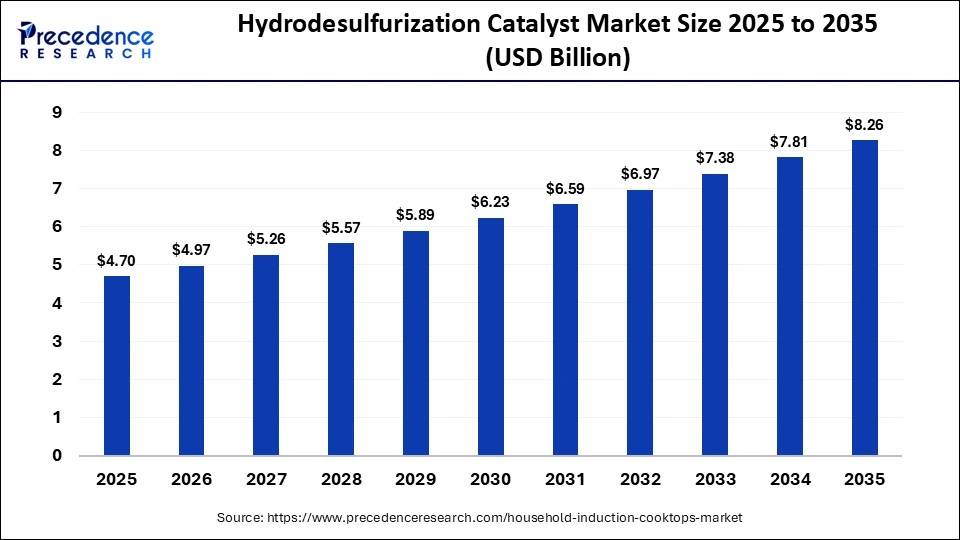
The global hydrodesulfurization catalyst market size is projected to grow from USD 4.97 billion in 2026 to USD 8.26 billion by 2035, registering a CAGR of 5.80% during the forecast period. The surge is largely attributed to stringent sulfur emission standards, technological advancements in refinery operations, and the growing need to process heavier crude oil.
Hydrodesulfurization catalysts play a crucial role in modern refining by removing sulfur compounds from fuels such as gasoline, diesel, and jet fuel. With global regulators enforcing ultra-low sulfur fuel mandates, refineries are rapidly upgrading catalyst systems to meet compliance while maintaining operational efficiency.
Key Insights: What’s Driving the Hydrodesulfurization Catalyst Market?
- The market was valued at USD 4.70 billion in 2025 and is expected to grow significantly, reaching USD 8.26 billion by 2035.
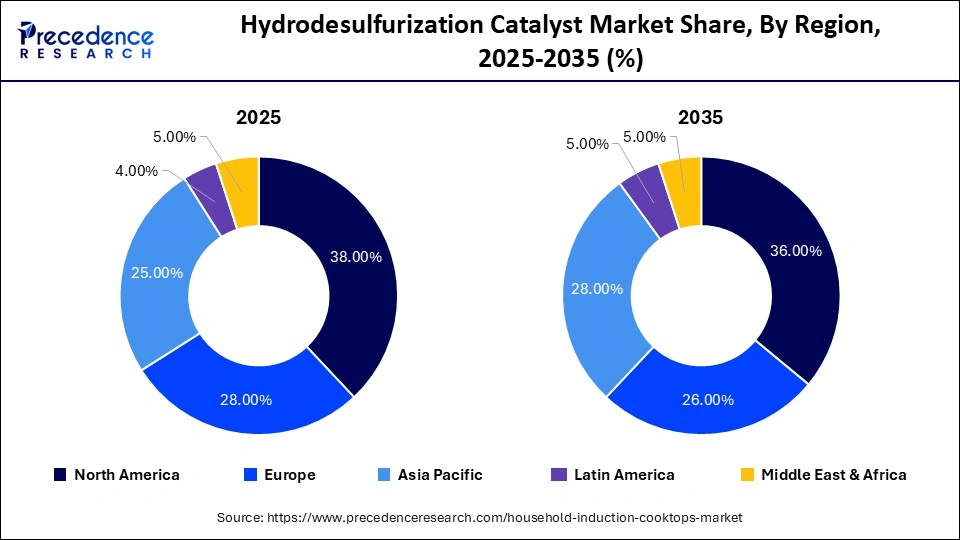
- North America emerged as the dominant region, accounting for 38% of the total market share in 2025 due to stringent emission regulations.
- Cobalt molybdenum catalysts led the market with a 38% share, owing to their cost-effectiveness and efficiency in sulfur removal.
- Petroleum refining remained the largest application segment, contributing 72% of the total demand in 2025.
- Oil & gas was the leading end-user industry, capturing 65% market share, driven by regulatory pressure for cleaner fuels.
- Asia-Pacific is anticipated to witness the fastest growth, supported by rapid refinery expansion and industrialization.
Market Overview: Why Are Hydrodesulfurization Catalysts Essential Today?
Hydrodesulfurization catalysts are indispensable in the petroleum refining process, enabling the removal of sulfur by converting it into hydrogen sulfide. This process ensures compliance with environmental standards such as ultra-low sulfur diesel (ULSD) requirements.
The market is evolving with the introduction of high-activity catalysts, designed to reduce hydrogen consumption and enhance energy efficiency. Industry leaders such as Haldor Topsoe, BASF, and Shell are innovating advanced catalyst systems for large-scale refinery operations, ensuring both sustainability and performance.
How is AI Transforming the Hydrodesulfurization Catalyst Market?
Artificial intelligence is redefining refinery operations by enabling real-time monitoring of catalyst performance. Advanced machine learning models help predict catalyst degradation, optimize replacement cycles, and reduce downtime leading to improved cost efficiency.
Moreover, AI-driven research is accelerating the development of next-generation catalysts with enhanced durability and activity. These innovations are helping refineries achieve deeper desulfurization levels while maintaining operational stability and sustainability.
What Are the Key Growth Drivers Shaping the Market?
- Rising Demand for Cleaner Fuels and Petrochemicals: The growing need for ultra-low sulfur fuels, driven by environmental concerns and global regulations, is significantly boosting demand for hydrodesulfurization catalysts.
- Expansion of Refining Capacity: Emerging economies, particularly in Asia-Pacific and the Middle East, are investing heavily in refinery expansions, increasing the demand for advanced hydrogenation catalysts.
- Growth of Bio-based Feedstocks: The shift toward renewable energy and biofuels has created a need for specialized catalysts capable of handling impurities in bio-based feedstocks.
Trends and Opportunities in the Market
- The development of nanostructured MoS₂ catalysts with enhanced surface area is enabling more efficient sulfur removal, especially for refractory compounds like 4,6-DMDBT.
- Refineries are increasingly adopting regeneration techniques using organic acids to extend catalyst life, reduce waste, and improve sustainability.
- Digital technologies are enabling predictive maintenance and real-time optimization, significantly improving catalyst lifespan and refinery efficiency.
Hydrodesulfurization Catalyst Market Attributes
| Report Coverage | Details |
| Market Size in 2025 | USD 4.70 Billion |
| Market Size in 2026 | USD 4.97 Billion |
| Market Size by 2035 | USD 8.26 Billion |
| Market Growth Rate from 2026 to 2035 | CAGR of 5.80% |
| Dominating Region | North America |
| Fastest Growing Region | Asia-Pacific |
| Base Year | 2025 |
| Forecast Period | 2026 to 2035 |
| Segments Covered | Catalyst Type, Application, End-User Industry, and Region |
| Regions Covered | North America, Europe, Asia-Pacific, Latin America, and Middle East & Africa |
Hydrodesulfurization Catalyst Market Segment Analysis: Where is the Market Concentrated?
Catalyst Type Insights
| Catalyst Type | 2025 Share | 2035 Share |
|---|---|---|
| Cobalt Molybdenum (CoMo) | 38% | 35% |
| Nickel Molybdenum (NiMo) | 32% | 30% |
| Platinum Group Metals (PGM) | 20% | 25% |
| Others | 10% | 10% |
Cobalt molybdenum catalysts dominated due to their cost-efficiency and stability, while nickel molybdenum catalysts are gaining traction for deep desulfurization. Platinum group metals are expected to see increased adoption due to superior catalytic activity.
Application Insights
| Application | 2025 Share | 2035 Share |
|---|---|---|
| Petroleum Refining | 72% | 68% |
| Chemical Production | 18% | 20% |
| Others | 10% | 12% |
Petroleum refining continues to dominate, supported by global fuel quality standards, while chemical production is emerging as a key growth segment due to demand for sulfur-free feedstocks.
End-User Industry Insights
| End-User | 2025 Share | 2035 Share |
|---|---|---|
| Oil & Gas | 65% | 60% |
| Chemicals | 20% | 22% |
| Energy | 10% | 12% |
| Others | 5% | 6% |
The oil & gas sector remains the primary consumer, while chemical and energy industries are steadily increasing their adoption of advanced catalysts.
Also Read: GaAs Wafer Market Size Forecasted to Reach USD 1.9 Billion by 2035
Hydrodesulfurization Catalyst Market Regional Analysis
North America: The Market Leader
North America dominated the global market with a 38% share in 2025, driven by strict EPA regulations and advanced refining infrastructure. The U.S. remains a key contributor due to its large-scale refining capacity and continuous technological innovation.
Europe: Sustainability Driving Growth
Europe holds the second-largest share, supported by stringent environmental regulations such as IMO 2020 sulfur caps and ongoing refinery modernization projects.
Asia-Pacific: The Fastest-Growing Region
Rapid industrialization, expanding refinery capacities, and stricter emission standards are driving significant growth in Asia-Pacific, particularly in China and India.
Middle East & Africa: Emerging Refining Hub
The region is transforming into a downstream petrochemical hub, with heavy investments in refinery upgrades and cleaner fuel production.
Competitive Landscape: Key Players Shaping the Market
Leading companies operating in the hydrodesulfurization catalyst market include:
- Albemarle Corporation
- BASF SE
- Clariant AG
- Johnson Matthey PLC
- Chevron Phillips Chemical Company LLC
- Honeywell UOP
- ExxonMobil Chemical Company
- Haldor Topsoe A/S
- Shell Global Solutions International B.V.
- Sinopec Limited
- Saudi Aramco
- Grace Catalysts Technologies
- Nippon Ketjen Co.
- PetroChina Company Limited
Latest Breakthroughs and Strategic Developments
- June 2025: Clariant introduced its ShiftMax 100 RE catalyst at INERATEC’s e-fuels plant in Germany, enabling CO₂ recycling into synthetic fuels.
- November 2025: SONATRACH partnered with SINOPEC Guangzhou Engineering to develop a hydrotreating unit in Algeria, boosting gasoline production capacity.
Case Study: Refinery Optimization Through Advanced Catalysts
A leading North American refinery upgraded its catalyst system to a high-activity CoMo-based formulation integrated with AI monitoring tools. This resulted in a 15% improvement in sulfur removal efficiency and a 10% reduction in operational costs, highlighting the transformative potential of advanced catalysts and digital technologies.
Segments Covered in the Report
By Catalyst Type
- Cobalt Molybdenum (CoMo)
- Nickel Molybdenum (NiMo)
- Platinum Group Metals (PGM)
- Others
By Application
- Petroleum Refining
- Diesel Desulfurization
- Gasoline Desulfurization
- Jet Fuel Desulfurization
- Chemical Production
- Production of Fine Chemicals
- Production of Specialty Products
- Others
- Environmental Control
By End-User Industry
- Oil & Gas
- Oil Refining
- Natural Gas Processing
- Chemicals
- Petrochemicals
- Specialty Chemicals
- Energy
- Power Plants
- Others
- Environmental Protection
By Region
- North America
- Latin America
- Europe
- Asia-pacific
- Middle and East Africa
Get this report to explore global market size, share, CAGR, and trends, featuring detailed segmental analysis and an insightful competitive landscape overview @ https://www.precedenceresearch.com/sample/8285
You can place an order or ask any questions. Please feel free to contact us at sales@precedenceresearch.com |+1 804 441 9344

- Persulfates Market Revenue and Trends Analysis 2026–2035 - June 16, 2026
- 2-Methoxy-2-Methylheptane Market Size Worth USD 132.10 Million by 2035 Amid Rising Demand for Sustainable Fuel Additives and High-Purity Chemical Intermediates - June 15, 2026
- Citronellol Market Size Forecasted to Reach USD 2.54 Billion by 2035 as Demand for Natural Fragrance Ingredients Accelerates Worldwide - June 12, 2026
