
Citronellol Market Size Forecasted to Reach USD 2.54 Billion by 2035 as Demand for Natural Fragrance Ingredients Accelerates Worldwide
The global citronellol market is entering a new phase of sustainable growth as consumers, manufacturers, and regulatory authorities increasingly favor natural ingredients over synthetic alternatives. The global citronellol market size was valued at USD 1.50 billion in 2025 and is projected to grow to USD 2.54 billion by 2035, expanding at a CAGR of 5.20% from 2026 to 2035.
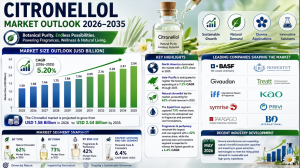
Citronellol, a naturally occurring aromatic compound extracted from rose, geranium, citronella, and lemongrass oils, has become an essential ingredient across fragrances, cosmetics, personal care products, aromatherapy solutions, household cleaners, and natural insect repellents. Growing awareness about ingredient transparency, sustainability, and wellness-focused lifestyles continues to strengthen demand across developed and emerging economies.
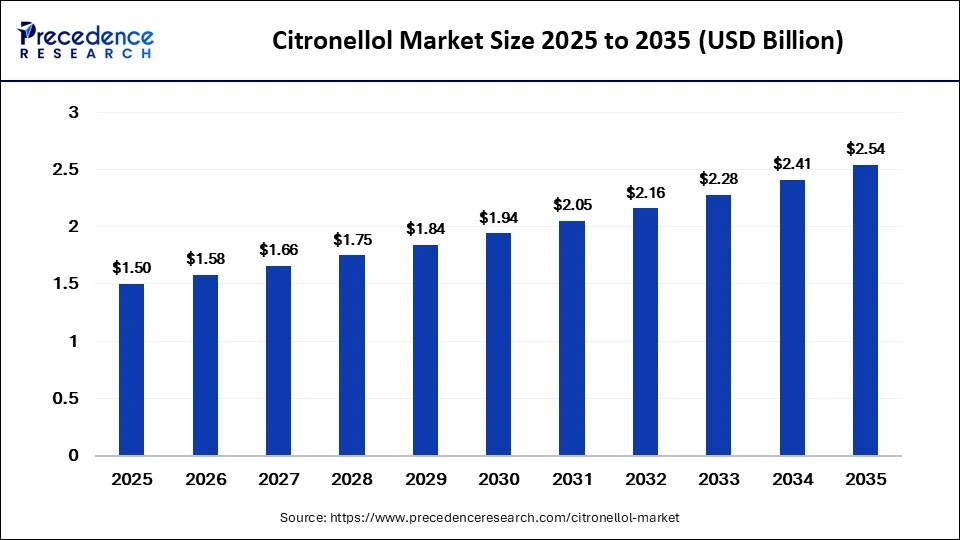
Citronellol Market Key Highlights
- North America emerged as the largest regional market and accounted for approximately 42% of global revenue in 2025, supported by strong demand for premium fragrances and natural personal care products.
- Asia-Pacific is anticipated to register the fastest growth rate of 7.2% through 2035, driven by expanding cosmetics manufacturing, essential oil production, and rising disposable incomes.
- Natural citronellol remained the leading source category, capturing 62% of total market revenue in 2025 as clean-label and botanical formulations gained momentum worldwide.
- The fragrances and perfumery segment generated the highest revenue contribution, accounting for 42% of the global market in 2025.
- The personal care and cosmetics sector is expected to witness the fastest expansion, advancing at a CAGR of 6.4% during the forecast period.
- BASF SE, Givaudan SA, Symrise AG, Kao Corporation, Takasago International Corporation, and International Flavors & Fragrances Inc. continue to strengthen their market positions through innovation and sustainable sourcing initiatives.
Citronellol Market Revenue Outlook

How Is Artificial Intelligence Transforming the Citronellol Industry?
Artificial intelligence is becoming a powerful catalyst for innovation across the citronellol value chain. AI-driven machine learning platforms are helping manufacturers optimize microbial fermentation processes and engineer bio-based production pathways capable of delivering higher citronellol yields while reducing environmental impact.
Advanced predictive analytics and physics-informed neural networks are also enabling fragrance developers to design more stable formulations, improve product longevity, and overcome traditional challenges related to citronellol volatility. As a result, manufacturers are developing longer-lasting perfumes, skincare products, wearable repellents, and household solutions that deliver superior performance while maintaining sustainability goals.
Beyond manufacturing efficiency, AI is helping researchers identify synergistic ingredient combinations that enhance antimicrobial activity, fragrance retention, and consumer acceptance, creating new opportunities across personal care and wellness applications.
What Is Driving Growth in the Citronellol Market?
Growing Demand for Natural and Plant-Based Ingredients
Consumer preferences have shifted dramatically toward natural ingredients as awareness regarding the potential risks associated with synthetic chemicals continues to rise. Consumers increasingly seek clean-label products that are transparent, non-toxic, and environmentally responsible.
Citronellol aligns perfectly with these expectations because it is derived from natural botanical sources and offers multiple functional benefits including fragrance enhancement, antimicrobial activity, and insect-repelling properties.
Expanding Global Fragrance Industry
The worldwide fragrance and perfumery industry continues to experience robust growth, particularly in premium and luxury segments. Citronellol’s distinctive floral and citrus aroma makes it a valuable ingredient in perfumes, deodorants, body mists, and scented personal care products.
Rising disposable incomes and growing consumer spending on premium beauty products are further strengthening market demand.
Increasing Popularity of Aromatherapy and Wellness Products
The rapid expansion of wellness lifestyles has increased demand for essential oils, diffusers, scented candles, and aromatherapy products. Millennials and Gen Z consumers are particularly attracted to natural ingredients that promote relaxation, emotional well-being, and holistic health benefits.
What Opportunities Are Emerging for Market Participants?
Can Eco-Friendly Home Care Products Become the Next Growth Frontier?
Absolutely. The growing adoption of environmentally friendly household cleaning products presents one of the most promising opportunities for citronellol manufacturers.
Consumers increasingly prefer natural dishwashing liquids, laundry detergents, air fresheners, and multi-purpose cleaning solutions free from harsh synthetic chemicals. Citronellol’s pleasant fragrance profile and botanical origin make it an ideal ingredient for these applications.
Will Natural Insect Repellents Gain Wider Adoption?
The demand for plant-derived insect repellents is rising rapidly as consumers seek alternatives to traditional chemical-based products. Citronellol’s effectiveness against mosquitoes and other insects positions it as a preferred ingredient in sprays, candles, lotions, and outdoor protection products.
How Will Premium Beauty Products Influence Future Demand?
Luxury skincare and beauty brands are actively replacing synthetic fragrance compounds with naturally sourced ingredients. This trend is expected to generate substantial opportunities for suppliers capable of ensuring sustainable sourcing and premium-quality citronellol production.
Citronellol Market Segment Analysis
Source Analysis
The natural citronellol segment accounted for the largest market share of 62% in 2025. Its dominance was driven by rising demand for clean-label products, the expansion of natural cosmetics, and increasing sustainability initiatives. Regulatory restrictions on synthetic chemicals have further encouraged the adoption of naturally derived citronellol as a safer and environmentally friendly alternative.
The synthetic citronellol segment captured 38% of the market in 2025 and is projected to grow at the fastest CAGR of 3.2% through 2035. Growth is supported by its reliable supply chain, large-scale production capabilities, and widespread use in skincare, home care, and fragrance products. Its consistent fragrance profile and functional benefits, including antimicrobial and insect-repelling properties, make it highly suitable for industrial applications.
Purity Analysis
The ≤95% purity segment held a dominant 67% market share in 2025. Its leadership is attributed to cost-effective formulations, extensive use in household products, and large-scale industrial fragrance applications. The growing preference for natural mosquito repellents and safer alternatives to chemical-based products has further boosted demand.
The >95% purity segment accounted for 33% of the market in 2025 and is expected to expand at the fastest CAGR of 6.9%. Increasing demand from premium fragrances, pharmaceutical products, and fine chemicals is supporting growth. High-purity citronellol is valued for its strong antimicrobial properties and superior safety profile.
Form Analysis
The liquid segment led the market with a 73% share in 2025. Its dominance is driven by ease of formulation, strong demand from the fragrance industry, and favorable handling characteristics. Liquid citronellol is widely used as a fragrance enhancer in premium perfumes, skincare products, and cosmetics.
The solid segment represented 27% of the market in 2025 and is projected to grow at a CAGR of 4.1%. Demand is increasing due to its suitability for controlled-release applications, improved stability, and industrial processing requirements. Its pleasant floral aroma and skin-friendly properties also support usage in personal care products.
End-Use Industry Analysis
The fragrances and perfumery segment captured the largest share of 42% in 2025. Growth is driven by increasing demand for premium fragrances, luxury perfume launches, and the adoption of natural aroma ingredients. Citronellol is widely utilized in perfumes, scented candles, and eco-friendly insect-repelling products.
The personal care and cosmetics segment accounted for 25% of the market in 2025 and is expected to register the fastest CAGR of 6.4%. Rising demand for clean beauty products and natural ingredients is accelerating growth. Citronellol is extensively used in lotions, shampoos, soaps, creams, and body mists due to its fragrance and antimicrobial benefits.
The household products segment held a 16% share in 2025 and is projected to grow at a CAGR of 4.0%. Increasing use of citronellol in air fresheners, cleaning products, and natural insect repellents is supporting segment growth. Consumers are increasingly seeking eco-friendly alternatives to synthetic chemicals.
Citronellol Market Share, By End-Use Industry, 2025-2035 (%)
| End-Use Industry | 2025 | 2035 | CAGR (%) |
| Fragrances & Perfumery | 42.00% | 43.00% | 5.50% |
| Personal Care & Cosmetics | 25.00% | 28.00% | 6.40% |
| Household Products | 16.00% | 14.00% | 4.00% |
| Food & Beverage Flavoring | 8.00% | 8.50% | 5.80% |
| Pharmaceuticals | 4.00% | 3.50% | 4.50% |
| Others | 5.00% | 3.00% | 3.20% |
Citronellol Market Regional Analysis
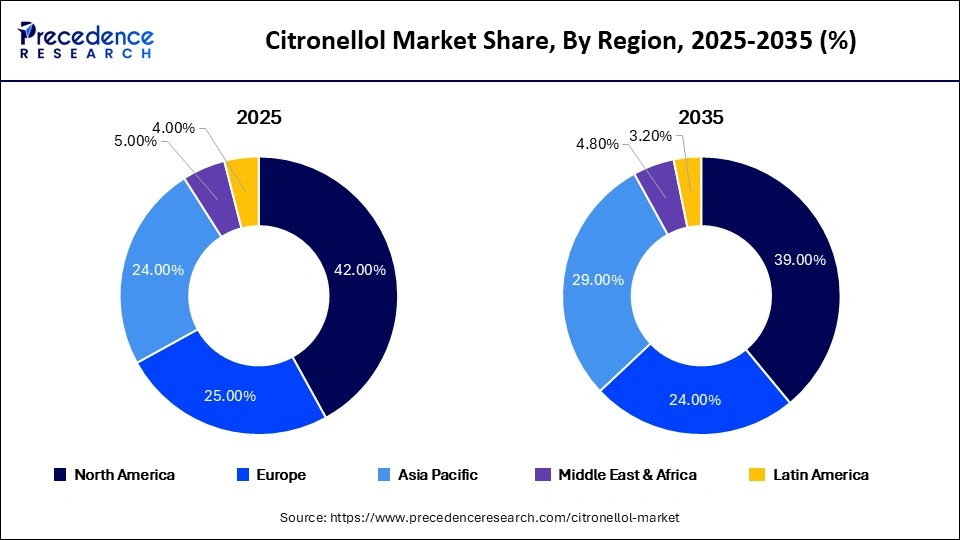
Why Does North America Lead the Citronellol Market?
North America accounted for the largest market share of 42% in 2025. The region benefits from a strong fragrance manufacturing industry, high consumption of personal care products, and growing demand for natural aroma ingredients. Consumer preference for organic and plant-based products continues to strengthen market growth.
U.S. Market Overview
The U.S. citronellol market was valued at USD 530 million in 2025 and is expected to reach USD 890 million by 2035. Growth is driven by increasing demand for natural ingredients across cosmetics, fragrances, household care, and aromatherapy applications.
How is Europe Strengthening its Market Position?
Europe held the second-largest market share of 25% in 2025 and is projected to grow at a CAGR of 4.8%. Growth is supported by the region’s well-established cosmetics and perfume industries, strict regulations favoring natural ingredients, and rising demand for sustainable fragrance solutions.
UK Market Overview
The UK market is benefiting from increasing consumer preference for clean beauty and plant-based wellness products. Manufacturers are actively replacing synthetic ingredients with natural alternatives such as citronellol.
Why is Asia-Pacific the Fastest-Growing Region?
Asia-Pacific represented 24% of the market in 2025 and is expected to grow at the fastest CAGR of 7.2% through 2035. Rapid expansion of the cosmetics industry, increasing essential oil production, and growing use of natural cleaning products and insect repellents are key growth drivers.
China Market Overview
The Chinese market is expanding due to rising demand for clean-label ingredients, a growing cosmetics sector, and increased use of natural insect repellents. Enhanced extraction capabilities and sustainable farming practices are also supporting regional growth.
What Drives Growth in Latin America?
Latin America accounted for 5% of the market in 2025 and is expected to grow at a CAGR of 4.8%. Abundant availability of natural feedstocks and the expansion of the beauty and personal care industry are supporting market development. Growing awareness of essential oil benefits is further boosting demand.
Brazil Market Overview
Brazil’s market growth is fueled by rising demand for natural cosmetics and household care products. The increasing prevalence of mosquito-borne diseases has also strengthened the need for natural insect-repelling solutions.
How is the Middle East & Africa Market Evolving?
The Middle East & Africa region held a 4% market share in 2025 and is projected to grow at a CAGR of 4.1%. Expansion of the personal care industry, increasing demand for luxury fragrances, and growth in regional cosmetics manufacturing are supporting market growth.
UAE Market Overview
The UAE market is witnessing strong demand for plant-based ingredients in cosmetics and personal care products. Rising consumer preference for organic alternatives, aromatherapy products, and eco-friendly fragrances is creating new growth opportunities.
Leading Companies in the Citronellol Market
1. Global Chemical & Ingredient Giants
These Tier-1 companies primarily produce synthetic or bio-based Citronellol at high volume and purity grades, setting the standard for the global supply chain.
BASF SE
Offerings: Produces a high-grade, synthetic, highly pure Citronellol (3,7-dimethyl-6-octen-1-ol) under its Aroma Ingredients division.
Key Attributes: Renowned for a fresh, powerful, and long-lasting rosy-citrus profile. It serves as an indispensable building block for functional products (such as detergents and soaps) due to its excellent stability.
International Flavors & Fragrances Inc. (IFF)
Offerings: Supplies standardized high-performance aroma chemicals, prominently Citronellol 950 and Citronellol 700.
Key Attributes: Marketed with a clear olfactive description (floral rose, waxy, geranium, with soft powdery notes). IFF stresses sustainability for these products, highlighting them as renewable and readily biodegradable.
Symrise AG
Offerings: Manufactures synthetic aroma chemicals and specialized grades, notably Citronellol AJ.
Key Attributes: Derived from terpene-based precursors (pine trees), Symrise’s citronellol provides a fresh, floral rose note utilized extensively across fine fragrances, cosmetics, body washes, and household items.
2. Multinational Flavor & Fragrance (F&F) Houses
These companies focus heavily on utilizing Citronellol in proprietary compounding, high-end fine fragrances, and custom consumer product formulations, while supplying individual raw molecules.
Givaudan SA
Offerings: Givaudan provides pure Citronellol as part of its extensive palette of fragrance ingredients, alongside closely related proprietary derivatives and functional citrus/floral molecules.
Key Attributes: Focused on high-purity olfactive performance, strict regulatory compliance, and a shift toward green chemistry and biodegradable consumer applications.
Takasago International Corporation
Offerings: Supplies high-purity Citronellol and specialized optical isomers (such as L-Citronellol / laevo-citronellol).
Key Attributes: Leveraging its expertise in asymmetric synthesis and catalytic technology, Takasago delivers premium-grade, precise chiral configurations of citronellol which offer a much cleaner, deeper, and more authentic rose profile.
Robertet SA
Offerings: Specializes primarily in Natural Citronellol extracted directly from botanical sources like Citronella oil, Geranium oil, and Rose oil.
Key Attributes: Positioned at the premium end of the market, catering strictly to natural-certified consumer goods, clean beauty, and luxury organic fine fragrances.
3. Specialized & Regional Chemical Manufacturers
These companies bridge the gap between high-volume production and direct-to-market formulation ingredients, particularly strong in industrial and personal care sectors.
Privi Speciality Chemicals Limited (formerly Privi Organics)
Offerings: One of the largest global manufacturers and exporters of aroma chemicals. Offers high-purity Citronellol alongside derivatives like Citronellyl Acetate and Citronellyl Nitrile.
Key Attributes: Known for reliable, large-scale synthetic chemical production utilizing global supply chains to serve major FMCG and multinational F&F houses.
Kao Corporation
Offerings: Produces Citronellol and related aliphatic/terpene alcohols under its Chemical Business division.
Key Attributes: Heavily integrated vertically, Kao uses its citronellol production internally for its massive consumer product portfolio (laundry detergents, hygiene products, cosmetics) while also supplying it externally to the global market.
4. Natural Extracts, Oils & Custom Formulators
These suppliers focus heavily on sourcing natural Citronella/Geranium essential oils, isolating natural citronellol, or providing private-label manufacturing and bulk distribution.
Treatt plc
Offerings: Sells Natural Citronellol isolated from essential oils, alongside standardized fractionated essential oils (like Citronella oil).
Key Attributes: Focuses heavily on the beverage, flavor, and clean-label fragrance industries where authentic, naturally sourced ingredients are mandatory.
Bo International
Offerings: A major private label manufacturer and supplier of essential oils and cosmetic raw materials. Supplies Citronellol both as a pure chemical ingredient and as part of natural carrier/essential oils (like Citronella and Geranium).
Key Attributes: Specializes in supplying the personal care, aromatherapy, and cosmetics industries with custom-packaged or bulk formulation ingredients.
Crescent Fragrances Pvt. Ltd. & Jayshree Aromatics Pvt. Ltd.
Offerings: Major Indian manufacturers and exporters offering Synthetic and Natural Citronellol, as well as ester derivatives such as Citronellyl Acetate, Citronellyl Formate, and Citronellyl Butyrate.
Key Attributes: Cater extensively to mid-tier and functional fragrance markets (soaps, incense/agarbatti, home care products) requiring cost-effective, bulk-volume aromatic molecules.
Jiangxi Global Natural Spice Co., Ltd. & Luyuan Natural Perfume Oil Refinery
Offerings: Specialized Chinese botanical extractors that offer Natural Citronellol isolated via the fractional distillation of locally sourced Citronella Oil.
Key Attributes: Key global suppliers for 100% pure, natural-origin citronellol used in natural insect repellents, traditional cosmetics, and natural flavor applications.
Lubon Industry Co., Ltd.
Offerings: A fine chemical manufacturer providing Citronellol and intermediate chemical reagents.
Key Attributes: Functions as a raw material supplier for industrial synthesis, providing dependable batch-produced aroma compounds for general chemical and consumer goods applications.
Segments Covered in the Report
By Source
- Natural Citronellol
- Synthetic Citronellol
By Purity Level
- ≤95% Purity
- >95% Purity
By Form
- Liquid
- Solid
By End-Use Industry
- Fragrances and Perfumery
- Personal Care and Cosmetics
- Household Products
- Food and Beverage Flavoring
- Pharmaceuticals
- Others
By Region
- North America
- Latin America
- Europe
- Asia-pacific
- Middle and East Africa
Read Also: Cesium Market Size to Reach USD 758 Billion by 2035
Get this report to explore global market size, share, CAGR, and trends, featuring detailed segmental analysis and an insightful competitive landscape overview @ https://www.precedenceresearch.com/sample/8475
You can place an order or ask any questions. Please feel free to contact us at sales@precedenceresearch.com |+1 804 441 9344

- 2-Methoxy-2-Methylheptane Market Size Worth USD 132.10 Million by 2035 Amid Rising Demand for Sustainable Fuel Additives and High-Purity Chemical Intermediates - June 15, 2026
- Citronellol Market Size Forecasted to Reach USD 2.54 Billion by 2035 as Demand for Natural Fragrance Ingredients Accelerates Worldwide - June 12, 2026
- Cesium Market Size to Reach USD 758 Billion by 2035 as Demand Accelerates Across Energy Exploration, Semiconductors, and Advanced Telecommunications - June 11, 2026
