Green Chelates Market Surges Toward USD 1.88 Billion by 2035 as Industries Accelerate Shift Toward Sustainable Chemical Solutions
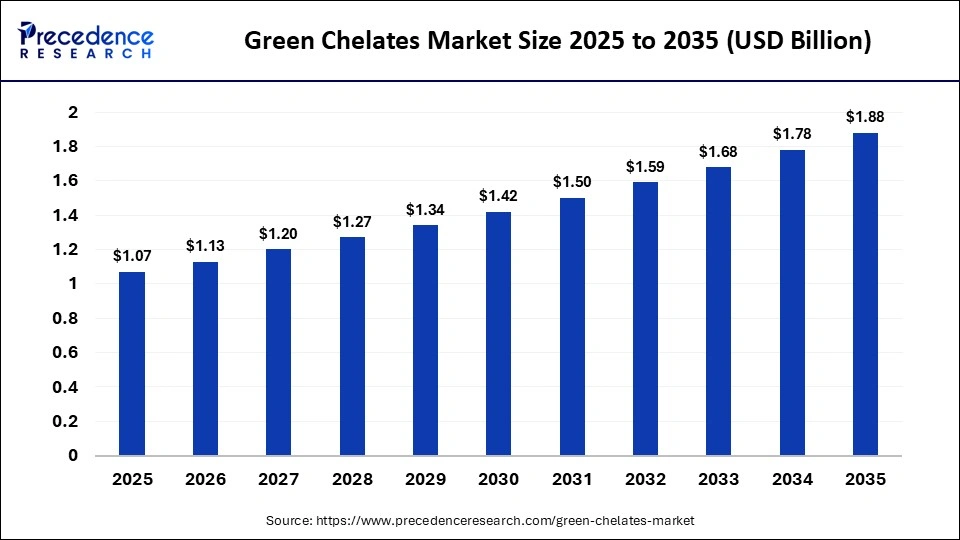
The global green chelates market is witnessing robust momentum as industries worldwide transition toward biodegradable and environmentally responsible chemical solutions. The market size was valued at USD 1.07 billion in 2025 and is projected to grow from USD 1.13 billion in 2026 to approximately USD 1.88 billion by 2035, registering a CAGR of 5.82% during the forecast period from 2026 to 2035.
The market is being driven by increasing environmental awareness, stricter wastewater discharge regulations, and rising demand for sustainable alternatives to conventional chelating agents such as EDTA. Green chelates are rapidly gaining traction across detergents, water treatment, agriculture, personal care, and industrial applications due to their biodegradability, low toxicity, and superior environmental profile.
As governments intensify sustainability mandates and consumers increasingly prefer clean-label and eco-conscious products, manufacturers are investing heavily in advanced bio-based chelation technologies to strengthen market competitiveness and regulatory compliance.
Green Chelates Market Key Highlights
- Europe dominated the global green chelates market in 2025 by accounting for 39.2% of total market revenue, supported by stringent environmental regulations and strong adoption of sustainable chemicals.
- Asia Pacific is projected to witness the fastest growth through 2035 due to rapid industrialization, expanding agriculture activities, and rising awareness regarding eco-friendly formulations.
- The sodium gluconate segment held the largest market share of 39.5% in 2025 because of its excellent biodegradability, water solubility, and wide applicability across detergents and industrial cleaning.
- The detergents & cleaning application segment captured 47.3% of the global market share in 2025 owing to increasing demand for sustainable cleaning agents.
- Liquid green chelates dominated the market with a 64.2% share in 2025 due to ease of handling, faster chelation efficiency, and broad industrial compatibility.
- Technical grade green chelates accounted for 61.4% of market revenue in 2025 as industries increasingly adopted cost-effective biodegradable alternatives for large-scale operations.
- BASF SE, Nouryon, Dow Chemical Company, Kemira Oyj, Evonik Industries AG, and LANXESS AG remain among the leading innovators shaping the competitive landscape.
How are Sustainability Regulations Transforming the Green Chelates Market?
The global regulatory landscape is becoming increasingly favorable for green chelates as governments and environmental agencies impose stricter controls on hazardous and non-biodegradable chemicals. Traditional chelating agents, particularly EDTA-based compounds, have faced mounting scrutiny due to their environmental persistence and contribution to aquatic pollution.
This transition is compelling manufacturers in sectors such as detergents, agrochemicals, personal care, and water treatment to adopt biodegradable alternatives that deliver effective metal ion sequestration while minimizing ecological impact.
Moreover, industries are integrating green chemistry principles into product development strategies to align with environmental, social, and governance (ESG) goals. This trend is significantly accelerating the commercialization of next-generation bio-based chelating agents.
Green Chelates Market Size Overview and Forecast
| Market Metrics | Details |
|---|---|
| Market Size in 2025 | USD 1.07 Billion |
| Market Size in 2026 | USD 1.13 Billion |
| Projected Market Size by 2035 | USD 1.88 Billion |
| CAGR (2026–2035) | 5.82% |
| Dominating Region | Europe |
| Fastest Growing Region | Asia Pacific |
What Role is Artificial Intelligence Playing in the Green Chelates Market?
Artificial Intelligence (AI) is emerging as a transformative force in the green chelates industry by streamlining formulation development, optimizing manufacturing efficiency, and enhancing product performance prediction.
Machine learning algorithms are increasingly being used to simulate metal-ligand interactions, enabling researchers to develop biodegradable chelates with highly targeted stability and binding capabilities. AI-based predictive modeling also helps manufacturers customize formulations for applications such as water treatment, detergents, and agriculture under varying environmental conditions.
In addition, AI-driven quality monitoring systems and computer vision technologies are improving production consistency and reducing operational waste in bio-based chemical manufacturing. As sustainability and operational efficiency become critical business priorities, AI integration is expected to further accelerate innovation across the green chelates ecosystem.
Why is Demand for Green Chelates Rising Across Industries?
The growing popularity of green chelates can be attributed to their environmental compatibility and multifunctional performance advantages.
In the agriculture industry, green chelates are increasingly utilized to improve micronutrient delivery and soil health while reducing groundwater contamination risks. The shift toward sustainable farming practices and precision agriculture is further strengthening demand.
Similarly, the detergents and cleaning sector is rapidly replacing conventional chelating agents with biodegradable alternatives to meet consumer demand for non-toxic household products. Water treatment facilities are also incorporating green chelates to improve metal ion management while complying with wastewater regulations.
The personal care and cosmetics industry is another rapidly emerging application area as brands focus on clean-label product formulations free from environmentally harmful chemicals.
Could Sustainable Agriculture Become the Biggest Opportunity for Green Chelates?
Sustainable agriculture is expected to emerge as one of the most lucrative growth avenues for green chelate manufacturers over the next decade.
Farmers worldwide are increasingly adopting biodegradable micronutrient delivery systems to improve crop productivity while maintaining soil fertility and reducing environmental degradation. Green chelates improve nutrient absorption efficiency and minimize nutrient loss, making them ideal for modern precision farming techniques.
Government initiatives supporting organic farming, regenerative agriculture, and sustainable fertilizer usage are also expected to create substantial long-term opportunities for market participants.
Why are Green Chelates Becoming Essential in Cleaning Products?
Green chelates are becoming critical ingredients in modern cleaning formulations due to their superior metal ion binding capability and environmentally friendly profile.
These chelating agents prevent scaling, improve detergent efficiency, stabilize formulations, and enhance cleaning performance in both household and industrial applications. Rising consumer preference for biodegradable and hypoallergenic cleaning products is further boosting adoption.
As sustainability standards tighten globally, manufacturers are increasingly reformulating detergents with green chelates such as MGDA, GLDA, and sodium gluconate to ensure regulatory compliance and eco-label certification.
Green Chelates Market Segment Analysis
Type Analysis
The sodium gluconate segment accounted for 39.5% of market revenue in 2025 due to its excellent biodegradability, low toxicity, and strong compatibility across multiple industrial applications.
Its extensive use in detergents, water treatment systems, food processing, and concrete admixtures has reinforced its market dominance. Manufacturers also favor sodium gluconate because of its cost efficiency, strong water solubility, and stable performance under varying pH conditions.
The methylglycindiacetic acid (MGDA) segment is projected to expand at the fastest CAGR during the forecast period due to its superior biodegradability and high-performance metal-binding properties.
MGDA is increasingly being adopted in detergents and industrial cleaning formulations where both eco-compliance and performance efficiency are essential.
Application Analysis
The detergents & cleaning segment captured 47.3% of total market share in 2025 due to growing demand for environmentally safe and effective cleaning products.
Green chelates improve cleaning efficiency, prevent scaling, and maintain formulation stability in liquid and powder detergents. Rising consumer awareness regarding sustainable household products continues to support strong segment growth.
The personal care & cosmetics segment is anticipated to witness the highest CAGR through 2035 as clean beauty trends continue reshaping the global cosmetics industry.
Manufacturers are increasingly utilizing biodegradable chelating agents in skincare, haircare, and cosmetic products to improve product stability and extend shelf life while avoiding environmentally persistent chemicals.
Form Analysis
Liquid green chelates accounted for 64.2% of market revenue in 2025 due to their ease of handling, rapid solubility, and compatibility with industrial processing systems.
These formulations are particularly preferred in detergents, water treatment, and agricultural spray applications where accurate dosing and operational efficiency are critical.
Powder and granule formulations are expected to expand significantly due to advantages such as longer shelf life, lower transportation costs, and improved storage stability.
Advancements in granulation technologies are also improving dispersibility and application efficiency across industrial sectors.
Grade Analysis
Technical grade products dominated the market with a 61.4% share in 2025 due to widespread adoption across industrial manufacturing, water treatment, and cleaning applications.
Their cost-effectiveness and strong metal ion sequestration performance make them ideal for large-scale industrial use.
The cosmetic & pharmaceutical grade segment is projected to grow rapidly owing to rising demand for high-purity biodegradable ingredients in sensitive applications.
Stringent regulations surrounding cosmetic safety and environmental sustainability are accelerating the transition toward advanced bio-based chelating solutions.
Green Chelates Market Regional Analysis
Europe emerged as the leading regional market in 2025 by accounting for 39.2% of global revenue.
The region’s dominance is primarily supported by strict environmental regulations, advanced sustainability policies, and strong consumer demand for eco-friendly products. European industries are rapidly transitioning away from persistent chemical agents in favor of biodegradable alternatives.
The Europe green chelates market is projected to grow from USD 419.44 million in 2025 to USD 746.36 million by 2035, registering a CAGR of 5.93%.
Germany remains a key growth engine within Europe due to its advanced industrial base, strong R&D ecosystem, and strict chemical discharge regulations. The country’s growing focus on sustainable manufacturing and green chemistry innovation continues to accelerate adoption across industrial and consumer sectors.
Asia Pacific is expected to register the fastest CAGR during the forecast period owing to expanding industrialization, rising environmental awareness, and growing adoption of sustainable agricultural practices.
Countries including China, India, Japan, and Southeast Asian nations are increasingly implementing environmental reforms that encourage biodegradable chemical adoption.
China is emerging as a major growth hub due to large-scale agricultural production, rapid industrial expansion, and rising investment in wastewater management infrastructure. Local manufacturing advancements are also helping improve affordability and accessibility of green chelates.
Green Chelates Market Competitive Landscape
- BASF SE
- Nouryon
- The Dow Chemical Company
- Innospec Inc.
- Kemira Oyj
- Nippon Shokubai Co., Ltd.
- LANXESS AG
- Mitsubishi Chemical Group
- Jungbunzlauer Suisse AG
- ADM (Archer-Daniels-Midland Company)
- Evonik Industries AG
- Zschimmer & Schwarz
- Nagase & Co., Ltd.
Latest Breakthroughs
The green chelates industry is witnessing accelerated innovation as chemical manufacturers strengthen their sustainable product portfolios.
- In April 2025, BASF Care Chemicals introduced Trilon G, a sustainable chelating solution designed for home care and industrial cleaning applications. The launch reinforces BASF’s commitment toward environmentally responsible cleaning formulations.
- In October 2023, Nouryon unveiled Dissolvine GL Premium, a highly concentrated GLDA-based chelating agent, alongside Berol Nexxt, a next-generation multifunctional surfactant platform introduced during SEPAWA in Berlin.
These product developments reflect the growing industry focus on high-performance biodegradable formulations capable of meeting increasingly complex sustainability requirements.
Segments Covered in the Report
By Type
- Sodium Gluconate
- Methylglycindiacetic Acid (MGDA)
- L-Glutamic Acid N, N-Diacetic Acid (GLDA)
- Others (EDDS, IDS, IDS)
By Application
- Detergents & Cleaning
- Personal Care & Cosmetics
- Agrochemicals
- Water Treatment
- Pulp & Paper
- Others (Food & Beverage, Pharma)
By Form
- Liquid
- Powder/Granules
By Grade
- Technical Grade
- Cosmetic & Pharmaceutical Grade
- Agricultural Grade
By Region
- North America
- Europe
- Asia-Pacific
- Latin America
- Middle East & Africa
Read Also: Povidone Iodine Market Size to Surpass USD 2.59 Billion by 2035
Get this report to explore global market size, share, CAGR, and trends, featuring detailed segmental analysis and an insightful competitive landscape overview @https://www.precedenceresearch.com/sample/7561
You can place an order or ask any questions. Please feel free to contact us at sales@precedenceresearch.com |+1 804 441 9344