
High Temperature Grease Market Size to Surpass USD 48.71 Billion by 2035 as Industries Shift Toward High-Performance Lubrication Solutions
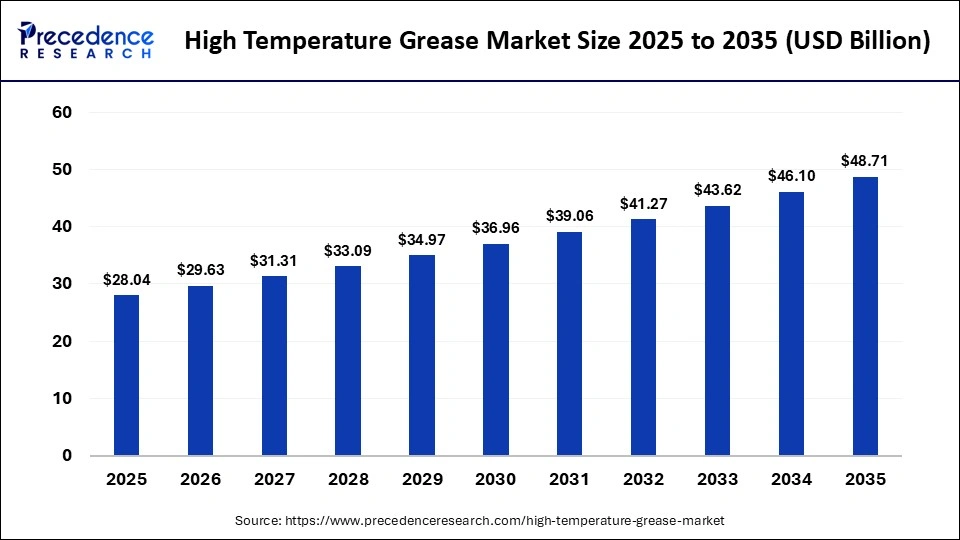
The global high temperature grease market size was valued at USD 28.04 billion in 2025 and is projected to rise from USD 29.63 billion in 2026 to nearly USD 48.71 billion by 2035, expanding at a CAGR of 5.68% from 2026 to 2035. The market is witnessing robust momentum due to the growing need for specialty lubricants capable of operating under extreme heat, pressure, and harsh industrial environments.
High temperature greases are increasingly becoming critical in automotive systems, industrial machinery, aerospace applications, steel manufacturing, and electric vehicles. Industries are focusing on operational reliability, reduced downtime, and energy-efficient manufacturing, creating significant demand for advanced grease technologies that offer enhanced oxidation resistance, thermal stability, and long lubrication intervals.
The increasing integration of automation across heavy industries, coupled with the expansion of EV production and aerospace manufacturing, is reshaping the competitive landscape of the high temperature grease market globally.
High Temperature Grease Market Key Points
- Asia-Pacific emerged as the dominant regional market with a 38% market share in 2025 due to strong industrial manufacturing activities.
- North America is anticipated to witness the fastest growth during the forecast period driven by aerospace, EV, and advanced manufacturing sectors.
- Soap-based thickeners accounted for approximately 65.4% of the market share in 2025 owing to their cost efficiency and superior compatibility.
- Mineral oil-based grease captured nearly 58.5% share in 2025 because of its large-scale industrial adoption and affordability.
- Automotive applications held 42.6% market share in 2025 due to extensive use in wheel bearings, braking systems, and chassis lubrication.
- Manufacturing and steel industries dominated the end-user segment with 44.1% share in 2025.
- Synthetic oil and non-soap thickener segments are expected to register the highest growth rates through 2035.
- Shell plc, ExxonMobil Corporation, Chevron Corporation, BP p.l.c. (Castrol), TotalEnergies SE, FUCHS Petrolub SE, SKF Group, Sinopec Limited, PetroChina Company Limited, and The Dow Chemical Company are among the leading market participants.
What is Driving the Growth of the High Temperature Grease Market?
The growing complexity of industrial machinery and equipment is significantly increasing the need for reliable lubrication solutions capable of operating in severe environments. High temperature greases provide critical protection against friction, corrosion, oxidation, and wear in machinery exposed to extreme thermal stress.
Industries such as automotive manufacturing, steel production, cement processing, mining, aerospace, and power generation increasingly rely on specialty lubricants to ensure uninterrupted operations and reduce maintenance cycles. These greases improve operational safety, enhance equipment lifespan, and lower overall operational costs.
Additionally, the transition toward electric mobility is creating new lubrication requirements. EV components such as electric motors, bearings, and drivetrain systems operate under unique thermal and rotational stresses, making advanced grease formulations essential for long-term efficiency and durability.
How is Artificial Intelligence Transforming the High Temperature Grease Market?
Artificial intelligence is emerging as a powerful tool in lubricant formulation and predictive maintenance across industrial operations. AI-driven systems are enabling grease manufacturers to optimize chemical formulations capable of withstanding extreme heat, pressure, and operational loads.
Machine learning algorithms analyze equipment performance data to predict grease degradation, oxidation levels, and wear patterns. This allows manufacturers and plant operators to optimize lubrication schedules, minimize unexpected breakdowns, and improve machinery performance.
AI-powered sensors are also increasingly being deployed in manufacturing plants and automotive systems for real-time monitoring of temperature conditions and lubricant efficiency. These smart lubrication technologies are helping industries reduce maintenance costs while maximizing productivity and energy efficiency.
Can Collaborations and Expansions Redefine the Future of Specialty Lubricants?
Strategic Partnerships are Accelerating Product Innovation
Leading grease manufacturers are increasingly entering collaborations to develop next-generation high temperature lubricants with enhanced thermal stability and oxidation resistance.
For instance, SKF collaborated with ExxonMobil to develop advanced grease solutions specifically designed for industrial bearing applications. Such collaborations are improving product reliability while addressing the growing demand for energy-efficient industrial operations.
Are Government Efficiency Initiatives Supporting Market Expansion?
Governments worldwide are encouraging industries to adopt energy-efficient manufacturing technologies and sustainable industrial practices. Regulations focused on reducing energy losses and improving equipment reliability are boosting the adoption of high-performance lubricants across sectors.
The U.S. government continues to support industrial efficiency programs that encourage the use of advanced lubricants capable of minimizing operational waste and improving machinery lifespan.
Why are Companies Expanding Specialty Grease Portfolios?
Global lubricant manufacturers are aggressively expanding their specialty grease product lines to cater to rising demand from automotive, steel, cement, aerospace, and power generation industries.
Shell recently expanded its Gadus high temperature grease portfolio to support a broader range of industrial operations. Companies are also investing heavily in synthetic base oils and advanced thickener technologies to improve lubricant durability and operational efficiency.
High Temperature Grease Market Key Metrics
| Report Coverage | Details |
|---|---|
| Market Size in 2025 | USD 28.04 Billion |
| Market Size in 2026 | USD 29.63 Billion |
| Market Size by 2035 | USD 48.71 Billion |
| CAGR (2026–2035) | 5.68% |
| Dominating Region | Asia-Pacific |
| Fastest Growing Region | North America |
| Base Year | 2025 |
| Forecast Period | 2026 to 2035 |
| Segments Covered | Type, Base Oil, Application, End User, Region |
High Temperature Grease Market Segmentation
By Type
The soap-based thickeners segment accounted for approximately 65.4% of the market share in 2025. Lithium and lithium-complex soap greases continue to dominate because of their excellent balance between thermal stability, affordability, chemical resistance, and reliability.
These greases are widely preferred in industrial operations due to their compatibility with various industrial oils and additives. Their strong OEM acceptance and cost-effective manufacturing processes further strengthen segment growth.
Meanwhile, non-soap thickeners such as polyurea, clay, and silica-based formulations are projected to witness the fastest growth during the forecast period. These products provide superior oxidation resistance and extended relubrication intervals, making them ideal for electric vehicles, aerospace systems, and high-performance industrial machinery.
By Base Oil Type
Although mineral oil-based greases held around 58.5% market share in 2025, synthetic oils are rapidly gaining industry attention.
Mineral oil remains widely adopted because of its low production cost, strong supply chain availability, and compatibility with traditional thickener systems. However, modern industrial systems increasingly demand lubricants that perform efficiently under extreme operational conditions.
Synthetic oils offer superior viscosity control, oxidation resistance, and long service life at elevated temperatures. Industries involving wind turbines, electric vehicles, aerospace systems, and high-speed manufacturing are increasingly transitioning toward synthetic grease technologies to improve operational reliability and reduce maintenance frequency.
By Application Type
The automotive segment dominated the market with 42.6% share in 2025. Modern automotive systems operate under increasingly demanding thermal conditions, particularly within wheel bearings, CV joints, braking systems, and chassis components.
The adoption of turbocharged engines, high-speed transmissions, and advanced braking systems has significantly increased the need for durable lubrication solutions capable of withstanding continuous heat exposure.
At the same time, aerospace and defense applications are expected to register the fastest growth rate through 2035. Aircraft systems and military equipment operate under severe thermal and pressure fluctuations, creating strong demand for premium-grade lubricants with zero-failure performance characteristics.
By End User Type
Manufacturing and steel industries held 44.1% market share in 2025 due to heavy usage of furnaces, rollers, bearings, conveyors, and kilns operating under high-temperature conditions.
Continuous industrial operations require consistent lubrication to minimize wear, prevent equipment failures, and avoid costly downtime. High-performance greases are increasingly becoming essential for improving productivity and operational continuity in these sectors.
Additionally, the rapid expansion of electric vehicle manufacturing is opening new opportunities for grease suppliers. EV systems demand specialized lubrication solutions for bearings, cooling systems, power electronics, and electric drivetrains.
High Temperature Grease Market Regional Analysis
Asia-Pacific dominated the global market with 38% share in 2025 owing to its large industrial manufacturing ecosystem and rapidly expanding automotive production base.
Countries such as China, India, Japan, and South Korea continue to witness strong growth in steel manufacturing, heavy machinery production, and industrial automation. The availability of cost-effective raw materials and the presence of leading lubricant manufacturers further support regional expansion.
China remains the largest contributor within Asia-Pacific. Rapid industrialization, growing manufacturing output, and government initiatives supporting energy-efficient industrial operations continue to strengthen the country’s demand for specialty lubricants.
North America is projected to witness the fastest CAGR during the forecast period due to rapid adoption of advanced industrial technologies and increasing investments in aerospace, electric vehicles, and renewable energy sectors.
The United States leads the regional market with strong demand from aerospace manufacturing, defense systems, and high-performance automotive applications. Government initiatives focused on sustainable industrial operations and energy-efficient manufacturing are further accelerating market growth.
The region is also witnessing rising adoption of predictive maintenance systems and AI-powered lubrication monitoring technologies, creating additional opportunities for premium grease manufacturers.
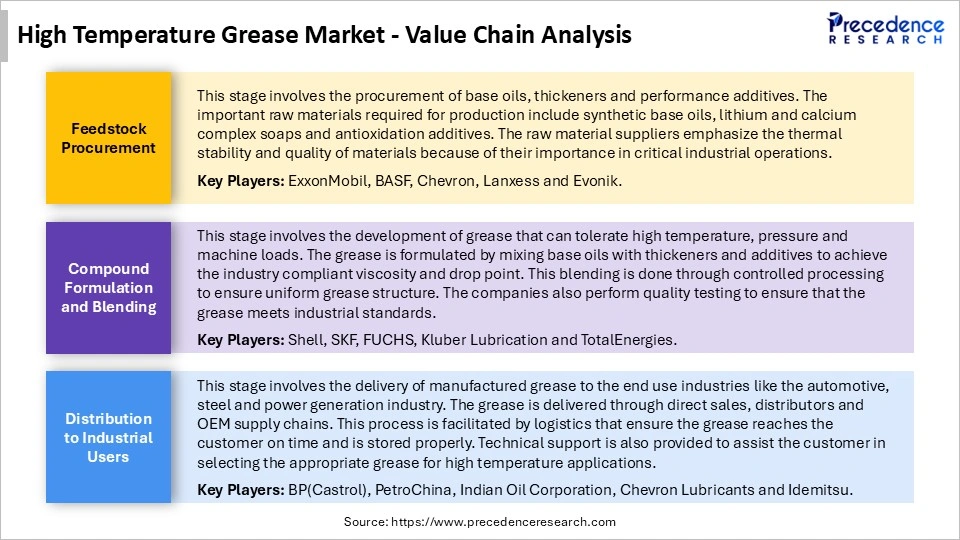
High Temperature Grease Market Value Chain Analysis
Latest Industry Developments
- In February 2025, Petroking Petroleum Hebei Co. Ltd. introduced high-performance high-temperature greases designed for heavy-duty automotive and industrial equipment applications.
- In June 2025, FUCHS Lubricants launched a high temperature automotive grease optimized for electric power steering and automobile transmission systems.
- In September 2025, Lubrizol Corporation introduced HybriCal, a lithium-free grease thickener delivering enhanced thermal stability and optimized power efficiency in manufacturing operations.
High Temperature Grease Market Key Players
- Shell plc
- ExxonMobil Corporation
- Chevron Corporation
- BP p.l.c. (Castrol)
- TotalEnergies SE
- FUCHS Petrolub SE
- Kluber Lubrication (Freudenberg Group)
- Sinopec Limited
- PetroChina Company Limited
- The Dow Chemical Company
- SKF Group
These companies are focusing heavily on product innovation, sustainable lubricant development, synthetic grease technologies, and strategic partnerships to expand their global market presence.
Segments Covered in This Report
By Type
- Soap-based Thickeners (Lithium/Aluminum Complex)
- Non-Soap Thickeners (Polyurea/Clay/Silica)
- Others (Synthetic/PFPE-based)
By Base Oil
- Mineral Oil
- Synthetic Oil (PAO/Esters/Silicone)
- Semi-Synthetic & Bio-based
By Application
- Automotive (Wheel Bearings, Engines, Chassis)
- Industrial Machinery (Steel/Cement/Paper Mills)
- Aerospace & Defense
- Others (Food Processing, Marine)
By End-User
- Manufacturing & Steel
- Electric Vehicle (EV) Sector
- Power Generation
- Others
By Region
- North America
- Europe
- Asia-Pacific
- Latin America
- Middle East & Africa
Read Also: Pour Point Depressant Market Surges Toward USD 3.78 Billion by 2035
Get this report to explore global market size, share, CAGR, and trends, featuring detailed segmental analysis and an insightful competitive landscape overview @https://www.precedenceresearch.com/sample/7563
You can place an order or ask any questions. Please feel free to contact us at sales@precedenceresearch.com |+1 804 441 9344