
Non-Stick Conveyor Belt Market Size Expected Reach USD 7.73 Billion by 2035 Amid Rising Demand for Hygienic Industrial Automation
The global non-stick conveyor belt market size is projected to grow from USD 4.27 billion in 2026 to USD 7.73 billion by 2035, at a CAGR of 6.82%. The market size was estimated at USD 3.99 billion in 2025. This growth trajectory is driven by increasing demand for hygienic, low-maintenance, and high-efficiency conveyor systems across food processing, packaging, and pharmaceutical industries. As automation becomes integral to industrial operations, non-stick conveyor belts are emerging as a critical component in ensuring contamination-free and efficient production workflows.
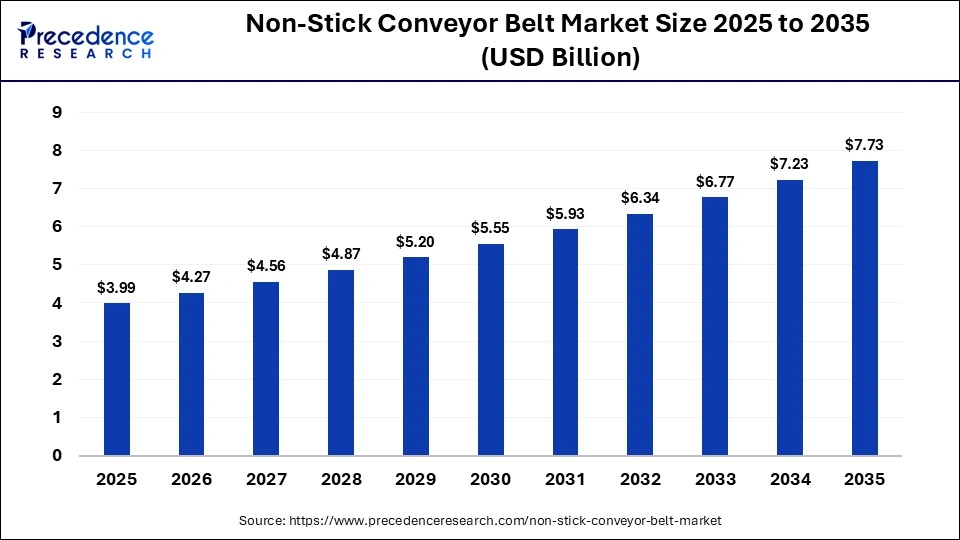
Non-Stick Conveyor Belt Market Key Points
- The market was valued at USD 3.99 billion in 2025, reflecting strong industrial adoption globally.
- Asia Pacific led the market with a 35% share in 2025, driven by rapid industrialization.
- North America is expected to register the fastest CAGR through 2035, fueled by automation and regulatory compliance.
- PTFE material dominated with 45% market share, owing to superior heat resistance and durability.
- Food processing emerged as the leading application segment, contributing 35% share in 2025.
- Food & beverage remained the top end-use industry with 40% market share, supported by strict hygiene standards.
- Direct sales accounted for 50% share, highlighting preference for customized industrial solutions.
What is Driving the Growth of the Non-Stick Conveyor Belt Market?
The market is gaining momentum due to its critical role in industries that require clean, efficient, and continuous material handling. Non-stick conveyor belts, designed with advanced coatings like PTFE and silicone, prevent product adhesion ensuring smooth operations, reduced waste, and enhanced hygiene.
The increasing adoption of automated production lines, coupled with stringent food safety regulations, is accelerating demand. Industries such as food processing, pharmaceuticals, textiles, and packaging rely heavily on these belts for temperature resistance, low friction, and easy cleaning, making them indispensable in modern manufacturing ecosystems.
How is AI Transforming the Non-Stick Conveyor Belt Market?
Artificial intelligence is revolutionizing conveyor belt systems by enabling real-time monitoring and predictive maintenance. AI-powered sensors detect wear and tear early, reducing unexpected downtime and improving operational efficiency.
Additionally, AI-driven systems optimize belt speed, load distribution, and temperature control, ensuring higher productivity and reduced material wastage. These smart systems are paving the way for intelligent factories, where conveyor belts adapt dynamically to production requirements.
Non-Stick Conveyor Belt Market Regional Analysis
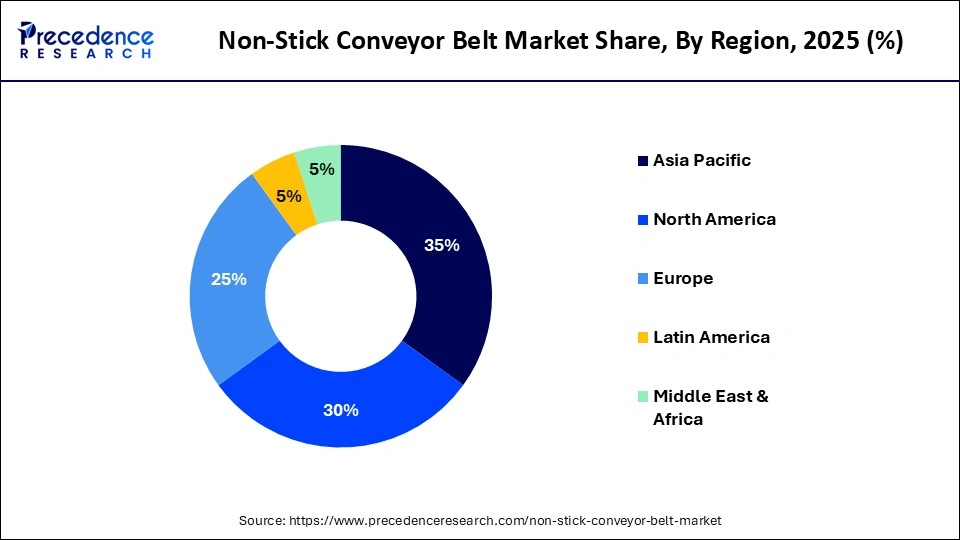
Asia Pacific held the largest share of 35% in 2025, supported by rapid industrialization, expanding food processing industries, and strong manufacturing growth. Affordable production, rising automation, and increasing demand for packaged foods contributed to the region’s leadership.
India is emerging as a high-growth market due to the expansion of bakery, packaged food, and food processing sectors. Government initiatives and rising investments in organized manufacturing are driving adoption of advanced conveyor belts, alongside growing demand for automation and food safety compliance.
North America is expected to witness the fastest growth due to advanced food processing and pharmaceutical industries. Automation, strict regulatory standards, and the shift toward high-performance conveyor systems are key growth drivers.
The U.S. market is mature and technology-driven, with strong demand from food, pharmaceutical, and packaging sectors. Growth is supported by strict regulations, ongoing equipment upgrades, and rising adoption of customized, high-performance conveyor belt solutions.
Non-Stick Conveyor Belt Market Growth Factors
- Rising demand for hygienic material handling systems in food and pharma industries
- Growing adoption of automation and smart manufacturing technologies
- Increased use of PTFE and silicone materials for high-temperature applications
- Expansion of e-commerce and packaging industries
- Demand for energy-efficient, low-friction conveyor systems
- Rising preference for custom-designed conveyor solutions
Key Opportunities and Trends in the Non-Stick Conveyor Belt Market
- Rapid industrialization and expansion of food processing sectors in emerging economies are significantly boosting demand for advanced conveyor systems.
- The integration of AI and sensor-based technologies is driving adoption of smart conveyor systems capable of predictive maintenance and real-time optimization.
- Manufacturers are increasingly focusing on eco-friendly and recyclable conveyor belt materials, aligning with global sustainability goals.
- Sectors such as frozen foods, bakery, ready-to-eat meals, and pharmaceuticals present significant growth opportunities due to specialized handling requirements.
Non-Stick Conveyor Belt Market Key Metrics
| Report Coverage | Details |
| Market Size in 2025 | USD 3.99 Billion |
| Market Size in 2026 | USD 4.27 Billion |
| Market Size by 2035 | USD 7.73 Billion |
| Market Growth Rate from 2026 to 2035 | CAGR of 6.82% |
| Dominating Region | Asia Pacific |
| Fastest Growing Region | North America |
| Base Year | 2025 |
| Forecast Period | 2026 to 2035 |
| Segments Covered | Material Type, Application, End User Industry, Distribution Channel, and Region |
| Regions Covered | North America, Europe, Asia-Pacific, Latin America, and Middle East & Africa |
Non-Stick Conveyor Belt Market Segmental Analysis
By Material Type
PTFE led the non-stick conveyor belt market with a 45% share in 2025 due to its excellent chemical resistance, high heat tolerance, and strong non-stick properties. These belts perform efficiently in demanding environments like food processing, electronics, and packaging. Their durability, low maintenance, and compliance with food safety standards make them ideal for high-volume industrial use.
Silicone belts are projected to grow at the fastest CAGR of 6.3%, driven by demand for flexible, lightweight, and cost-effective solutions. They are particularly suitable for delicate applications such as baking and confectionery processing. Innovations in silicone-coated fabrics and increasing customization options are further accelerating their adoption.
By Application
The food processing segment held a 35% market share in 2025, supported by its extensive use in baking, freezing, cooking, and drying processes. The need for hygienic, contamination-free handling and increasing automation in food manufacturing are key factors driving this dominance.
The packaging segment is growing steadily due to the expansion of e-commerce, pharmaceuticals, and packaged food industries. Non-stick conveyor belts are increasingly used in labeling, sealing, and wrapping processes, improving efficiency and reducing product sticking.
By End Use Industry
The food & beverage industry accounted for 40% of the market in 2025, driven by strict hygiene regulations and continuous production requirements. Non-stick belts are essential for handling sticky and temperature-sensitive food products, supporting consistent and safe operations.
The pharmaceutical segment is expected to grow at a CAGR of 5.7%, fueled by rising drug manufacturing and strict cleanroom standards. Increasing use in applications like tablet coating and sterile packaging is boosting demand, along with growth in biologics and medical packaging.
By Distribution Channel
Direct sales dominated with a 50% share in 2025, as large manufacturers prefer customized solutions, better pricing control, and reliable after-sales support. This channel is especially important for large-scale industrial and automation projects.
Online sales are expected to grow at a CAGR of 5.9%, driven by digitalization and easy access to product information. Small and mid-sized businesses benefit from competitive pricing, quick delivery, and standardized options offered through B2B e-commerce platforms.
Read Also: Inorganic Scintillators Market Size Expected to Reach USD 1.52 Billion by 2035
Non-Stick Conveyor Belt Market Value Chain Analysis
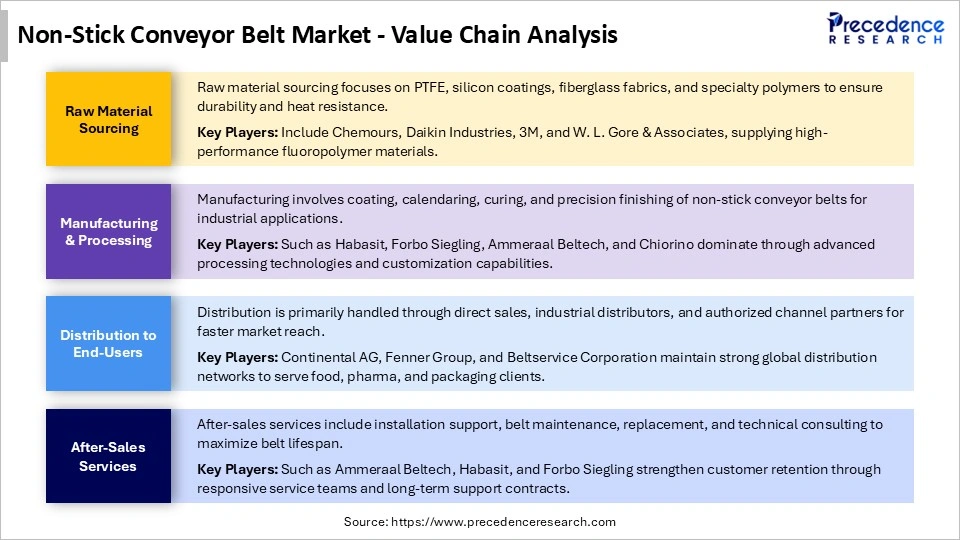
Leading Companies
- Habasit AG
- Ammeraal Beltech
- Forbo Movement Systems
- Fenner Dunlop
- Mitsuboshi Belting Ltd.
- Intralox
- Bando Chemical Industries, Ltd.
- ContiTech AG
- Esbelt S.A.
- Sampla Belting
- Volta Belting Technology Ltd.
- Chiorino S.p.A.
- Nitta Corporation
- Sparks Belting Company
- YongLi Belting
Latest Breakthroughs and Innovations
- Shanghai Puteken Transmission System Co., Ltd. introduced advanced silicone timing belts with enhanced thermal stability and precision for automation.
- Launch of heat-resistant, anti-static conveyor belts for biscuit and dough processing, improving efficiency in food manufacturing.
- Increasing adoption of PTFE-Teflon belts for extreme industrial conditions due to superior durability and chemical resistance.
Segments Covered in the Report
By Material Type
- PTFE (Polytetrafluoroethylene)
- Silicone
- Rubber
- Others
By Application
- Food Processing
- Packaging
- Textile
- Pharmaceuticals
- Others
By End User Industry
- Food & Beverage
- Automotive
- Textile
- Pharmaceuticals
- Others
By Distribution Channel
- Direct Sales
- Distributors
- Online Sales
By Region
- North America
- Europe
- Asia-Pacific
- Latin America
- Middle East & Africa
Get this report to explore global market size, share, CAGR, and trends, featuring detailed segmental analysis and an insightful competitive landscape overview @ https://www.precedenceresearch.com/sample/7670
You can place an order or ask any questions. Please feel free to contact us at sales@precedenceresearch.com |+1 804 441 9344