
Liquid Crystal Polymer Market Size to Worth USD 3.82 Billion by 2035 Amid Rising Demand for High-Performance Electronics and Advanced Materials
The global liquid crystal polymer (LCP) market is entering a transformative growth phase as industries increasingly seek high-performance materials capable of meeting the demands of next-generation electronics, automotive systems, aerospace technologies, and healthcare applications.
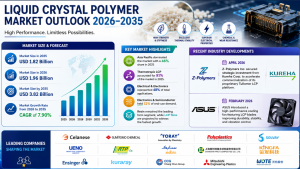
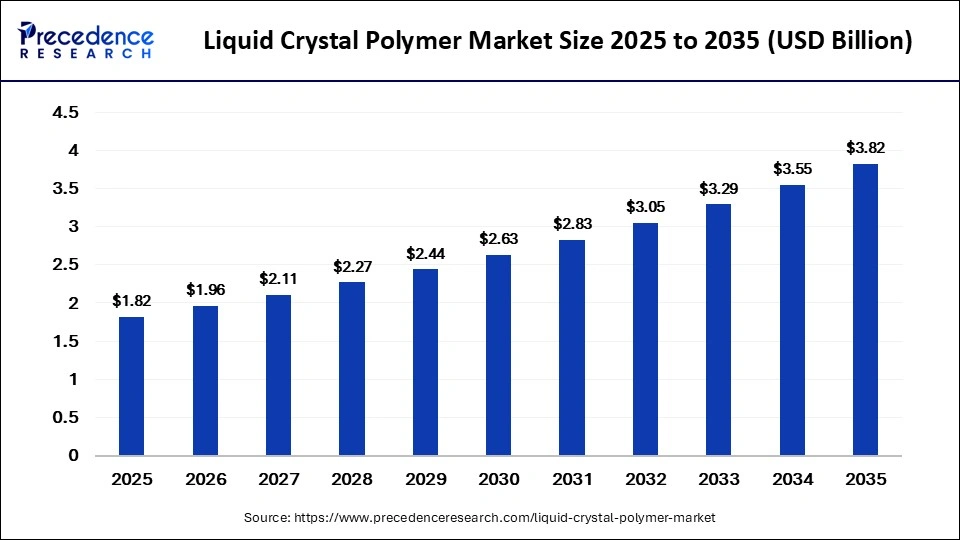
According to Precedence Research, the global liquid crystal polymer market size was valued at USD 1.82 billion in 2025 and is projected to grow from USD 1.96 billion in 2026 to approximately USD 3.82 billion by 2035, registering a CAGR of 7.90% during the forecast period.
The market’s expansion is being fueled by rapid technological advancements in material science, increasing miniaturization of electronic components, growing adoption of electric vehicles, and rising demand for lightweight, heat-resistant, and chemically inert materials. Liquid crystal polymers have emerged as a preferred engineering thermoplastic due to their exceptional dimensional stability, low moisture absorption, superior dielectric properties, and ability to withstand extreme operating conditions.
Liquid Crystal Polymer Market Key Points
- Asia Pacific emerged as the leading regional market in 2025, accounting for 46% of total global revenue and is expected to maintain the fastest growth rate through 2035.
- The thermotropic liquid crystal polymer segment dominated the market with an overwhelming 91% share in 2025 owing to its extensive usage in electronic devices and precision-engineered components.
- The resin form segment captured 62% of market revenue in 2025, driven by strong demand from injection molding applications.
- Electrical and electronics applications represented nearly 48% of total market demand and continue to benefit from semiconductor innovation and device miniaturization.
- Electronics and semiconductor industries accounted for 52% of overall end-use consumption in 2025, making them the largest industrial users of liquid crystal polymers.
- Injection molding remained the dominant processing technology with a 67% market share due to its efficiency in manufacturing precision components.
- The market is witnessing increasing adoption of LCP films for 5G communication systems, flexible electronics, RF antennas, and advanced semiconductor packaging.
Liquid Crystal Polymer Market Revenue Outlook
| Market Indicator | Value |
|---|---|
| Market Size 2025 | USD 1.82 Billion |
| Market Size 2026 | USD 1.96 Billion |
| Forecast Value 2035 | USD 3.82 Billion |
| CAGR (2026-2035) | 7.90% |
| Leading Region | Asia Pacific |
| Fastest Growing Region | Asia Pacific |
| Largest Application | Electrical & Electronics |
| Largest End-use Industry | Electronics & Semiconductor |
How Is Artificial Intelligence Transforming the Liquid Crystal Polymer Market?
Artificial intelligence is rapidly becoming a critical innovation tool within the advanced materials and specialty chemicals industries. In the liquid crystal polymer sector, AI-powered platforms are helping researchers predict molecular behavior, optimize material formulations, and accelerate product development cycles.
Advanced machine learning technologies such as convolutional neural networks (CNNs) and support vector machines (SVMs) are enabling manufacturers to model liquid crystal properties with greater accuracy. These capabilities improve material performance in sensing systems, electronic packaging, and high-frequency communication devices.
AI is also supporting scientists in forecasting the physical, chemical, and alignment characteristics of liquid crystal molecules. As a result, manufacturers can reduce research costs, shorten development timelines, and create more efficient LCP products tailored to next-generation applications such as 5G infrastructure, autonomous vehicles, and semiconductor packaging.
Why Is the Liquid Crystal Polymer Market Growing So Rapidly?
The primary driver behind market growth is the expanding electronics industry. The ongoing trend toward smaller, lighter, and more powerful electronic devices is creating significant demand for materials that offer excellent thermal stability and electrical performance.
Liquid crystal polymers provide unique advantages including:
- Exceptional heat resistance
- Low dielectric constant
- Superior chemical resistance
- Minimal moisture absorption
- High dimensional stability
- Excellent mechanical strength
These properties make LCP an ideal material for connectors, sensors, semiconductor packaging, antenna systems, automotive electronics, and medical devices.
Growing investments in semiconductor manufacturing, rising deployment of 5G networks, increasing production of electric vehicles, and expansion of aerospace communication systems are further strengthening market demand worldwide.
What Emerging Opportunities Are Creating New Revenue Streams?
Can Advanced Circuit Substrates Unlock Future Market Growth?
Absolutely.
One of the most promising opportunities lies in the development of multilayer resin substrates utilizing liquid crystal polymers. These advanced substrates support complex circuit architectures, high-density wiring, and superior moisture resistance, making them ideal for advanced electronic systems.
As semiconductor manufacturers continue to develop smaller and more powerful chips, LCP-based substrates are expected to become a critical component of future electronics manufacturing.
Why Are LCP Films Gaining Attention Across High-Tech Industries?
LCP films are experiencing strong demand due to their ability to operate effectively under high-frequency and high-speed conditions.
Their applications include:
- 5G communication systems
- Flexible displays
- RF antennas
- Aerospace communication equipment
- Advanced semiconductor packaging
The films segment is projected to register the fastest CAGR of 9.3% through 2035, highlighting its growing importance across multiple industries.
Liquid Crystal Polymer Market Segmentation
By Type
The thermotropic liquid crystal polymer segment held the largest share of the market, accounting for 91% in 2025. The segment generated around USD 1.66 billion and is projected to reach nearly USD 3.51 billion by 2035, expanding at a CAGR of 8.1%. Growth is driven by strong demand from the electronics industry, where thermotropic LCPs are widely used in precision electronic components, connectors, computers, televisions, and automotive electronics due to their excellent thermal and dimensional stability.
The lyotropic liquid crystal polymer segment accounted for approximately USD 163.8 million in 2025 and is expected to reach USD 305.6 million by 2035, growing at a CAGR of 5.4%. The segment benefits from its extensive use in high-performance fibers and films, particularly in aerospace and industrial applications that require lightweight, durable, and high-strength materials.
Liquid Crystal Polymer Market Share, By Type, 2025-2035 (%)
| Type | 2025 | 2035 | CAGR (%) |
| Thermotropic Liquid Crystal Polymer | 91.00% | 92.00% | 8.10% |
| Lyotropic Liquid Crystal Polymer | 9.00% | 8.00% | 5.40% |
By Form
The resin segment dominated the market with a 62% share in 2025, generating around USD 1.13 billion. It is expected to reach nearly USD 2.29 billion by 2035 at a CAGR of 7.5%. Demand for injection-molded components, electrical parts, and heat-resistant engineering materials continues to support the segment’s leadership.
The fibers segment generated approximately USD 254.8 million in 2025 and is projected to reach USD 496.6 million by 2035, growing at a CAGR of 6.6%. Increasing demand for industrial textiles, aerospace reinforcement materials, and high-strength composites is fueling segment expansion.
The films segment reached USD 345.8 million in 2025 and is expected to grow to nearly USD 878.6 million by 2035, registering the fastest CAGR of 9.3%. Rising deployment of flexible electronics, advanced packaging solutions, and 5G communication technologies is driving demand for LCP films.
Liquid Crystal Polymer Market Share, By Form, 2025-2035 (%)
| Form | 2025 | 2035 | CAGR (%) |
| Resin | 62.00% | 60.00% | 7.50% |
| Fibers | 14.00% | 13.00% | 6.60% |
| Films | 19.00% | 23.00% | 9.30% |
| Others | 5.00% | 4.00% | 5.80% |
By Application
The electrical and electronics segment held a 48% market share in 2025 and generated approximately USD 873.6 million. The segment is forecast to reach USD 1.91 billion by 2035, growing at a CAGR of 8.7%. Increased miniaturization of devices, semiconductor demand, and connector applications continue to support growth.
The automotive segment accounted for USD 382.2 million in 2025 and is projected to reach around USD 840.4 million by 2035 at a CAGR of 8.3%. Growing electric vehicle production, increasing adoption of automotive sensors, and expansion of ADAS technologies are key growth drivers.
The consumer goods segment generated nearly USD 182 million in 2025 and is expected to reach USD 343.8 million by 2035, growing at a CAGR of 6.4%. Rising demand for lightweight, long-lasting consumer products and wearable electronics is contributing to market expansion.
| Application | 2025 | 2035 | CAGR (%) |
| Electrical & Electronics | 48.00% | 50.00% | 8.70% |
| Automotive | 21.00% | 22.00% | 8.30% |
| Consumer Goods | 10.00% | 9.00% | 6.40% |
| Industrial Components | 12.00% | 11.00% | 7.00% |
| Medical Devices | 6.00% | 6.00% | 8.00% |
| Others | 3.00% | 2.00% | 5.50% |
By End-Use Industry
The electronics and semiconductor segment dominated the market with a 52% share in 2025. Revenue stood at approximately USD 946.4 million and is expected to reach USD 2.06 billion by 2035, growing at a CAGR of 8.8%. Extensive use of LCPs in semiconductor packaging and advanced electronics manufacturing supports segment growth.
The automotive end-use segment generated around USD 345.8 million in 2025 and is projected to reach USD 764 million by 2035. Increasing use of lightweight materials, sensors, and electronic connectors in electric and autonomous vehicles is driving demand.
The industrial manufacturing segment accounted for USD 236.6 million in 2025 and is expected to reach nearly USD 420.2 million by 2035, growing at a CAGR of 6.9%. Rising demand for precision-engineered components and advanced processing technologies is supporting growth.
Liquid Crystal Polymer Market Share, By End-use Industry, 2025-2035 (%)
| End-Use Industry | 2025 | 2035 | CAGR (%) |
| Electronics & Semiconductor | 52.00% | 54.00% | 8.80% |
| Automotive | 19.00% | 20.00% | 8.20% |
| Industrial Manufacturing | 13.00% | 11.00% | 6.90% |
| Healthcare | 7.00% | 7.00% | 7.80% |
| Aerospace & Defense | 6.00% | 6.00% | 7.40% |
| Others | 3.00% | 2.00% | 5.70% |
By Processing Technology
The injection molding segment held a dominant 67% share in 2025, generating approximately USD 1.22 billion. The segment is expected to reach USD 2.52 billion by 2035 at a CAGR of 7.8%. Its ability to produce precise, heat-resistant, and dimensionally stable components makes it the preferred manufacturing technology.
The extrusion segment accounted for nearly USD 327.6 million in 2025 and is projected to reach USD 725.8 million by 2035, growing at the fastest CAGR of 8.1%. Increasing production of LCP films, fibers, communication cables, and flexible electronic components is driving adoption.
The blow molding segment generated approximately USD 145.6 million in 2025 and is expected to reach USD 305.6 million by 2035 at a CAGR of 6.2%. Demand is supported by the need for lightweight and cost-effective hollow plastic components used across specialized industries.
Liquid Crystal Polymer Market Share, By Processing Technology, 2025-2035 (%)
| Processing Technology | 2025 | 2035 | CAGR (%) |
| Injection Molding | 67.00% | 66.00% | 7.80% |
| Extrusion | 18.00% | 19.00% | 8.10% |
| Blow Molding | 8.00% | 8.00% | 6.20% |
| Compression Molding | 7.00% | 7.00% | 6.00% |
Liquid Crystal Polymer Market Regional Insights
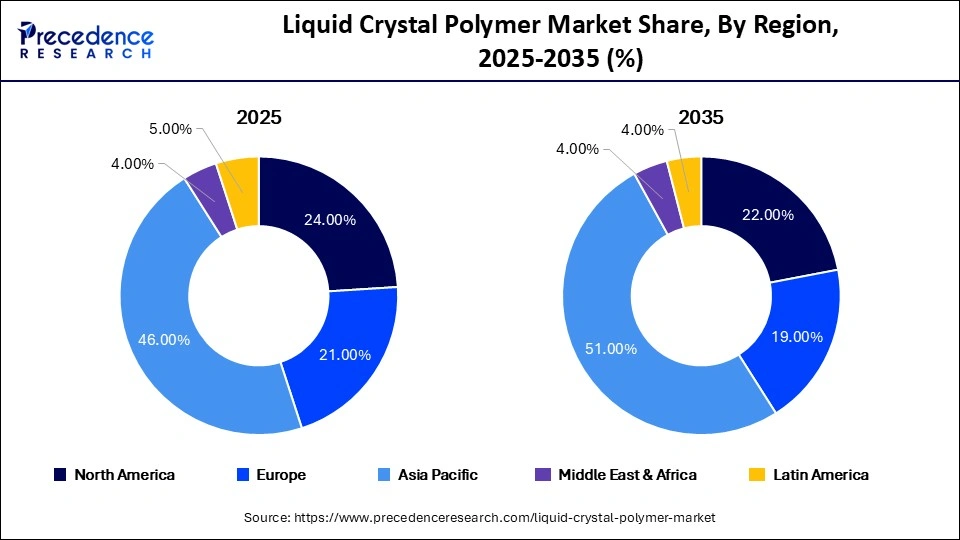
Asia Pacific dominated the global liquid crystal polymer market with a 46% share in 2025 and is forecast to grow at the fastest CAGR of 9.2% through 2035. Rapid industrialization, expanding electronics manufacturing, and increasing automotive electronics production are key growth drivers across the region.
China remains the largest contributor to the Asia Pacific market, supported by robust electronics production and significant investments in research and development aimed at enhancing advanced LCP applications.
North America accounted for 24% of the market in 2025 and is projected to grow at a CAGR of 6.9%. Strong semiconductor manufacturing capabilities, growing demand for high-performance materials, and increasing investments in automotive electronics continue to support regional growth.
The U.S. market benefits from rising investments in 5G infrastructure, semiconductor packaging technologies, and advanced electronics manufacturing, positioning the country as a major growth hub.
Europe held a 21% market share in 2025 and is expected to expand at a CAGR of 6.7%. Growth is supported by increasing electric vehicle production, aerospace applications, and regulations promoting fuel-efficient and lightweight materials.
Germany leads the European market due to strong demand for automotive radar systems, industrial connectors, and advanced manufacturing technologies.
The Middle East & Africa accounted for nearly 4% of the market in 2025 and is expected to grow at a CAGR of 6.8%. Investments in industrial infrastructure, telecommunications, and electronics manufacturing are creating new opportunities for market participants.
The UAE is witnessing increased adoption of LCPs in telecommunications, medical devices, consumer electronics, and lightweight automotive applications, supporting market growth.
Latin America held nearly 5% of the market in 2025 and is projected to grow at a CAGR of 6.5%. Rising automotive production, industrial electronics demand, and foreign investments in manufacturing are driving regional growth.
Brazil dominates the Latin American market due to growing adoption of high-performance engineering materials and increasing collaboration between polymer manufacturers and electronics OEMs.
Liquid Crystal Polymer Market Competitive Landscape
- Celanese Corporation
- Sumitomo Chemical
- Toray Industries
- Polyplastics Co.
- Solvay
- Ueno Fine Chemicals Industry
- RTP Company
- SABIC
- Shanghai PRET Composites
- Kingfa Sci. & Tech.
- Ensinger
- Kuraray
- Chang Chun Group
- Mitsubishi Engineering-Plastics
- Shenzhen Wote Advanced Materials
Latest Industry Developments
Z-Polymers Accelerates Commercialization of Advanced LCP Technology
In April 2026, Z-Polymers Inc. secured a strategic investment from Kureha Corporation’s U.S. subsidiary. The collaboration includes a joint development agreement aimed at accelerating commercialization of the company’s proprietary Tullomer liquid crystal polymer platform.
ASUS Introduces LCP-Based High-Performance Cooling Technology
In February 2026, ASUS launched a next-generation performance case fan featuring liquid crystal polymer blades. The material’s superior dimensional stability, vibration damping capabilities, and low thermal expansion improve airflow efficiency and durability in high-performance computing systems.
Segment Covered in the Report
By Type
- Thermotropic Liquid Crystal Polymer
- Lyotropic Liquid Crystal Polymer
By Form
- Resin
- Fibers
- Films
- Others
By Application
- Electrical & Electronics
- Automotive
- Consumer Goods
- Industrial Components
- Medical Devices
- Others
By End-use Industry
- Electronics & Semiconductor
- Automotive
- Industrial Manufacturing
- Healthcare
- Aerospace & Defense
- Others
By Processing Technology
- Injection Molding
- Extrusion
- Blow Molding
- Compression Molding
By Region
- North America
- Latin America
- Europe
- Asia-pacific
- Middle and East Africa
Read Also: 1,5-Hexadiene Market Size Forecasted to Reach USD 317 Million by 2035
Get this report to explore global market size, share, CAGR, and trends, featuring detailed segmental analysis and an insightful competitive landscape overview @ https://www.precedenceresearch.com/sample/8441
You can place an order or ask any questions. Please feel free to contact us at sales@precedenceresearch.com |+1 804 441 9344

- Persulfates Market Revenue and Trends Analysis 2026–2035 - June 16, 2026
- 2-Methoxy-2-Methylheptane Market Size Worth USD 132.10 Million by 2035 Amid Rising Demand for Sustainable Fuel Additives and High-Purity Chemical Intermediates - June 15, 2026
- Citronellol Market Size Forecasted to Reach USD 2.54 Billion by 2035 as Demand for Natural Fragrance Ingredients Accelerates Worldwide - June 12, 2026
