
1,5-Hexadiene Market Size Forecasted to Reach USD 317 Million by 2035 as Demand for High-Performance Polymers and Synthetic Rubber Accelerates
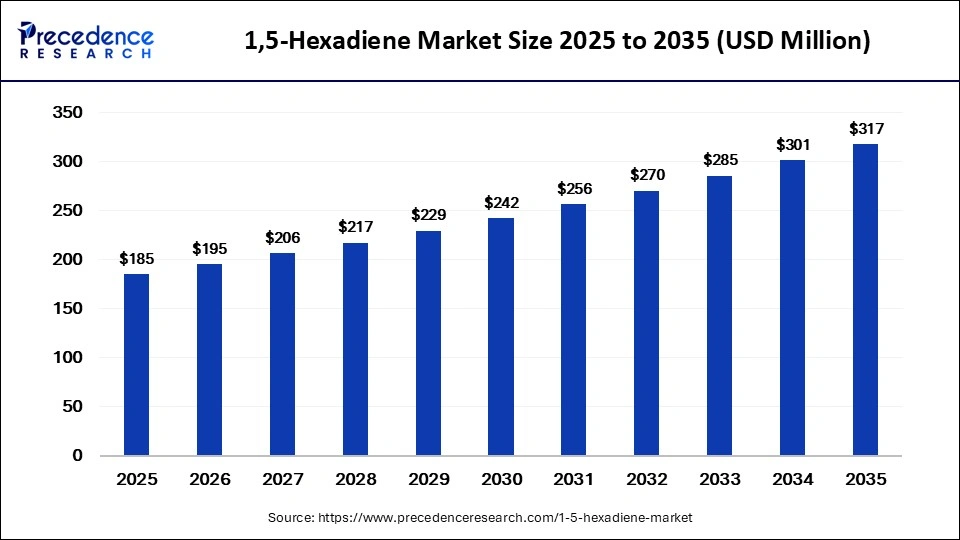
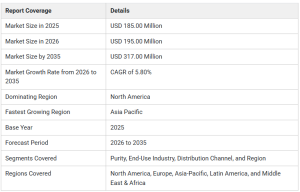
The global 1,5-hexadiene market is witnessing steady growth as industries increasingly adopt advanced polymers, specialty chemicals, and high-performance elastomers to improve product durability, flexibility, and chemical resistance. The global 1,5-hexadiene market size was valued at USD 185 million in 2025 and is projected to grow from USD 195 million in 2026 to approximately USD 317 million by 2035, expanding at a CAGR of 5.8% during the forecast period.

The market’s expansion is primarily driven by the growing demand for synthetic rubber, rising automotive production, rapid industrialization, increasing investments in specialty chemical manufacturing, and advancements in polymer science. As industries continue to seek lightweight, durable, and heat-resistant materials, 1,5-hexadiene is becoming an increasingly important building block in chemical synthesis and polymer engineering.
1,5-Hexadiene Market Key Points
- Asia Pacific emerged as the largest regional market, accounting for 34% of global revenue in 2025 and is expected to register the fastest CAGR of 7.2% through 2035.
- North America captured 31% of the global market in 2025, supported by strong automotive and specialty chemical industries.
- The 95%-98% purity segment dominated the market with a 47% share in 2025 due to widespread applications in polymer manufacturing.
- Specialty chemicals represented the largest application segment, contributing 33% of total market revenue in 2025.
- The chemical industry accounted for 48% of total end-use demand, making it the leading industry vertical.
- Direct sales remained the preferred distribution channel, holding 58% of market revenue in 2025.
How is Artificial Intelligence Transforming the 1,5-Hexadiene Market?
Artificial intelligence is rapidly reshaping chemical manufacturing operations worldwide. In the 1,5-hexadiene industry, AI-powered predictive analytics systems are helping manufacturers optimize reaction conditions, improve production yields, and reduce raw material wastage. These advancements enable producers to achieve greater consistency in product quality while lowering operational costs.
AI is also accelerating research and development efforts across polymer science and specialty chemicals. Advanced machine learning models are assisting scientists in discovering new formulations, identifying efficient catalysts, and shortening product development cycles. Furthermore, AI-driven supply chain management systems are helping companies forecast demand more accurately, optimize inventory planning, and strengthen procurement strategies amid volatile raw material markets.
Why is Demand for Synthetic Rubber Fueling Market Expansion?
One of the strongest growth drivers for the 1,5-hexadiene market is the rising global demand for synthetic rubber products.
As a critical precursor in the production of Ethylene Propylene Diene Monomer (EPDM) rubber, 1,5-hexadiene contributes significantly to manufacturing durable, weather-resistant, and heat-resistant elastomers. EPDM rubbers are extensively utilized in automotive seals, hoses, roofing membranes, industrial gaskets, and construction materials.
The growing emphasis on durable materials in automotive and industrial applications continues to generate substantial demand for high-performance synthetic rubber, creating long-term growth opportunities for market participants.
Can Automotive Electrification Create New Growth Opportunities?
The rapid shift toward electric mobility is creating a favorable environment for 1,5-hexadiene consumption.
Electric vehicles require lightweight materials that improve efficiency and battery performance. High-performance elastomers and advanced polymers developed using 1,5-hexadiene offer excellent thermal stability, flexibility, and resistance to harsh environmental conditions.
As global EV production expands, manufacturers are expected to increase their consumption of specialty polymers for weather seals, battery protection systems, anti-vibration components, and insulation materials. This trend is anticipated to become one of the most significant growth catalysts over the next decade.
What Emerging Trends are Shaping the Industry?
Several macroeconomic and industrial trends are influencing the future trajectory of the market.
The expansion of global construction activities is increasing demand for specialty polymers and synthetic rubber materials.
Automotive manufacturers are increasingly adopting lightweight elastomers and advanced polymer solutions.
Pharmaceutical companies are utilizing high-purity 1,5-hexadiene in the synthesis of complex active pharmaceutical ingredients and specialty intermediates.
Chemical manufacturers are investing heavily in advanced polymer technologies and specialty chemical innovations.
Growing industrialization across emerging economies is creating new opportunities for large-scale chemical production and consumption.
Expert Perspective
“1,5-Hexadiene is gradually transitioning from a niche chemical intermediate into a strategically important building block for advanced material innovation. The convergence of automotive electrification, specialty chemical development, and next-generation polymer technologies is expected to create substantial opportunities for manufacturers throughout the value chain.”
— Precedence Research Principal Consultant
1,5-Hexadiene Market Key Attributes
1,5-Hexadiene Market Segmental Outlook

- Persulfates Market Revenue and Trends Analysis 2026–2035 - June 16, 2026
- 2-Methoxy-2-Methylheptane Market Size Worth USD 132.10 Million by 2035 Amid Rising Demand for Sustainable Fuel Additives and High-Purity Chemical Intermediates - June 15, 2026
- Citronellol Market Size Forecasted to Reach USD 2.54 Billion by 2035 as Demand for Natural Fragrance Ingredients Accelerates Worldwide - June 12, 2026
