
Heavy Metal Testing Market Size to Reach USD 7.20 Billion by 2035 Amid Rising Demand for Food Safety, Water Quality Monitoring, and Regulatory Compliance
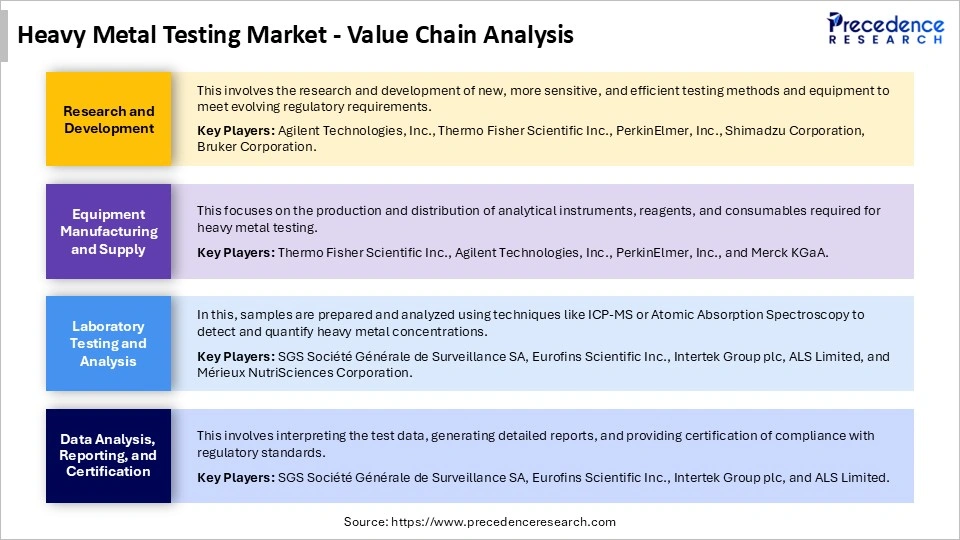
The global heavy metal testing market is undergoing a transformative phase as governments, food manufacturers, environmental agencies, and healthcare organizations intensify efforts to combat toxic metal contamination across food, water, pharmaceuticals, and industrial ecosystems.
The global heavy metal testing market size was valued at USD 3.75 billion in 2025 and is projected to rise from USD 4.00 billion in 2026 to nearly USD 7.20 billion by 2035, expanding at a CAGR of 6.75% during the forecast period from 2026 to 2035.
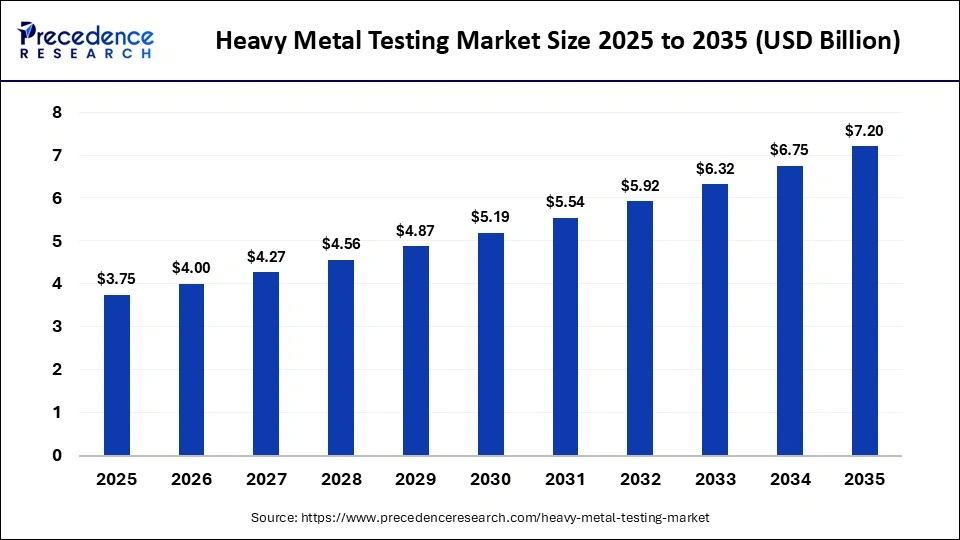
The increasing prevalence of industrial pollution, growing concerns regarding contaminated drinking water, stricter international food safety standards, and rising public awareness regarding heavy metal toxicity are among the primary growth drivers shaping the market. Technological breakthroughs in inductively coupled plasma mass spectrometry (ICP-MS), biosensors, atomic absorption spectroscopy (AAS), and portable testing systems are significantly enhancing the speed, sensitivity, and efficiency of heavy metal detection worldwide.
Heavy Metal Testing Market Key Points
- North America dominated the global heavy metal testing market in 2025 by accounting for 38.8% of total revenue, supported by strong EPA and FDA regulations and advanced laboratory infrastructure.
- Asia Pacific is projected to witness the fastest growth rate of 6.5% between 2026 and 2035 due to rapid industrialization, stricter pollution monitoring, and rising food safety enforcement.
- The arsenic testing segment emerged as the leading type category with a 51.3% market share in 2025 because of its carcinogenic nature and widespread contamination risks.
- ICP-MS technology held the largest share of 39.6% in 2025 owing to its ultra-low detection capabilities and high-throughput testing efficiency.
- Food safety testing accounted for 41.8% of the global market share as governments intensified monitoring of toxic metals across supply chains.
- Food & beverages remained the largest sample type segment with a 45.4% market share in 2025 due to increased testing requirements in grains, seafood, dairy, and processed foods.
- Laboratories represented the dominant end-user segment with 40.4% market share as regulatory-grade testing requires advanced infrastructure and certified analytical expertise.
What is Heavy Metal Testing and Why Is It Becoming Essential Across Industries?
Heavy metal testing refers to analytical procedures used to identify and quantify toxic metals such as arsenic, mercury, cadmium, and lead in environmental, industrial, food, pharmaceutical, and biological samples. These testing methods ensure compliance with international regulatory standards while protecting consumers and ecosystems from long-term toxic exposure.
Heavy metals are increasingly becoming a global public health concern because they can accumulate in the human body over time, causing neurological disorders, organ damage, developmental abnormalities, and even cancer. Regulatory agencies worldwide are tightening permissible contamination thresholds across drinking water systems, packaged foods, dietary supplements, cosmetics, and industrial products. As a result, industries are investing heavily in accurate, high-sensitivity analytical technologies.
The market is also benefiting from expanding testing programs in municipal water systems, pharmaceutical manufacturing, agricultural supply chains, and environmental monitoring projects.
How Is Artificial Intelligence Revolutionizing the Heavy Metal Testing Market?
Artificial intelligence is rapidly reshaping the operational dynamics of heavy metal testing laboratories by improving analytical precision, workflow automation, and predictive contamination assessment. AI-powered software systems are helping laboratories optimize instrument calibration, automate sample prioritization, and streamline data interpretation processes, reducing turnaround times while improving testing reliability.
Machine learning algorithms are also improving the sensitivity of electrochemical sensors and spectroscopy systems by identifying subtle contamination signatures that traditional analysis may overlook. This is particularly important in ultra-trace level detection for arsenic, mercury, cadmium, and lead across complex food and environmental matrices.
Additionally, AI-driven predictive models are enabling environmental agencies and industrial facilities to anticipate contamination hotspots using historical pollution data, industrial activity patterns, and geographical variables. This proactive monitoring capability is expected to become a major competitive advantage for laboratories and regulatory bodies over the next decade.
Heavy Metal Testing Market Revenue Overview
| Market Indicator | Value |
|---|---|
| Market Size in 2025 | USD 3.75 Billion |
| Market Size in 2026 | USD 4.00 Billion |
| Market Size by 2035 | USD 7.20 Billion |
| CAGR (2026–2035) | 6.75% |
| Dominating Region | North America |
| Fastest Growing Region | Asia Pacific |
What Factors Are Driving the Growth of the Heavy Metal Testing Market?
Increasing Government Regulations on Food and Water Safety
Governments worldwide are enforcing stricter regulations on toxic metal contamination in food, water, pharmaceuticals, and industrial products. Agencies such as the EPA, FDA, WHO, REACH, and FSSAI are mandating routine heavy metal testing to protect public health and maintain product quality standards.
Rising Industrial Pollution and Environmental Monitoring
Rapid industrialization across emerging economies has significantly increased contamination risks in soil, rivers, and groundwater systems. Mining, petrochemicals, agriculture, and manufacturing industries are under increasing pressure to implement routine environmental monitoring programs.
Growing Consumer Awareness Regarding Toxic Exposure
Consumers are becoming increasingly aware of the long-term health effects of heavy metal exposure. Concerns regarding contaminated seafood, baby foods, dietary supplements, and drinking water are encouraging manufacturers to adopt rigorous testing and quality assurance protocols.
Technological Advancements in Analytical Instruments
Modern testing technologies such as ICP-MS, portable AAS systems, biosensors, and AI-enabled analytical platforms are improving testing speed, sensitivity, portability, and cost-efficiency. These innovations are enabling laboratories to handle higher testing volumes with greater accuracy.
Why Is Food Safety Testing Becoming the Largest Application Area?
Food safety testing dominated the market with a 41.8% share in 2025 because contamination risks exist across nearly every stage of the food supply chain. Heavy metals can enter crops through contaminated irrigation water, fertilizers, industrial emissions, and polluted soils.
Seafood, dairy products, grains, baby foods, and plant-based proteins are particularly vulnerable to contamination. Regulatory authorities across North America, Europe, and Asia are therefore increasing surveillance and batch-level testing requirements.
The increasing popularity of global food trade is also accelerating demand for standardized testing procedures to ensure compliance with import-export regulations.
Can Environmental Testing Become the Next Major Growth Opportunity?
Environmental testing is projected to grow at a CAGR of 5.6% through 2035 as governments intensify efforts to monitor industrial pollution and protect drinking water systems. Environmental agencies are increasingly deploying portable and real-time testing systems for rapid field analysis.
Water contamination crises across several regions have amplified public concern regarding arsenic, mercury, and lead exposure. This is driving investments in advanced monitoring infrastructure and decentralized testing solutions.
The adoption of portable ICP-MS and automated spectroscopy systems is expected to significantly improve contamination response times in environmental surveillance programs.