

Expandable Microspheres Market Size to Surpass USD 9.04 Billion by 2035 as Lightweight Material Innovation Accelerates Across Automotive and Construction Industries
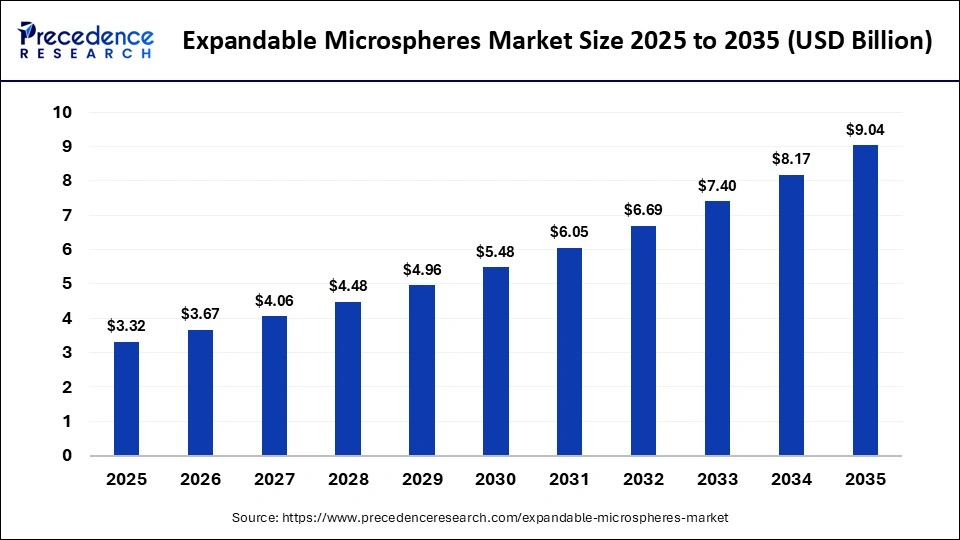
The global expandable microspheres market is witnessing a significant transformation as industries increasingly prioritize lightweighting, thermal insulation, and sustainable material innovation. According to Precedence Research, the market size accounted for USD 3.32 billion in 2025 and is projected to rise from USD 3.67 billion in 2026 to nearly USD 9.04 billion by 2035, expanding at a CAGR of 10.53% during the forecast period from 2026 to 2035.
Expandable microspheres are gaining traction across automotive, construction, paints & coatings, packaging, plastics, and sports equipment applications because of their unique ability to expand up to 60–80 times their original size when heated. These microscopic polymer spheres help manufacturers reduce material density, improve insulation performance, enhance surface smoothness, and lower overall production costs without compromising structural integrity.
The growing emphasis on vehicle lightweighting, low-emission construction materials, and energy-efficient manufacturing is expected to continue driving market expansion globally. Government-backed sustainability initiatives and advancements in polymer chemistry are further creating new opportunities for microsphere manufacturers and specialty material innovators.
Expandable Microspheres Market Key Points
- The global expandable microspheres market reached USD 3.32 billion in 2025 and is forecasted to hit USD 9.04 billion by 2035.
- The market is projected to grow at a healthy CAGR of 10.53% from 2026 to 2035.
- North America dominated the global market in 2025 with a 40.4% market share due to strong automotive and industrial demand.
- Asia Pacific is expected to emerge as the fastest-growing regional market, expanding at a CAGR of 10% during the forecast period.
- Dry expandable microspheres led the market by type with a 70.4% share in 2025.
- Polyacrylic ester (PAE) microspheres captured 52.5% of the total revenue share owing to superior thermal and mechanical properties.
- Automotive remained the leading application segment, accounting for 38.6% market share in 2025.
- Paints & coatings emerged as the dominant end-user industry with a 43.4% market share.
- The rising global electric vehicle fleet and increasing infrastructure spending are creating long-term opportunities for lightweight material suppliers.
Why Is the Expandable Microspheres Market Growing So Rapidly?
The demand for expandable microspheres is accelerating because industries are under increasing pressure to reduce material consumption, improve energy efficiency, and meet sustainability targets. These microspheres are increasingly being integrated into automotive interiors, underbody coatings, insulation panels, adhesives, and specialty composites to reduce weight while enhancing durability and thermal performance.
According to industry estimates, adding expandable microspheres at concentrations of only 1–2% by weight can reduce component density by approximately 15–40%, making them highly attractive for automotive OEMs focused on fuel efficiency and EV range optimization.
The construction sector is also emerging as a major consumer of microsphere-enhanced materials. With worldwide construction activity surpassing USD 13 trillion in annual output during 2024, demand for lightweight plasters, thermal insulation coatings, and energy-efficient building materials has surged considerably.
Furthermore, rising urbanization and infrastructure modernization projects across Asia-Pacific, North America, and Europe are expected to sustain strong long-term demand for advanced polymer additives.
How Is Artificial Intelligence Transforming the Expandable Microspheres Industry?
Artificial intelligence is playing a growing role in optimizing expandable microsphere manufacturing processes and improving product consistency. AI-driven predictive analytics systems are increasingly being deployed to regulate critical production variables such as particle size distribution, shell thickness, thermal expansion ratios, and polymerization conditions.
Manufacturers are leveraging machine learning models to simulate interactions between temperature, pressure, monomer compositions, and blowing agents, helping reduce raw material waste and improve production efficiency.
In addition, AI-powered process monitoring systems are helping manufacturers detect abnormalities during microsphere synthesis and thermal expansion stages in real time. These intelligent systems significantly reduce downtime while improving quality assurance, particularly for high-volume applications in automotive lightweighting, specialty coatings, and industrial insulation.
As digital manufacturing adoption increases, AI integration is expected to become a core competitive differentiator for microsphere producers worldwide.
Expandable Microspheres Market Size Overview
| Market Indicator | Value |
|---|---|
| Market Size in 2025 | USD 3.32 Billion |
| Market Size in 2026 | USD 3.67 Billion |
| Forecast Market Size by 2035 | USD 9.04 Billion |
| CAGR (2026–2035) | 10.53% |
| Dominant Region | North America |
| Fastest Growing Region | Asia Pacific |
What Are the Major Growth Drivers Shaping the Industry?
Rising Demand for Lightweight Automotive Components
Automotive manufacturers are increasingly incorporating expandable microspheres into interior panels, door trims, sealants, and bumpers to reduce vehicle weight while maintaining mechanical strength. The rapid expansion of electric vehicles is further intensifying demand for lightweight materials that improve driving range and energy efficiency.
Expansion of Sustainable Construction Materials
Construction companies are increasingly adopting microsphere-enhanced insulation coatings, sealants, and lightweight plasters to improve thermal efficiency and reduce material consumption in modern infrastructure projects.
Growing Use in Paints & Coatings
Expandable microspheres are becoming highly valuable in paints and coatings applications because they improve texture control, abrasion resistance, thermal insulation, and surface smoothness while helping reduce volatile organic compound (VOC) emissions.
Increasing Packaging Innovation
Packaging manufacturers are incorporating microspheres into laminates and plastics to create lightweight yet durable packaging solutions that support sustainability goals and transportation efficiency.
Continuous Advances in Polymer Engineering
Research and development investments in advanced polymer formulations are improving compatibility between microspheres and various resin systems, expanding their use across adhesives, composites, specialty coatings, and industrial applications.
Could Expandable Microspheres Become Essential for the EV Revolution?
The rapid expansion of the global electric vehicle market is creating unprecedented opportunities for expandable microsphere manufacturers.
Global EV stock surpassed 40 million units in 2024, with electric vehicles accounting for nearly 18–20% of new passenger vehicle sales in 2025. Automakers are under constant pressure to maximize battery efficiency and driving range, making lightweighting technologies increasingly essential.
Expandable microspheres are helping automotive engineers reduce the weight of interior plastics, underbody coatings, EPDM seals, and structural fillers without compromising durability or safety standards. As EV adoption accelerates globally, the demand for high-performance lightweight additives is expected to rise substantially.
Can Sustainability Trends Unlock New Revenue Opportunities?
Sustainability is becoming one of the strongest long-term growth catalysts for the expandable microspheres market.
Manufacturers are focusing on reducing raw material consumption, lowering emissions, and developing water-based formulations that comply with increasingly strict environmental regulations. Microspheres enable material reduction while improving thermal efficiency, making them attractive for environmentally conscious industries.
In addition, innovations in polymer shell design and blowing agents are helping manufacturers develop low-emission, recyclable, and high-performance formulations that align with global sustainability mandates.
Expandable Microspheres Market Segmental Outlook
Type Insights
The dry segment dominated the expandable microspheres market in 2025, accounting for 70.4% of the total market share. Their lightweight structure helps reduce material usage in automotive and construction applications while improving insulation and composite performance.
Dry microspheres are widely used in coatings, adhesives, and bulk material processing because they lower operational costs and enhance product efficiency. Growing regulatory focus on lightweight and energy-efficient materials is also supporting demand for dry expandable microspheres.
The wet segment is projected to grow at the fastest CAGR of 8.6% during the forecast period. Wet expandable microspheres offer excellent dispersion in liquid formulations, making them highly suitable for paints, coatings, adhesives, and specialty polymers.
Their superior shell properties improve thermal insulation, surface finish, and compressive strength. Increasing adoption in emerging markets due to ease of application and versatility is further driving segment growth.
Polymer Type Insights
The polyacrylic ester (PAE) segment held the largest revenue share of 52.5% in 2025. PAE microspheres are preferred because they provide excellent thermal stability, mechanical strength, and controlled expansion under heat.
These microspheres are extensively used in coatings, adhesives, packaging, and lightweight composites across automotive and construction industries. Their compatibility with multiple resin systems and continuous advancements in shell design are expected to strengthen market dominance.
The polyvinyl acetate (PVA) segment is expected to register the fastest CAGR of 8.8% over the forecast period. PVA microspheres are widely adopted in water-based coatings, laminates, and adhesives because of their strong bonding and dispersion properties.
Growing applications in biodegradable polymers, specialty adhesives, and functional coatings are expected to accelerate demand for PVA microspheres globally.
Application Insights
The automotive segment dominated the expandable microspheres market in 2025 with a 38.6% market share. Automakers are increasingly using expandable microspheres in door panels, bumpers, and interior trims to reduce vehicle weight while maintaining durability.
The rising focus on fuel efficiency and electric vehicles is increasing the demand for lightweight materials. Expandable microspheres also improve thermal insulation and acoustic performance in automotive components.
The sports & leisure segment is projected to grow at the fastest CAGR of 8.9% during the forecast period. Rising consumer demand for lightweight and high-performance sports equipment is driving segment expansion.
Manufacturers are increasingly incorporating expandable microspheres into sportswear, protective gear, and recreational products to improve comfort, resilience, and material performance.
End-User Industry Insights
The paints & coatings segment accounted for the largest market share of 43.4% in 2025. Expandable microspheres improve texture control, thermal insulation, abrasion resistance, and surface smoothness in coatings.
Paint manufacturers are increasingly using microspheres to reduce volatile organic compounds (VOCs) while maintaining coating performance. Growing infrastructure renovation activities and demand for protective coatings are further supporting market growth.
The plastic segment is expected to grow at the fastest CAGR of 9% over the forecast period. Expandable microspheres reduce part density and improve dimensional stability in molded plastic products.
Increasing demand for lightweight plastics in automotive, medical devices, housing, and consumer goods is expected to drive segment growth in the coming years.
Expandable Microspheres Market Regional Insights
Why Did North America Dominate the Market?
North America led the expandable microspheres market in 2025, capturing 40.4% of the total market share. Strong demand from automotive coatings, specialty composites, and industrial applications is supporting regional growth.
The region benefits from advanced manufacturing infrastructure, strong research capabilities, and collaboration between material suppliers and industrial manufacturers. Continuous investments in advanced material technologies are further boosting adoption.
The North America expandable microspheres market size was valued at USD 1.34 billion in 2025 and is projected to reach USD 3.66 billion by 2035, growing at a CAGR of 10.57% from 2026 to 2035.
Why Is the U.S. Leading the North American Market?
The U.S. expandable microspheres market was valued at USD 1.01 billion in 2025 and is expected to reach USD 2.76 billion by 2035.
Strong demand from automotive, aerospace, and industrial sectors is driving market growth. Manufacturers are increasingly adopting expandable microspheres in lightweight composites, insulation systems, and vibration-damping coatings to improve energy efficiency and material performance.
Government sustainability initiatives and strong polymer production infrastructure are also contributing to market expansion.
Why Is Asia Pacific the Fastest-Growing Region?
Asia Pacific is expected to grow at the fastest CAGR of 10% during the forecast period. Rapid industrialization and expanding automotive, electronics, and construction industries are fueling demand for expandable microspheres.
Countries such as China and India are witnessing strong growth in lightweight composites, insulation panels, coatings, and sealants. Increasing investments in polymer production and material innovation are further supporting regional growth.
China remains a major contributor to the Asia Pacific market due to its strong manufacturing base and rising domestic demand for advanced materials.
Local manufacturers are expanding production capacities for polyacrylic ester and polyvinyl acetate microspheres to support growing applications in construction, automotive, and industrial coatings.
Government-backed industrial modernization programs are also encouraging adoption of lightweight and energy-efficient materials.
Why Is Europe Emerging as a Key Market?
Europe is expected to hold a notable share of the expandable microspheres market due to stringent environmental regulations and growing adoption of sustainable materials.
Manufacturers are increasingly using expandable microspheres in coatings, construction materials, and industrial composites to reduce density, improve insulation, and enhance durability.
Strong collaboration between research institutes and chemical manufacturers is helping develop advanced microsphere technologies for specialized industrial applications.
Germany dominates the European market due to strong demand from automotive manufacturing and specialty coatings industries.
Expandable microspheres are increasingly used in thermoplastic composites, underbody coatings, and lightweight automotive parts to improve insulation and reduce weight. Rising adoption in renewable energy applications, including wind turbine components, is also supporting market growth.
Expandable Microspheres Market Value Chain
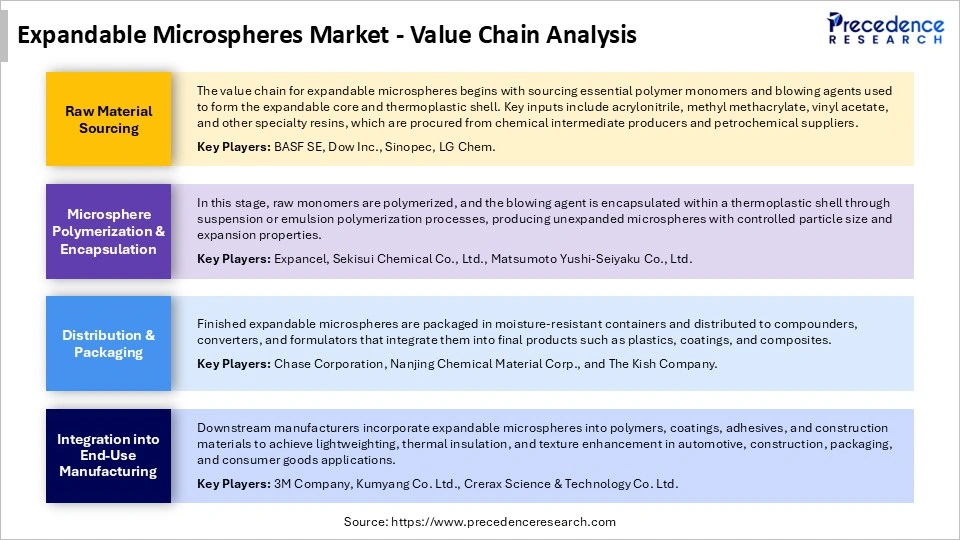
Expandable Microspheres Market Key Players
3M Company: Produces hollow glass microspheres (e.g., iM Series, Glass Bubbles) used as lightweight fillers in composites, plastics, coatings, and adhesives for automotive, aerospace, and construction applications
AkzoNobel N.V.: Manufactures expandable microspheres under the brand Expancel (via Nouryon, formerly part of AkzoNobel), used as lightweight fillers and blowing agents in polymers, coatings, and elastomers
Bublon GmbH: Specializes in expandable polymer microspheres for lightweight fillers in plastics, coatings, and construction materials
Chase Corporation: Offers Microbubbles® – expandable and non-expandable polymer microspheres for use in coatings, adhesives, sealants, and lightweight composite materials
Chinasinno Chemical Co. Ltd.: Produces expandable microspheres for use in plastics, rubber, and coating applications as lightweight fillers
Crerax Science & Technology Co. Ltd.:Manufactures expandable polymer microspheres for industrial applications including plastics and coatings
Dennert Poraver GmbH: Produces PORAVER – expandable glass microspheres for lightweight concrete, insulation, and construction applications
Kumyang Co. Ltd.: Supplies expandable microspheres for use in plastics, coatings, and adhesive formulations
Kureha Corporation: Offers expandable polymer microspheres for specialized applications in electronics, automotive, and medical devices
Matsumoto Yushi-Seiyaku Co., Ltd.: Manufactures Microspher® – expandable and non-expandable polymer microspheres for cosmetics, coatings, and industrial applications
Nanjing Chemical Material Corp.: Produces expandable microspheres for use in plastics, rubber, and coating industries
Nouryon/Expancel: Market leader offering Expancel® expandable microspheres (thermoplastic hollow spheres) – the most widely used brand for lightweight fillers and blowing agents in polymers, coatings, adhesives, and 3D printing
Sekisui Chemical Co., Ltd.: Produces EXPANCEL-type expandable microspheres and SEKISUI FOAM for lightweight materials in automotive and construction
The Kish Company: Distributes specialty microspheres including expandable types for industrial applications
Trelleborg AB: Offers expandable microspheres in engineered polymer solutions for automotive, aerospace, and industrial applications
Latest Industry Developments
- In April 2025, Nouryon introduced Expancel WB microspheres at Chinaplas in Shanghai for white shoe sole applications, enhancing comfort and performance in footwear manufacturing.
- Terumo Europe N.V. launched BioPearlTM microspheres, the first resorbable drug-eluting microspheres designed for minimally invasive medical treatments.
- Varian, a Siemens Healthineers company, received CE Mark approval for Embozene microspheres used in Genicular Artery Embolisation (GAE) therapy for knee osteoarthritis treatment.
Segments Covered in the Report
By Type
- Dry
- Wet
By Polymer Type
- Polyacrylic Ester (PAE)
- Polyvinyl Acetate (PVA)
- Vinyl Acetate Ethylene (VAE)
By Application/End Use
- Automotive
- Construction
- Consumer Goods
- Sports & Leisure
- Others (Packaging, Textile)
By End-User Industry
- Paints & Coatings
- Plastics
- Rubber
- Others
By Region
- North America
- Europe
- Asia-Pacific
- Latin America
- Middle East & Africa
Read Also: Solder Flux Market Surges Toward USD 5.34 Billion by 2035
Get this report to explore global market size, share, CAGR, and trends, featuring detailed segmental analysis and an insightful competitive landscape overview @ https://www.precedenceresearch.com/sample/7290
You can place an order or ask any questions. Please feel free to contact us at sales@precedenceresearch.com |+1 804 441 9344
