
Press Releases

Heavy Metal Testing Market Size to Reach USD 7.20 Billion by 2035 Amid Rising Demand for Food Safety, Water Quality Monitoring, and Regulatory Compliance

The global heavy metal testing market is undergoing a transformative phase as governments, food manufacturers, environmental agencies, and healthcare organizations intensify efforts to combat toxic metal contamination across food, water, pharmaceuticals, and industrial ecosystems.

The global heavy metal testing market size was valued at USD 3.75 billion in 2025 and is projected to rise from USD 4.00 billion in 2026 to nearly USD 7.20 billion by 2035, expanding at a CAGR of 6.75% during the forecast period from 2026 to 2035.
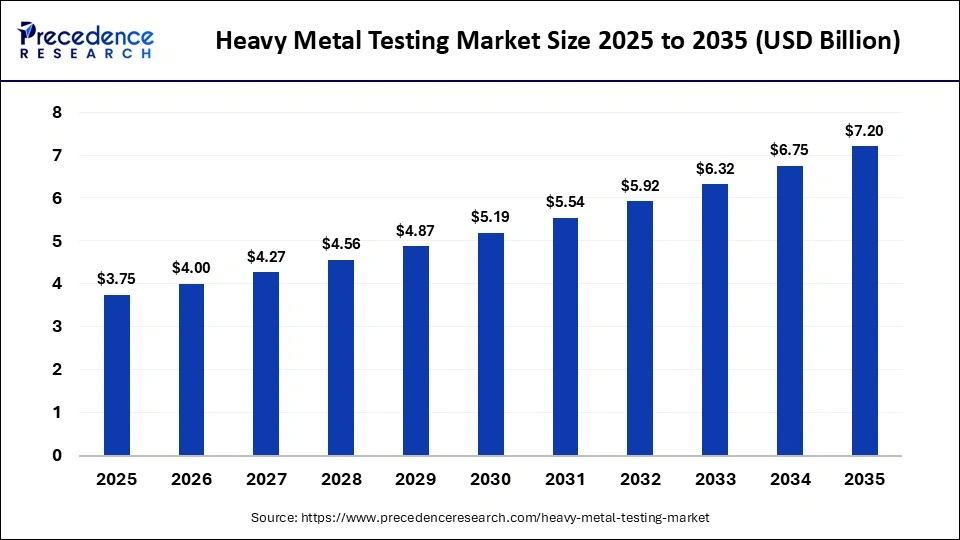
Heavy Metal Testing Market Size 2025 to 2035

The increasing prevalence of industrial pollution, growing concerns regarding contaminated drinking water, stricter international food safety standards, and rising public awareness regarding heavy metal toxicity are among the primary growth drivers shaping the market. Technological breakthroughs in inductively coupled plasma mass spectrometry (ICP-MS), biosensors, atomic absorption spectroscopy (AAS), and portable testing systems are significantly enhancing the speed, sensitivity, and efficiency of heavy metal detection worldwide.

Heavy Metal Testing Market Key Points

  • North America dominated the global heavy metal testing market in 2025 by accounting for 38.8% of total revenue, supported by strong EPA and FDA regulations and advanced laboratory infrastructure.
  • Asia Pacific is projected to witness the fastest growth rate of 6.5% between 2026 and 2035 due to rapid industrialization, stricter pollution monitoring, and rising food safety enforcement.
  • The arsenic testing segment emerged as the leading type category with a 51.3% market share in 2025 because of its carcinogenic nature and widespread contamination risks.
  • ICP-MS technology held the largest share of 39.6% in 2025 owing to its ultra-low detection capabilities and high-throughput testing efficiency.
  • Food safety testing accounted for 41.8% of the global market share as governments intensified monitoring of toxic metals across supply chains.
  • Food & beverages remained the largest sample type segment with a 45.4% market share in 2025 due to increased testing requirements in grains, seafood, dairy, and processed foods.
  • Laboratories represented the dominant end-user segment with 40.4% market share as regulatory-grade testing requires advanced infrastructure and certified analytical expertise.

What is Heavy Metal Testing and Why Is It Becoming Essential Across Industries?

Heavy metal testing refers to analytical procedures used to identify and quantify toxic metals such as arsenic, mercury, cadmium, and lead in environmental, industrial, food, pharmaceutical, and biological samples. These testing methods ensure compliance with international regulatory standards while protecting consumers and ecosystems from long-term toxic exposure.

Heavy metals are increasingly becoming a global public health concern because they can accumulate in the human body over time, causing neurological disorders, organ damage, developmental abnormalities, and even cancer. Regulatory agencies worldwide are tightening permissible contamination thresholds across drinking water systems, packaged foods, dietary supplements, cosmetics, and industrial products. As a result, industries are investing heavily in accurate, high-sensitivity analytical technologies.

The market is also benefiting from expanding testing programs in municipal water systems, pharmaceutical manufacturing, agricultural supply chains, and environmental monitoring projects.

How Is Artificial Intelligence Revolutionizing the Heavy Metal Testing Market?

Artificial intelligence is rapidly reshaping the operational dynamics of heavy metal testing laboratories by improving analytical precision, workflow automation, and predictive contamination assessment. AI-powered software systems are helping laboratories optimize instrument calibration, automate sample prioritization, and streamline data interpretation processes, reducing turnaround times while improving testing reliability.

Machine learning algorithms are also improving the sensitivity of electrochemical sensors and spectroscopy systems by identifying subtle contamination signatures that traditional analysis may overlook. This is particularly important in ultra-trace level detection for arsenic, mercury, cadmium, and lead across complex food and environmental matrices.

Additionally, AI-driven predictive models are enabling environmental agencies and industrial facilities to anticipate contamination hotspots using historical pollution data, industrial activity patterns, and geographical variables. This proactive monitoring capability is expected to become a major competitive advantage for laboratories and regulatory bodies over the next decade.

Heavy Metal Testing Market Revenue Overview

Market IndicatorValue
Market Size in 2025USD 3.75 Billion
Market Size in 2026USD 4.00 Billion
Market Size by 2035USD 7.20 Billion
CAGR (2026–2035)6.75%
Dominating RegionNorth America
Fastest Growing RegionAsia Pacific

What Factors Are Driving the Growth of the Heavy Metal Testing Market?

Increasing Government Regulations on Food and Water Safety

Governments worldwide are enforcing stricter regulations on toxic metal contamination in food, water, pharmaceuticals, and industrial products. Agencies such as the EPA, FDA, WHO, REACH, and FSSAI are mandating routine heavy metal testing to protect public health and maintain product quality standards.

Rising Industrial Pollution and Environmental Monitoring

Rapid industrialization across emerging economies has significantly increased contamination risks in soil, rivers, and groundwater systems. Mining, petrochemicals, agriculture, and manufacturing industries are under increasing pressure to implement routine environmental monitoring programs.

Growing Consumer Awareness Regarding Toxic Exposure

Consumers are becoming increasingly aware of the long-term health effects of heavy metal exposure. Concerns regarding contaminated seafood, baby foods, dietary supplements, and drinking water are encouraging manufacturers to adopt rigorous testing and quality assurance protocols.

Technological Advancements in Analytical Instruments

Modern testing technologies such as ICP-MS, portable AAS systems, biosensors, and AI-enabled analytical platforms are improving testing speed, sensitivity, portability, and cost-efficiency. These innovations are enabling laboratories to handle higher testing volumes with greater accuracy.

Why Is Food Safety Testing Becoming the Largest Application Area?

Food safety testing dominated the market with a 41.8% share in 2025 because contamination risks exist across nearly every stage of the food supply chain. Heavy metals can enter crops through contaminated irrigation water, fertilizers, industrial emissions, and polluted soils.

Seafood, dairy products, grains, baby foods, and plant-based proteins are particularly vulnerable to contamination. Regulatory authorities across North America, Europe, and Asia are therefore increasing surveillance and batch-level testing requirements.

The increasing popularity of global food trade is also accelerating demand for standardized testing procedures to ensure compliance with import-export regulations.

Can Environmental Testing Become the Next Major Growth Opportunity?

Environmental testing is projected to grow at a CAGR of 5.6% through 2035 as governments intensify efforts to monitor industrial pollution and protect drinking water systems. Environmental agencies are increasingly deploying portable and real-time testing systems for rapid field analysis.

Water contamination crises across several regions have amplified public concern regarding arsenic, mercury, and lead exposure. This is driving investments in advanced monitoring infrastructure and decentralized testing solutions.

The adoption of portable ICP-MS and automated spectroscopy systems is expected to significantly improve contamination response times in environmental surveillance programs.
Heavy Metal Testing Market Segmental Outlook

Type Insights

The arsenic segment accounted for the largest market share of 51.3% in 2025 due to its extreme toxicity, widespread environmental presence, and strict global regulatory limits. Arsenic is classified as a Group 1 carcinogen by the IARC, making routine testing essential across drinking water, food, soil, and consumer products.

Governments and regulatory agencies such as the EPA and FDA have implemented stringent limits for arsenic contamination, increasing demand for accurate and continuous testing solutions worldwide.

The mercury segment is projected to witness the fastest CAGR of 5.5% during the forecast period. Growth is driven by increasing regulatory scrutiny, rising public awareness regarding contamination, and the widespread use of mercury in healthcare and electronics industries.

Advanced technologies such as spectroscopy and robotic testing systems are improving detection speed and accuracy, further supporting demand for mercury testing across water, soil, and biological samples.

Technology/Method Insights

The ICP-MS segment held the largest market share of 39.6% in 2025 due to its ultra-low detection capabilities, multi-element analysis, and high sample throughput. The technology is widely used across food, pharmaceutical, and water testing applications because it can detect toxic metals at parts-per-billion and parts-per-trillion levels.

Its accuracy and efficiency make ICP-MS highly suitable for meeting stringent global regulations for lead, cadmium, mercury, and arsenic testing.

The atomic absorption spectroscopy (AAS) segment is expected to grow at the fastest CAGR of 5.8% during the forecast period. Growth is mainly attributed to its affordability, operational simplicity, and increasing adoption in portable and automated testing systems.

Portable AAS devices are increasingly being used in environmental monitoring applications, including soil, water, and industrial testing, driving wider adoption globally.

Application Insights

The food safety testing segment captured 41.8% of the market share in 2025 due to rising concerns about heavy metal contamination in food products. Strict food safety regulations and growing consumer awareness regarding health risks associated with arsenic, lead, and mercury exposure significantly boosted testing demand.

Heavy metals can contaminate food at multiple stages of the supply chain, making routine testing essential for ensuring food safety and regulatory compliance.

The environmental testing segment is anticipated to grow at the fastest CAGR of 5.6% during the forecast period. Increasing industrial pollution, contamination of water sources, and growing awareness about environmental health risks are driving demand for heavy metal monitoring.

Advanced technologies such as ICP-MS and portable sensors are enabling faster and more reliable environmental testing, supporting regulatory compliance and pollution control initiatives.

Sample Type Insights

The food & beverages segment dominated the market with a 45.4% share in 2025. Growth is mainly driven by stringent food safety regulations and increasing consumer concerns about contamination from heavy metals such as arsenic, mercury, lead, and cadmium.

Testing demand remains particularly high in products such as grains, seafood, dairy products, and processed foods, where contamination risks are more significant.

The water segment is projected to register the fastest CAGR of 5.7% during the forecast period. Rising industrialization and increasing contamination of drinking and irrigation water are major factors driving growth.

Governments and environmental agencies are increasingly adopting advanced testing technologies to ensure water quality and public safety across municipal and industrial sectors.

End-User Insights

The laboratories segment accounted for 40.4% of the market share in 2025 due to the complexity and high cost of heavy metal testing technologies. Certified laboratories are essential for meeting regulatory compliance standards established by agencies such as the EPA and FDA.

Advanced analytical equipment like ICP-MS and AAS requires specialized infrastructure and trained professionals, making laboratories the preferred choice for accurate and reliable testing services.

The government segment is expected to grow at the fastest CAGR of 5.8% during the forecast period. Growth is fueled by increasing government focus on environmental safety, public health protection, and pollution monitoring.

Regulatory authorities worldwide are implementing stricter standards for heavy metal levels in air, soil, water, and food products, increasing demand for government-led testing programs.

Heavy Metal Testing Market Regional Insights

What Made North America Dominate the Market in 2025?

North America held the largest market share of 38.8% in 2025 due to strong regulatory enforcement, advanced laboratory infrastructure, and continuous monitoring requirements across industries.

Regulatory bodies such as the U.S. EPA and FDA enforce strict testing standards for food, water, pharmaceuticals, cosmetics, and consumer products, creating steady demand for heavy metal testing services.

The region also benefits from a well-established network of accredited laboratories equipped with advanced technologies such as ICP-MS, AAS, and X-ray fluorescence systems.

The U.S. remains the leading contributor to the global market due to strict regulatory standards and high public awareness regarding contamination risks.

Strong investments in R&D, advanced laboratory infrastructure, and widespread adoption of high-sensitivity testing technologies continue to strengthen the country’s market position.

Asia Pacific Heavy Metal Testing Market

Asia Pacific is expected to grow at the fastest CAGR of 6.5% during the forecast period. Rapid industrialization, urbanization, and increasing environmental concerns are major growth drivers.

Countries such as China and India are strengthening regulations related to food safety, industrial emissions, and water quality, increasing demand for accredited heavy metal testing services.

India is emerging as one of the fastest-growing markets due to tightening food and water safety regulations and growing awareness about contamination risks.

Investments in laboratory infrastructure and increasing adoption of advanced analytical technologies are further supporting market expansion.

Europe Heavy Metal Testing Market

Europe is expected to witness steady growth due to stringent regulations, strong consumer safety awareness, and advanced testing infrastructure.

Regulations such as REACH and RoHS require manufacturers to conduct routine heavy metal testing across chemicals, electronics, and consumer products, supporting consistent market demand.

Germany plays a significant role in the European market due to its strong manufacturing sector and strict product quality standards.

Continuous investments in laboratory automation, analytical innovation, and regulatory compliance are helping the country maintain its leadership position in the region.

Latin America Heavy Metal Testing Market

Latin America is experiencing steady market growth due to rising industrialization, increasing mining activities, and growing awareness about contamination-related health risks.

Governments across the region are strengthening regulations related to water quality, food safety, and environmental protection, boosting demand for testing services.

Brazil remains a key market in the region due to strong regulatory oversight in mining, agriculture, and export industries.

Growing concerns regarding soil and water contamination are increasing demand for environmental and food testing services across the country.

Middle East & Africa Heavy Metal Testing Market

The Middle East & Africa market is growing due to increasing industrial activities, mining operations, and stricter environmental regulations.

Governments are strengthening monitoring programs for water quality, industrial effluents, and food safety, increasing the need for routine heavy metal testing.

Saudi Arabia is witnessing rising demand for heavy metal testing due to strict regulatory enforcement by the Saudi Food and Drug Authority.

Testing requirements for bottled water, dietary supplements, personal care products, and industrial wastewater are increasing significantly, supporting long-term market growth.

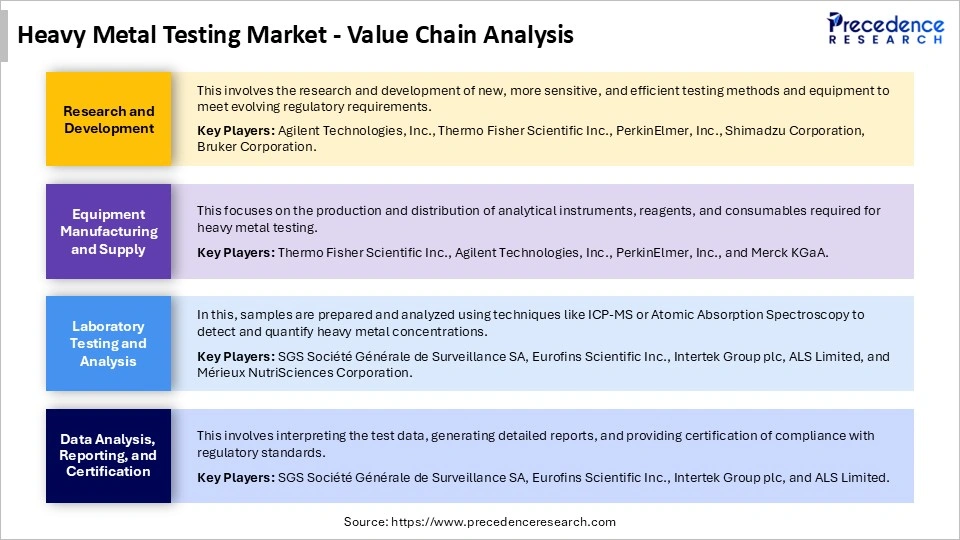
Heavy Metal Testing Market Value Chain

Heavy Metal Testing Market Value Chain

Heavy Metal Testing Market Companies

SGS S.A.

  • Comprehensive analytical testing solutions for all heavy metals

  • Uses ICP-MS, AAS, and HPLC with ICP-MS technologies

  • Services cover food, feed, minerals, and metals testing

  • Ensures compliance with national and international standards

  • Part of Mineral & Metal Testing service group

Eurofins Scientific SE

  • Detection and determination of heavy metals in food products

  • Testing for dietary supplements heavy metal contamination

  • Testing packages: 2 metals (Cadmium, Lead) or 4 metals (Cd, Pb, Hg, Arsenic)

  • Individual element analysis available for 15+ elements

  • Accredited laboratory for food testing

Intertek Group plc

  • Metallurgical testing services for minerals industry

  • Materials testing of metals for multiple industries

  • Tests iron, steel, aluminum, copper, nickel, and alloys

  • Applications: aerospace, automotive, oil & gas, power generation, rail, nuclear

  • Non-destructive testing capabilities for metals

Bureau Veritas SA

  • Metallurgical testing for mineral processing and batch-scale tests

  • Metals analysis in air using 90%+ NIOSH/OSHA approved methods

  • Technologies: ICP/MS, ICP-OES for comprehensive metal analysis

  • Ultratrace mercury detection using CVAA technology

  • Detection limits down to 0.5 ng for air monitoring

ALS Limited

  • Mining and metallurgy testing services including heavy metals

  • Environmental testing for heavy metals in soil, water, air

  • Food and consumer goods heavy metal testing

  • Global laboratory network

TUV SUD AG

  • Food safety testing including heavy metals in food products

  • Industrial hygiene and environmental testing

  • Consumer product testing for heavy metal compliance

  • Regulatory compliance testing services

Mérieux NutriSciences

  • Food safety testing for heavy metals (Cd, Pb, Hg, As)

  • Dietary supplements and pharmaceutical testing

  • Nutritional and food safety analytical services

  • Global network of food testing laboratories

LGC Group

  • Reference materials and testing services for heavy metals

  • Analytical testing for environmental and food applications

  • Metrological traceability for heavy metal measurements

  • Forensic and drug testing capabilities

AsureQuality Limited

  • Food and agricultural product testing including heavy metals

  • Environmental testing services

  • Export certification and testing

  • New Zealand-based global testing provider

Microbac Laboratories, Inc.

  • Environmental testing for heavy metals in water, soil, waste

  • Pharmaceutical and cosmetic testing

  • Food and beverage heavy metal analysis

  • 150+ laboratory locations nationwide

EMSL Analytical, Inc.

  • Environmental testing for heavy metals

  • Water, soil, air, and waste analysis

  • Industrial hygiene and asbestos testing

  • 100+ laboratory locations in US, Canada, Caribbean

OMIC USA Inc.

  • Food testing services including heavy metals

  • Dietary supplements and botanical testing

  • Import/export compliance testing

  • Food safety certification services

R J Hill Laboratories Limited

  • Agriculture and food testing services

  • Soil, fertilizer, and plant testing for heavy metals

  • Food safety and quality testing

  • New Zealand-based laboratory services

Pace Analytical Services, LLC

  • Environmental testing for heavy metals

  • Energy sector testing (oil, gas, coal)

  • Water, soil, and air analysis

  • Industrial hygiene and emissions testing

NSF International

  • Food and dietary supplement testing for heavy metals

  • Consumer product safety testing

  • Water quality testing

  • Public health and safety certification services

Segments Covered in the Report

By Type

  • Arsenic
  • Lead
  • Cadmium
  • Mercury
  • Others

By Technology/Method

  • ICP-MS
  • AAS
  • ICP-OES
  • XRF
  • Others

By Application

  • Food Safety Testing
  • Environmental Testing
  • Clinical Diagnostics
  • Industrial Quality Control
  • Others

By Sample Type

  • Food & Beverages
  • Water
  • Soil
  • Blood & Biological
  • Others

By End-User

  • Laboratories
  • Government
  • Industrial
  • Environmental Agencies
  • Others

By Region

  • North America
  • Europe
  • Asia-Pacific
  • Latin America
  • Middle East & Africa

Read Also: FRP Pipe Market Size to Surpass USD 8.99 Billion by 2035

Get this report to explore global market size, share, CAGR, and trends, featuring detailed segmental analysis and an insightful competitive landscape overview @ https://www.precedenceresearch.com/sample/7293

You can place an order or ask any questions. Please feel free to contact us at sales@precedenceresearch.com |+1 804 441 9344

Akshay Dhamal

Akshay Dhamal is a Digital Marketing Specialist with expertise in SEO, link building, and digital growth strategies. With over two years of experience at Precedence Research, he has hands-on expertise in on-page SEO, off-page SEO, technical SEO, keyword research, and website optimization. He is also a contributing author for Business Web Wire, Market Stats Insight, Chemical Materials Intelligence, US WebWire, ExpressWeb Wire, and Market Stat News, where he shares insights on digital marketing, market trends, and industry developments.

Leave a Reply

Your email address will not be published. Required fields are marked *