

Injection Molding Market Size to Surpass USD 588.71 Billion by 2035 Amid Rising Demand for Lightweight and Precision-Manufactured Components
The global injection molding market is entering a transformative growth phase as industries increasingly prioritize lightweight materials, high-volume precision manufacturing, and sustainable production technologies. The global injection molding market size was valued at USD 335.00 billion in 2025 and is projected to rise from USD 354.43 billion in 2026 to nearly USD 588.71 billion by 2035, expanding at a CAGR of 5.80% between 2026 and 2035.
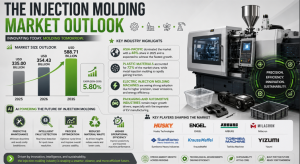
Injection molding continues to evolve as one of the most efficient and scalable manufacturing technologies used across packaging, automotive, healthcare, electronics, and consumer goods industries. The rising shift toward electric vehicles (EVs), recyclable plastics, smart factories, and advanced medical devices is significantly boosting global market momentum.
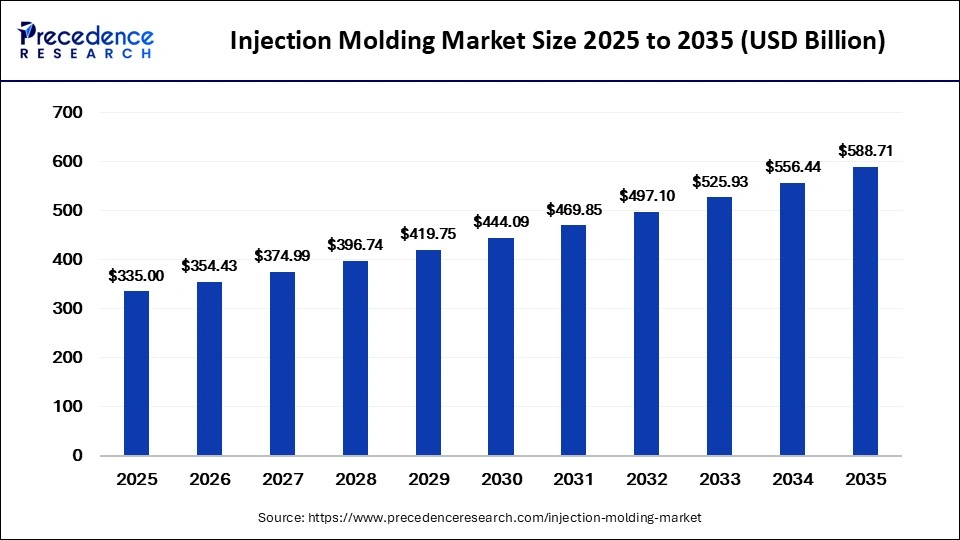
Injection Molding Market Key Insights
- The global injection molding market is expected to reach USD 588.71 billion by 2035 from USD 354.43 billion in 2026, growing at a CAGR of 5.80%.
- Asia-Pacific dominated the market with 48% share in 2025 due to strong manufacturing capabilities and rising industrialization.
- North America is projected to witness notable growth at a CAGR of 4.8% during the forecast period.
- Plastic materials accounted for 72% of total market revenue in 2025 owing to their lightweight and cost-effective properties.
- Electric injection molding machines are anticipated to grow rapidly at a CAGR of 8.5% due to energy efficiency and precision advantages.
- Thermoplastic injection molding led the process segment with 68% market share in 2025.
- Packaging emerged as the leading application segment with 28% share, supported by growing demand for sustainable packaging.
- Automotive applications are forecast to expand strongly as EV manufacturers increase adoption of lightweight molded components.
- Leading companies are increasingly integrating AI, robotics, and automation into molding systems to improve productivity and reduce waste.
How is Innovation Revolutionizing the Injection Molding Industry?
Injection molding technology has become the backbone of modern manufacturing due to its ability to produce highly complex, lightweight, and durable components at scale. From automotive dashboards and pharmaceutical packaging to medical tubing and consumer electronics housings, injection molding enables manufacturers to maintain consistency, accuracy, and cost efficiency.
The market is rapidly benefiting from the expansion of automation, robotics, and Industry 4.0 technologies. Smart manufacturing systems are helping companies improve throughput while minimizing operational costs and material waste. The growing preference for recyclable and lightweight materials is also influencing production strategies worldwide.
In industries such as healthcare and electronics, precision injection molding has become indispensable. The technology enables manufacturers to develop highly sophisticated micro-components used in wearable devices, surgical tools, and advanced semiconductor systems.
Can Artificial Intelligence Redefine Injection Molding Operations?
Artificial intelligence is becoming a game-changing force in the injection molding market. AI-powered systems are enabling manufacturers to monitor machine performance in real time, analyze process parameters, and optimize temperature, pressure, cooling cycles, and material flow automatically.
By integrating AI into manufacturing operations, companies are reducing machine downtime, improving quality assurance, and minimizing material scrap. Predictive maintenance capabilities powered by AI are also helping manufacturers prevent equipment failures and lower operational costs.
AI-driven fault detection systems are further enhancing productivity by identifying defects early in the manufacturing cycle. This allows manufacturers to improve product consistency while supporting sustainable production goals through reduced material wastage.
Injection Molding Market Snapshot
| Market Attribute | Details |
|---|---|
| Market Size 2025 | USD 335.00 Billion |
| Market Size 2026 | USD 354.43 Billion |
| Market Size 2035 | USD 588.71 Billion |
| CAGR (2026-2035) | 5.80% |
| Dominating Region | Asia-Pacific |
| Fastest Growing Region | North America |
| Leading Material | Plastic |
| Leading Application | Packaging |
| Key Growth Driver | Demand for Lightweight Components |
Why is Demand for Lightweight Automotive Components Fueling Market Expansion?
The automotive industry is increasingly replacing traditional metal parts with lightweight molded plastic components to improve fuel efficiency and reduce vehicle emissions. Governments worldwide are tightening environmental regulations, compelling automakers to adopt lighter materials in vehicle manufacturing.
Injection molding has become essential for producing automotive bumpers, dashboards, lighting systems, battery housings, and EV interior components. Advanced engineering thermoplastics are further expanding design possibilities for next-generation vehicles.
The accelerating global EV transition is expected to create substantial long-term opportunities for injection molding manufacturers.
What Major Trends Are Shaping the Future of Injection Molding?
The Rise of Electric Injection Molding Machines
Electric injection molding machines are rapidly gaining popularity because of their energy efficiency, operational precision, and low maintenance requirements. These machines are particularly preferred in healthcare, electronics, and precision packaging applications.
Sustainability and Green Manufacturing
Manufacturers are increasingly adopting recyclable plastics, biodegradable materials, and low-energy molding technologies to align with stricter environmental regulations and sustainability goals.
Growth of Precision and Medical Molding
The demand for precision-molded medical components continues to rise due to increasing healthcare investments, aging populations, and growing use of minimally invasive devices.
Expansion of Smart Manufacturing
Factories are integrating AI, robotics, IoT sensors, and automated inspection systems to improve operational efficiency and reduce production downtime.
What Opportunities are Emerging in Micro Injection Molding?
Micro injection molding is becoming one of the most promising growth areas within the industry. The technology allows manufacturers to produce highly accurate miniature plastic components with minimal waste.
This opportunity is particularly strong in:
- Medical devices
- Drug delivery systems
- Wearable healthcare products
- Telecommunications
- Semiconductor manufacturing
- Precision electronics
As industries continue miniaturization trends, the need for micro-molded parts is expected to surge significantly over the coming decade.
Injection Molding Market Segmental Analysis
Material Analysis
The plastic segment accounted for 72% of the injection molding market share in 2025. The segment’s growth is driven by rising demand for lightweight, durable, and cost-effective materials in packaging and industrial applications. Plastics offer excellent design flexibility, corrosion resistance, and suitability for large-scale manufacturing. Increasing adoption of engineering plastics and sustainable materials is also supporting market expansion.
The metal segment held 15% of the market share in 2025 and is projected to grow at the fastest CAGR of 7% during the forecast period. Growth is fueled by increasing demand for complex component manufacturing, superior mechanical properties, and precision tolerance. Expanding use in medical devices and miniaturized products is further driving segment growth.
The rubber segment captured 8% of the market share in 2025. Rising demand for flexible molded parts in automotive, industrial, and medical sectors is supporting growth. Rubber injection molding is widely used for seals, gaskets, hoses, and vibration-damping components due to its durability and performance advantages.
The ceramic segment accounted for 5% of the market share in 2025 and is expected to grow steadily. Ceramic injection molding is increasingly used for producing complex and precise parts in electronics, semiconductors, and aerospace applications. High-temperature resistance and lightweight properties are key factors driving adoption.
Injection Molding Market Share, By Material, 2025-2035 (%)
| Material | 2025 | 2035 | CAGR (%) |
| Plastic | 72.00% | 70.00% | 5.50% |
| Metal | 15.00% | 17.00% | 7.00% |
| Rubber | 8.00% | 8.00% | 5.00% |
| Ceramic | 5.00% | 5.00% | 4.50% |
Machine Type Analysis
Hydraulic machines dominated the injection molding market with a 45% share in 2025. Their strong clamping force, lower cost, and ability to process large molds make them widely used in automotive, packaging, and heavy industrial applications. These machines are preferred for reliable mass production and long-term performance.
Electric machines held 35% of the market share in 2025 and are projected to grow at the fastest CAGR of 8.5%. Demand is increasing due to their energy efficiency, precision, faster cycle times, and lower operational costs. Rising focus on sustainable manufacturing and reduced power consumption is accelerating adoption globally.
The hybrid machines segment represented 20% of the market share in 2025. These systems combine hydraulic power with electric efficiency, offering improved productivity, flexibility, and energy savings. Their balanced performance is making them increasingly attractive across industries.
Injection Molding Market Share, By Machine Type, 2025-2035 (%)
| Machine Type | 2025 | 2035 | CAGR (%) |
| Hydraulic Machines | 45.00% | 38.00% | 3.80% |
| Electric Machines | 35.00% | 42.00% | 8.50% |
| Hybrid Machines | 20.00% | 20.00% | 5.80% |
Process Analysis
Thermoplastic injection molding held the largest market share of 68% in 2025. The segment benefits from growing demand for lightweight, recyclable, and versatile materials. Thermoplastics are highly durable, cost-effective, and suitable for high-volume production, making them widely preferred across industries.
The thermoset injection molding segment captured 18% of the market share in 2025. The process is valued for producing heat-resistant, chemically stable, and mechanically strong components. It is commonly used in electrical insulation products and high-performance automotive parts.
Liquid silicone rubber (LSR) injection molding accounted for 14% of the market share in 2025 and is expected to register the fastest CAGR of 8.2%. Rising demand for biocompatible, flexible, and high-precision components in healthcare, electronics, and wearable devices is driving growth. LSR materials offer excellent thermal and chemical resistance.
Injection Molding Market Share, By Process, 2025-2035 (%)
| Process | 2025 | 2035 | CAGR (%) |
| Thermoplastic Injection Molding | 68.00% | 66.00% | 5.50% |
| Thermoset Injection Molding | 18.00% | 17.00% | 4.80% |
| Liquid Silicone Rubber Injection Molding | 14.00% | 17.00% | 8.20% |
Application Analysis
The packaging segment dominated the injection molding market with a 28% share in 2025. Growing demand for sustainable, lightweight, and recyclable packaging materials is a major growth driver. Injection molding enables high-precision production of containers, caps, and closures for packaged food and consumer products.
The automotive segment accounted for 24% of the market share in 2025 and is expected to grow steadily. Increasing demand for lightweight vehicle components, improved fuel efficiency, and emission reduction is supporting adoption. Injection molding is widely used for dashboards, bumpers, and lighting systems.
The consumer goods segment held 18% of the market share in 2025. Rising global demand for affordable, durable, and lightweight household and lifestyle products is driving growth. Injection molding supports cost-effective large-scale production with consistent quality.
The electronics segment represented 15% of the market share in 2025 and is projected to grow significantly. Increasing production of connectors, housings, insulators, and semiconductor components is boosting demand. Technological advancements in electronics manufacturing continue to support segment expansion.
The healthcare segment held 10% of the market share in 2025 and is expected to grow at the highest CAGR of 7.5%. Rising demand for disposable medical products, precision-molded diagnostic devices, and medical-grade components is fueling growth. Expanding healthcare infrastructure in developing economies is also contributing to demand.
Injection Molding Market Share, By Application, 2025-2035 (%)
| Application | 2025 | 2035 | CAGR (%) |
| Packaging | 28.00% | 27.00% | 5.20% |
| Automotive | 24.00% | 25.00% | 6.50% |
| Consumer Goods | 18.00% | 17.00% | 5.00% |
| Electronics | 15.00% | 16.00% | 6.80% |
| Healthcare | 10.00% | 11.00% | 7.50% |
| Construction | 5.00% | 4.00% | 4.50% |
End-Use Industry Analysis
The packaging industry accounted for 26% of the injection molding market share in 2025. Strong demand from the FMCG sector and rising preference for lightweight, durable, and recyclable packaging materials are key growth drivers. Sustainability initiatives are further boosting adoption.
The automotive industry held 24% of the market share in 2025 and is expected to expand steadily. Growing adoption of electric vehicles, demand for lightweight components, and increasing use of advanced molded parts are supporting market growth.
The electronics & electrical segment captured 18% of the market share in 2025. Rapid growth of smartphones, laptops, wearable devices, and semiconductor manufacturing is increasing demand for precision-molded components.
The consumer products segment accounted for 15% of the market share in 2025. Rising global demand for personal care, household, and lifestyle products is driving adoption of injection molding due to its cost efficiency and large-scale production capabilities.
Injection Molding Market Share, By End-Use Industry, 2025-2035 (%)
| End-Use Industry | 2025 | 2035 | CAGR (%) |
| Packaging | 26.00% | 25.00% | 5.20% |
| Automotive | 24.00% | 26.00% | 6.80% |
| Electronics & Electrical | 18.00% | 19.00% | 6.50% |
| Consumer Products | 15.00% | 14.00% | 5.00% |
| Medical Devices | 10.00% | 11.00% | 7.80% |
| Industrial Manufacturing | 7.00% | 5.00% | 4.50% |
Injection Molding Market Regional Analysis
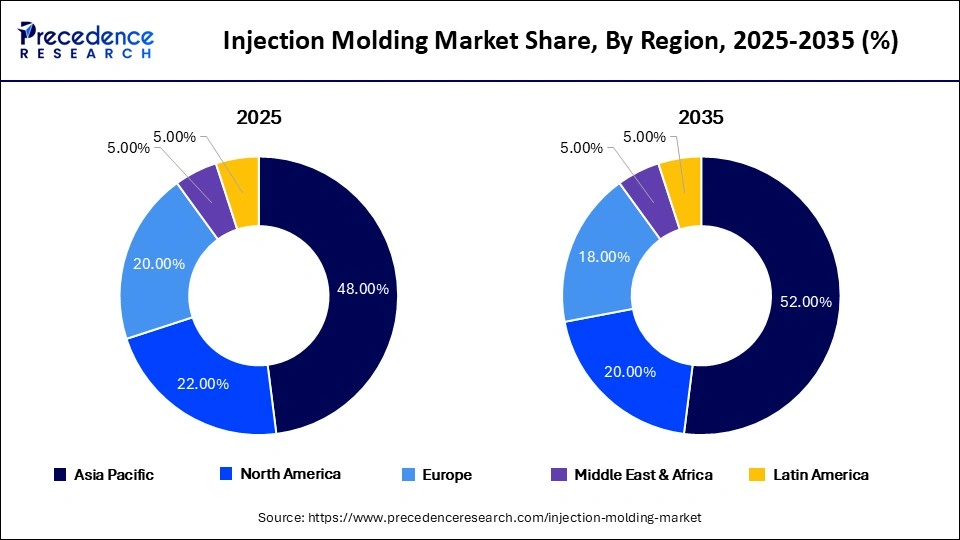
Asia-Pacific remained the dominant regional market with 48% share in 2025 and is expected to grow at the fastest CAGR of 7.2%.
The region benefits from:
- Strong manufacturing infrastructure
- Availability of low-cost labor
- Large-scale plastic production
- Rapid industrialization
- Expanding automotive and electronics sectors
China continues to lead regional growth due to its dominance in EV production, electronics manufacturing, and advanced industrial automation.
Asia-Pacific Market Size
| Year | Market Value |
|---|---|
| 2025 | USD 160.80 Billion |
| 2035 | USD 285.52 Billion |
North America is emerging as a strong growth market due to increasing investments in smart manufacturing, robotics, and AI-driven production systems.
The U.S. market is benefiting from reshoring initiatives, advanced manufacturing technologies, and strong R&D investments in high-performance materials.
Europe continues to demonstrate notable growth because of its advanced automotive and aerospace manufacturing industries.
Germany remains a major contributor owing to its strong industrial base, advanced engineering capabilities, and increasing adoption of precision injection molding technologies.
Recent Industry Breakthroughs
- In May 2025, HTI Plastics showcased advanced pharmaceutical injection molding capabilities at CPHI North America.
- In April 2025, C&J Industries expanded its Class 8 clean room facility equipped with all-electric Toshiba molding presses and advanced robotics.
- In October 2024, Biomerics launched metal injection molding services focused on precision medical device manufacturing.
Leading Companies in the Injection Molding Market
- Husky Technologies
- ENGEL
- ARBURG
- Milacron
- Sumitomo Heavy Industries
- Nissei Plastic Industrial
- KraussMaffei
- Shibaura Machine
- Yizumi
Expert Perspective
“Injection molding is rapidly transitioning from a traditional manufacturing process into an intelligent, AI-driven ecosystem. As sustainability, lightweighting, and automation become central priorities for global industries, manufacturers that invest in smart molding technologies and recyclable materials will gain long-term competitive advantages.”
— Principal Consultant at Precedence Research
Segments Covered in the Report
By Material
- Plastic
- Metal
- Rubber
- Ceramic
By Machine Type
- Hydraulic Injection Molding Machines
- Electric Injection Molding Machines
- Hybrid Injection Molding Machines
By Process
- Thermoplastic Injection Molding
- Thermoset Injection Molding
- Liquid Silicone Rubber Injection Molding
By Application
- Packaging
- Automotive
- Consumer Goods
- Electronics
- Healthcare
- Construction
By End-Use Industry
- Automotive
- Packaging
- Electronics & Electrical
- Medical Devices
- Consumer Products
- Industrial Manufacturing
By Clamping Force
- Below 200 Tons
- 200-500 Tons
- Above 500 Tons
By Region
- North America
- Latin America
- Europe
- Asia-pacific
- Middle and East Africa
Also Read: Soft Magnetic Materials Market Size Worth USD 73.77 Billion by 2035
Get this report to explore global market size, share, CAGR, and trends, featuring detailed segmental analysis and an insightful competitive landscape overview @ https://www.precedenceresearch.com/sample/8410
You can place an order or ask any questions. Please feel free to contact us at sales@precedenceresearch.com |+1 804 441 9344
