
Bio-Based Chemical Market Size to Surpass USD 278.49 Billion by 2035, Driven by Sustainable Manufacturing and Rising Demand for Green Alternatives
The global bio-based chemical market size was valued at USD 110.04 billion in 2025 and is projected to grow from USD 120.75 billion in 2026 to approximately USD 278.49 billion by 2035, expanding at a CAGR of 9.73% during the forecast period from 2026 to 2035.
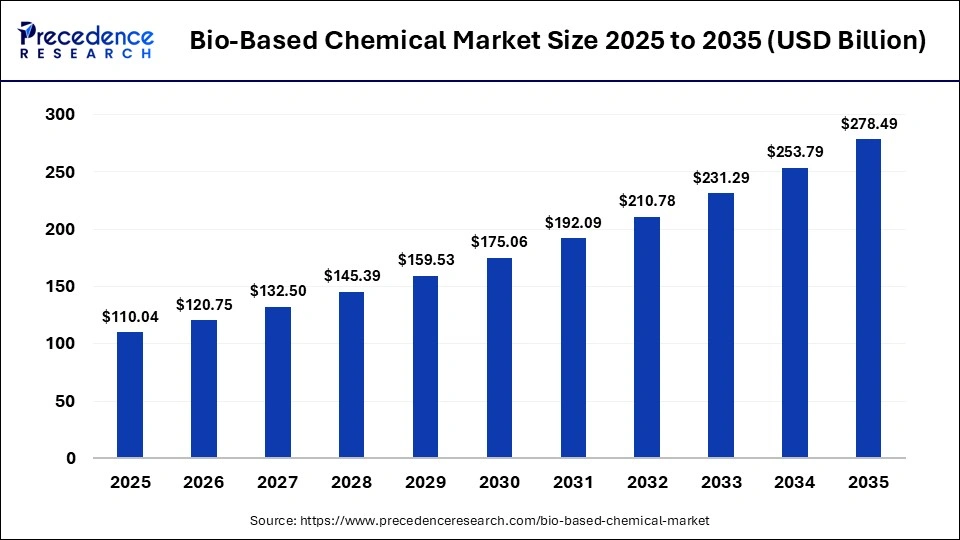
The market’s growth is strongly supported by increasing environmental regulations, rising carbon neutrality initiatives, growing demand for biodegradable products, and the rapid expansion of bio-refinery technologies. Governments and manufacturers worldwide are investing heavily in renewable feedstocks and sustainable chemical production to reduce dependence on fossil fuels and lower industrial carbon emissions.
Bio-Based Chemical Market Key Points
- Europe accounted for the largest market share of 50% in 2025 due to strong sustainability regulations and aggressive carbon reduction targets.
- Asia Pacific is anticipated to witness the fastest CAGR during the forecast period because of rapid industrialization and rising demand for eco-friendly materials.
- The platform chemicals segment dominated the market in 2025 owing to its extensive usage across industrial and pharmaceutical applications.
- Polymers for plastics are projected to register the highest growth rate between 2026 and 2035.
- Agricultural applications led the market in 2025 as governments promoted organic farming and biofertilizers.
- Industrial applications are expected to expand rapidly due to increasing use of sustainable coatings, lubricants, and polymers.
- Major companies are investing in bio-refinery innovations, circular economy initiatives, and advanced bio-based polymer production technologies.
What is Driving the Rapid Growth of the Bio-Based Chemical Market?
The increasing global concern regarding climate change and environmental degradation has significantly accelerated the shift from petrochemical-based products to renewable alternatives. Bio-based chemicals are manufactured using renewable biomass feedstocks such as agricultural crops, forestry materials, algae, sugars, starches, and plant oils, making them environmentally sustainable and biodegradable.
Industries are increasingly adopting bio-based chemicals to comply with stringent environmental policies and sustainability commitments. Governments across Europe, North America, and Asia are implementing strict carbon emission regulations and promoting circular economy frameworks, which are creating strong demand for green chemicals.
Another major factor supporting market expansion is the increasing consumer preference for sustainable products, especially in packaging, cosmetics, detergents, textiles, and personal care applications. Companies are also shifting toward renewable feedstocks to reduce volatility associated with fossil fuel prices and supply chain disruptions.
Bio-Based Chemical Market Size Overview
| Market Indicator | Value |
|---|---|
| Market Size 2025 | USD 110.04 Billion |
| Market Size 2026 | USD 120.75 Billion |
| Forecast Market Size 2035 | USD 278.49 Billion |
| CAGR (2026-2035) | 9.73% |
| Dominating Region | Europe |
| Fastest Growing Region | Asia Pacific |
| Leading Product Segment | Platform Chemicals |
| Fastest Growing Product Segment | Polymers for Plastics |
| Leading Application | Agricultural |
| Fastest Growing Application | Industrial |
How is AI Transforming the Bio-Based Chemical Market?
Artificial Intelligence has emerged as a transformative technology across the bio-based chemical industry. AI-powered systems are increasingly being used to optimize biomass conversion processes, improve production efficiency, and reduce operational costs across bio-refineries.
Advanced AI algorithms help manufacturers predict chemical reactions, optimize fermentation conditions, and improve feedstock utilization. This significantly minimizes waste generation while maximizing production yields. AI also supports dynamic process monitoring in applications such as anaerobic digestion and biochemical processing.
Additionally, AI-driven predictive maintenance systems are improving plant safety and operational reliability by identifying equipment failures before they occur. Machine learning models are also reducing the need for expensive trial-and-error experimentation, enabling faster commercialization of innovative bio-based products.
Why are Bioplastics Becoming a Major Trend in the Industry?
The rising adoption of bioplastics and sustainable polymers has become one of the most influential trends shaping the market landscape.
Traditional plastics continue to face severe criticism because of environmental pollution and non-biodegradability. As a result, manufacturers are rapidly shifting toward bio-based plastics that offer lower carbon footprints and improved recyclability.
Industries such as packaging, healthcare, automotive, and consumer goods are actively incorporating biodegradable polymers into their product lines to meet sustainability targets and comply with evolving environmental regulations.
The demand for bio-based coatings, adhesives, dyes, and surfactants is also rising significantly as manufacturers seek eco-friendly alternatives that deliver high performance while minimizing environmental impact.
Can Renewable Feedstocks Replace Petroleum-Based Chemicals?
Renewable feedstocks are increasingly being viewed as a long-term alternative to fossil fuel-derived raw materials.
Agricultural residues, plant oils, algae, starches, sugars, and forestry waste are becoming critical feedstocks for sustainable chemical production. Unlike petroleum resources, these materials are renewable, biodegradable, and environmentally friendly.
The transition toward renewable feedstocks is also supporting the development of circular economy ecosystems where waste materials are reused and converted into valuable chemicals and fuels. This not only reduces landfill waste but also lowers greenhouse gas emissions across industrial supply chains.
Bio-Based Chemical Market Segment Analysis
By Product Category
The platform chemicals segment held the dominant market position in 2025 due to its broad applicability across pharmaceuticals, manufacturing, industrial processing, and personal care sectors.
Platform chemicals act as intermediate molecular building blocks that can be converted into polymers, solvents, coatings, and specialized industrial materials. The growing demand for renewable industrial chemicals significantly contributed to segment expansion.
The polymers for plastics segment is projected to witness the fastest growth during the forecast period because of rising demand for biodegradable and non-toxic alternatives to conventional plastics.
Manufacturers worldwide are increasingly adopting bio-based polymers to reduce carbon emissions and comply with stricter environmental regulations regarding plastic waste management.
By Application
Agricultural applications dominated the market in 2025 due to increasing demand for biofertilizers, biopesticides, and sustainable farming solutions.
Governments worldwide are encouraging organic farming practices while restricting the use of harmful petrochemical pesticides and fertilizers. Growing awareness regarding food safety and environmental protection is further supporting the adoption of bio-based agricultural chemicals.
Industrial applications are projected to grow at a substantial pace as manufacturers increasingly adopt bio-based lubricants, coatings, adhesives, and polymers across automotive, textile, and construction industries.
The industrial sector is actively focusing on decarbonization and sustainable manufacturing, which is accelerating the integration of renewable chemicals into production processes.
Bio-Based Chemical Market Regional Analysis
Europe dominated the global market in 2025 and is expected to maintain its leadership throughout the forecast period.
The region’s strong market position is supported by:
- Strict environmental regulations
- Aggressive carbon neutrality goals
- European Green Deal initiatives
- High consumer awareness regarding sustainability
- Strong research and innovation ecosystem
The Europe bio-based chemicals market is projected to grow from USD 55.02 billion in 2025 to USD 140.64 billion by 2035 at a CAGR of 9.84%.
Germany emerged as the leading market within Europe due to its advanced industrial base, robust R&D ecosystem, and government support for renewable materials.
Germany is also one of the largest producers of bio-based polymers and continues to invest heavily in sustainable chemical innovations and large-scale industrial bio-refinery projects.
Asia Pacific is expected to witness the fastest growth during the forecast period because of abundant biomass availability, rapid industrialization, and rising environmental awareness.
Governments across the region are implementing strict carbon reduction initiatives while promoting biodegradable packaging and sustainable industrial materials.
China is anticipated to emerge as a major growth engine for the global market due to strong industrial expansion and ambitious carbon neutrality targets.
The country’s focus on reducing plastic pollution and replacing non-degradable products with biodegradable alternatives is accelerating market development. Increasing investments in R&D and sustainable manufacturing technologies are also supporting growth.
Bio-Based Chemical Market Value Chain Analysis
Feedstock Procurement
This stage involves sourcing renewable biomass materials such as agricultural crops, forestry products, oils, and organic waste.
Major Companies Involved
- Archer Daniels Midland Company
- Cargill Incorporated
- Stora Enso
Chemical Synthesis and Processing
This stage includes fermentation, catalytic conversion, enzymatic processing, and integrated bio-refinery operations.
Major Companies Involved
- BASF SE
- Evonik Industries AG
- Mitsubishi Chemical Group Corporation
Compound Formulation and Blending
This process converts bio-derived chemicals into end-use materials such as bioplastics and bio-solvents.
Major Companies Involved
- Braskem
- Corbion N.V.
- DuPont
Latest Innovations in the Bio-Based Chemical Market
The industry is witnessing rapid innovation as major companies invest in large-scale sustainable chemical production technologies.
In April 2025, Michelin announced the launch of its CERISEA project to produce 5-HMF (5-Hydroxymethylfurfural), a bio-sourced molecule used in green chemistry applications. The project is expected to establish the world’s largest HMF production facility with an annual production capacity of 3,000 metric tons.
In October 2025, Braskem introduced a new portfolio of bio-based and circular polymer solutions focused on sustainable packaging, healthcare, hygiene, and consumer goods applications.
Major Companies Operating in the Bio-Based Chemical Market
- BASF SE
- Braskem
- DuPont
- Cargill Incorporated
- Evonik Industries AG
- Corbion N.V.
- Mitsubishi Chemical Group Corporation
- Archer Daniels Midland Company
- Novozymes
- NatureWorks LLC
- Novamont
- Total Corbion PLA
- Arkema
- Biome Bioplastics
- DSM
- PTT Global Chemical
- GFBiochemicals Ltd.
Segment Covered in The Report
By Product Category
- Platform Chemicals
- Polymers for Plastics
- Paints, Coatings, Inks & Dyes
- Surfactants
- Cosmetics & Personal Care Products
- Adhesives
- Man-Made Fibers
- Others
By Application
- Industrial
- Agricultural
- Pharmaceutical
- Others
By Region
- North America
- Europe
- Asia-Pacific
- Latin America
- Middle East & Africa
Read Also: Soft Magnetic Materials Market Size Worth USD 73.77 Billion by 2035
Get this report to explore global market size, share, CAGR, and trends, featuring detailed segmental analysis and an insightful competitive landscape overview @ https://www.precedenceresearch.com/sample/7515
You can place an order or ask any questions. Please feel free to contact us at sales@precedenceresearch.com |+1 804 441 9344