
Sustainable Construction Chemicals Market Size to Reach USD 145.09 Billion by 2035, Driven by Green Building Regulations and Low-Carbon Construction Solutions
The global sustainable construction chemicals market size was valued at USD 77.15 billion in 2025 and is projected to increase from USD 82.18 billion in 2026 to approximately USD 145.09 billion by 2035, expanding at a CAGR of 6.52% from 2026 to 2035. The market is experiencing robust growth as governments, developers, and infrastructure planners increasingly prioritize environmentally responsible construction practices. Growing pressure to reduce carbon emissions, improve building durability, optimize cement usage, and comply with green building certifications is accelerating adoption of sustainable construction chemicals across residential, commercial, and infrastructure projects worldwide.
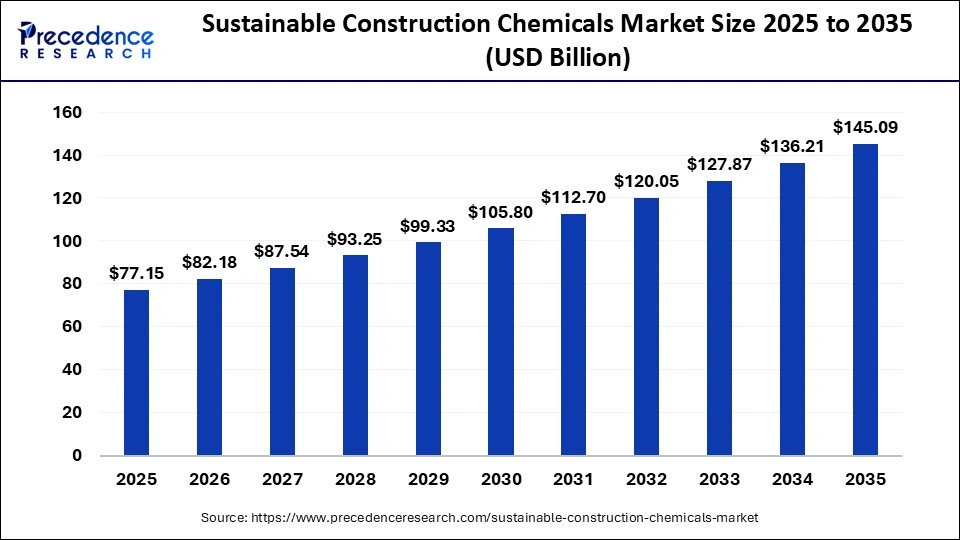
The market is further benefiting from rapid urbanization, smart city initiatives, stringent environmental regulations, and increased investment in resilient infrastructure. Sustainable construction chemicals are becoming critical components in modern construction because they improve structural performance while simultaneously reducing environmental impact throughout the building lifecycle.
Sustainable Construction Chemicals Market Key Points
• The global sustainable construction chemicals market was valued at USD 77.15 billion in 2025 and is expected to reach USD 145.09 billion by 2035.
• The market is projected to expand at a CAGR of 6.52% between 2026 and 2035.
• Asia Pacific emerged as the largest regional market, accounting for 38% of global revenue in 2025.
• Middle East & Africa is forecast to witness the fastest growth, expanding at approximately 13% CAGR through 2035.
• Concrete admixtures dominated the product type category with a 33% market share in 2025.
• Polymer-based chemicals captured 40% of the global market due to their versatility and durability.
• Infrastructure and transportation projects accounted for 35% of total market demand.
• Low VOC and green-certified products remained the most preferred sustainability feature across global construction projects.
• BASF SE continues to be recognized as one of the most influential investors and innovators supporting sustainable construction chemical technologies.
Sustainable Construction Chemicals Market Revenue Outlook
| Market Indicator | Value |
|---|---|
| Market Size 2025 | USD 77.15 Billion |
| Market Size 2026 | USD 82.18 Billion |
| Forecast Market Size 2035 | USD 145.09 Billion |
| CAGR (2026-2035) | 6.52% |
| Leading Region | Asia Pacific |
| Fastest Growing Region | Middle East & Africa |
| Leading Product Type | Concrete Admixtures |
| Leading Chemical Type | Polymer-Based Chemicals |
What Is Driving the Global Shift Toward Sustainable Construction Chemicals?
Sustainable construction chemicals refer to specialized formulations designed to improve building performance, extend service life, reduce maintenance requirements, and minimize environmental impact. These products include low-VOC admixtures, waterproofing solutions, eco-friendly sealants, protective coatings, flooring compounds, grouts, repair mortars, and bio-based chemical formulations.
The construction industry is undergoing a significant transformation as stakeholders seek ways to lower carbon emissions while maintaining structural integrity and economic viability. Sustainable construction chemicals enable reduced cement consumption, optimized water usage, improved energy efficiency, and longer-lasting structures, making them essential tools for achieving global sustainability objectives.
How Is Artificial Intelligence Transforming the Sustainable Construction Chemicals Industry?
Artificial intelligence is increasingly helping manufacturers formulate next-generation sustainable construction chemicals with improved performance characteristics and reduced environmental footprints. AI-driven material modeling platforms can analyze thousands of chemical combinations and predict durability, strength, curing behavior, and environmental performance before physical testing begins. This significantly reduces development time and accelerates commercialization of innovative green formulations.
In addition, AI-powered lifecycle assessment tools are enabling construction companies to evaluate embodied carbon, maintenance requirements, and long-term sustainability impacts of different chemical solutions. These technologies help developers select optimal materials that support green building certifications while maximizing project efficiency and cost savings.
What Are the Major Growth Factors Supporting Market Expansion?
Increasing Adoption of Green Building Certifications
The growing popularity of LEED, BREEAM, IGBC, and other sustainability certification programs is driving demand for environmentally friendly construction materials. Developers increasingly rely on sustainable chemicals to achieve certification requirements and improve property value.
Rising Infrastructure Development Worldwide
Massive investments in transportation corridors, smart cities, industrial parks, airports, railways, and urban redevelopment projects are generating substantial demand for high-performance sustainable chemical solutions.
Growing Regulatory Pressure
Governments worldwide are implementing stricter environmental regulations regarding emissions, VOC content, energy efficiency, and lifecycle sustainability. These policies are encouraging widespread adoption of greener construction materials.
Advancements in Green Chemistry
Innovations in bio-based formulations, nano-enhanced materials, and self-healing technologies are expanding application possibilities while improving sustainability performance.
What Emerging Opportunities Are Reshaping the Sustainable Construction Chemicals Market?
Can Bio-Based Construction Chemicals Become the Industry Standard?
Bio-derived chemicals are gaining significant traction as construction companies seek alternatives to petroleum-based materials. Continuous improvements in performance characteristics are making bio-based products increasingly competitive with traditional solutions.
Will Self-Healing Construction Materials Transform Infrastructure Maintenance?
Self-healing concrete and coatings represent one of the most promising opportunities in the market. These intelligent materials automatically repair micro-cracks, reducing maintenance costs while extending infrastructure lifespan.
How Will Smart Cities Influence Market Demand?
The rapid expansion of smart city projects globally is creating substantial opportunities for sustainable construction chemicals that support energy-efficient, durable, and resilient infrastructure development.
Can Carbon-Neutral Construction Become Mainstream?
Carbon-reducing and carbon-neutral formulations are expected to become one of the fastest-growing segments as governments and developers intensify efforts to achieve net-zero emissions targets.
Expert Perspective
According to Precedence Research Principal Consultan
“Construction sustainability is no longer limited to energy-efficient buildings. Material selection has become equally important. Sustainable construction chemicals are enabling developers to achieve carbon reduction targets while improving durability, lowering lifecycle costs, and enhancing structural performance. We anticipate accelerated adoption of bio-based and carbon-neutral formulations throughout the forecast period.”
Sustainable Construction Chemicals Market Segment Analysis
Product Type Analysis
Concrete admixtures dominated the sustainable construction chemicals market in 2025, accounting for around 30–35% of total revenue. Their ability to improve concrete strength, durability, workability, water resistance, and setting time made them essential across infrastructure, residential, and commercial construction projects. Growing emphasis on sustainable infrastructure further boosted demand, as admixtures help reduce cement consumption, lower carbon emissions, and minimize material waste.
Bio-based and nano-enhanced specialty chemicals are expected to expand at a CAGR of around 14% through 2035. Increasing demand for environmentally friendly construction materials is driving adoption. These advanced chemicals offer benefits such as self-healing properties, enhanced durability, and greater resistance to environmental stress. Their renewable composition also supports sustainability goals by reducing dependence on petrochemical-based inputs.
Chemical Type Analysis
Polymer-based chemicals held approximately 40% of the market share in 2025. Their widespread use in admixtures, coatings, adhesives, sealants, and waterproofing applications contributed to their leadership position. These chemicals improve flexibility, bonding strength, moisture resistance, and overall material performance while supporting longer service life and lower maintenance costs.
Bio-derived and green chemicals are projected to witness strong growth at a CAGR of nearly 15% through 2035. Derived from renewable resources, these chemicals help reduce environmental impact and dependence on fossil-based raw materials. Their increasing use in coatings, adhesives, and admixtures aligns with rising green building standards and sustainability initiatives worldwide.
Application Analysis
Structural concrete enhancement accounted for nearly 40% of the market in 2025. Construction companies increasingly rely on sustainable chemicals to improve compressive strength, load-bearing capacity, and resistance to environmental damage. These solutions support the development of durable infrastructure while reducing lifecycle costs and material consumption.
The repairs and restoration segment is expected to grow at a CAGR of around 11% during the forecast period. Aging infrastructure, growing renovation activities, and the need to extend building lifespans are key factors driving demand. Sustainable repair solutions help preserve existing assets while minimizing demolition waste and environmental impact.
End-Use Sector Analysis
Infrastructure and transportation projects represented approximately 35% of the market in 2025. Government investments in roads, bridges, railways, and urban development projects continue to increase demand for sustainable construction chemicals. These products improve durability, efficiency, and environmental performance in large-scale construction projects.
The residential construction segment is expected to grow steadily, supported by increasing demand for healthy and energy-efficient living spaces. Sustainable construction chemicals are widely used in coatings, adhesives, flooring, and sealants to improve indoor air quality and comply with green building standards.
Sustainability Feature Analysis
Low-VOC and green-certified products captured nearly 45% of the market share in 2025. Their ability to reduce emissions, improve indoor air quality, and support environmental compliance has made them a preferred choice among builders and developers. Government regulations and green building certifications continue to strengthen adoption.
Carbon-reducing and carbon-neutral construction chemicals are projected to grow at around 15% CAGR through 2035. These products help lower cement consumption, energy usage, and overall project emissions, making them increasingly attractive for infrastructure and commercial construction projects focused on achieving climate goals.
Delivery Format Analysis
Liquid formulations dominated the market with a 52% share in 2025. Their ease of application, precise dosing capabilities, and compatibility with admixtures, coatings, and sealants have contributed to widespread adoption. They also help reduce material waste and support automated construction processes.
Pre-packaged and ready-mix systems are expected to grow at a CAGR of around 14% during the forecast period. These solutions improve consistency, minimize on-site mixing errors, reduce material wastage, and simplify logistics, making them increasingly popular in small and medium-sized construction projects.
Sales Channel Insights
Direct sales channels accounted for nearly 50% of the sustainable construction chemicals market in 2025. Large construction projects and EPC contracts often require customized solutions, technical support, and long-term supplier relationships, making direct sales the preferred distribution model.
Online and e-procurement platforms are expected to register a CAGR of approximately 17% through 2035. Digital procurement offers pricing transparency, product comparison, and streamlined purchasing processes. Growing digitalization across the construction sector is accelerating the adoption of online sales channels.
Sustainable Construction Chemicals Market Regional Analysis
Why Is Asia Pacific Leading the Sustainable Construction Chemicals Market?
Asia Pacific dominated the global market with around 38% share in 2025 and is projected to reach USD 55.86 billion by 2035, rising from USD 29.32 billion in 2025. Rapid urbanization, large-scale infrastructure investments, and supportive government policies promoting green construction are driving regional growth. Increasing adoption of low-VOC and energy-efficient construction materials is further strengthening market demand.
China Market Trends
China remains the largest contributor to regional growth due to extensive infrastructure development, strict green building regulations, and strong domestic manufacturing capabilities. Government initiatives promoting sustainable construction continue to increase demand for environmentally friendly construction chemicals.
Why Is the Middle East & Africa the Fastest-Growing Region?
The Middle East & Africa accounted for approximately 13% of the global market in 2025. Growth is supported by government-led infrastructure projects, sustainability-focused development plans, and stricter building regulations. Rising investments in smart cities, industrial zones, and transportation networks are creating significant opportunities for sustainable construction chemical suppliers.
UAE Market Trends
The UAE leads regional adoption through strong sustainability regulations and green building initiatives. Saudi Arabia is witnessing rapid growth through Vision 2030 projects, while Qatar, South Africa, and Egypt continue investing in sustainable infrastructure and urban development.
Why Is Europe Experiencing Steady Growth?
Europe remains a mature and highly regulated market driven by stringent environmental standards and strong sustainability commitments. Growing investments in energy-efficient buildings and renovation projects continue to support demand for sustainable construction chemicals across the region.
Germany Market Trends
Germany leads the European market due to its advanced construction industry and focus on energy-efficient infrastructure. France benefits from sustainability-focused government programs, while the UK, Italy, and Spain are witnessing increasing demand through green building projects and urban redevelopment initiatives.
Why Is Latin America Emerging as a Growth Market?
Latin America is experiencing strong growth due to rapid urbanization, infrastructure modernization, and increasing awareness of sustainable construction practices. Government support for green building initiatives and rising demand for affordable housing continue to boost market expansion.
Brazil Market Trends
Brazil leads the regional market through large-scale infrastructure projects, growing housing demand, and increasing adoption of eco-friendly construction materials. The country’s focus on energy-efficient buildings and climate-resilient infrastructure is further accelerating the use of sustainable construction chemicals.
Chile and Colombia Outlook
Chile is benefiting from strong sustainability regulations and urban planning initiatives, while Colombia is emerging as a promising market due to investments in transportation infrastructure, public facilities, and urban development projects.
Latest Industry Innovations and Corporate Developments
The market continues to witness significant innovation in bio-based chemistry, nano-enhanced materials, carbon-neutral additives, and intelligent self-healing technologies.
In December 2025, Pidilite strengthened its innovation strategy through Pidilite Professional Solutions (PPS), offering integrated construction solutions tailored to architects, builders, structural consultants, and contractors. The initiative focuses on enhancing project performance, sustainability, and lifecycle efficiency.
Leading Companies Operating in the Sustainable Construction Chemicals Market
• Schlumberger (SLB)
• Halliburton
• Baker Hughes
• TechnipFMC
• Veolia
• SUEZ
• Aker Solutions
• Siemens Energy
• Xylem
• Aquatech
• Frames Group
• Ovivo
• CETCO (Minerals Technologies)
• Aris Water Solutions
• ProSep
Key value-chain participants also include BASF SE and Holcim Ltd, particularly in feedstock procurement and sustainable formulation development
Segment Covered in the Report
By Product Type
- Concrete Admixtures
- Waterproofing Chemicals
- Sealants & Adhesives
- Protective Coatings & Paints
- Flooring Compounds
- Repair & Rehabilitation Chemicals
- Grouts & Anchors
- Specialty Chemicals (bio-based, nano-enhanced)/Reclaimed
By Chemical Type
- Polymer-Based Chemicals
- Silicate & Mineral-Based Chemicals
- Bio-Derived/Green Chemicals
- Nano-Technology Enhanced Chemicals
- Recycled/Reclaimed Content Chemicals
By Application
- Structural Concrete Enhancement
- Waterproofing & Damp Proofing
- Surface Protection & Coating
- Flooring & Tile Installation
- Repairs & Restoration
- Sealing & Bonding
- Roofing & Cladding
By End-Use Sector
- Residential Construction
- Commercial Buildings
- Industrial Construction
- Infrastructure & Transportation Projects
- Institutional Projects (schools, hospitals)
By Sustainability Feature
- Low VOC/Green Certified
- Recyclable/Reprocessable
- Energy-Efficient Formulations
- Carbon-Reducing/Carbon-Neutral Solutions
- Water-Efficient/Reduced Waste Formulations
By Delivery Format
- Liquid Formulations
- Powder/Solid Formulations
- Pre-Packaged/Ready-Mix Systems
By Sales/Distribution Channel
- Direct sales (Projects/EPC Contracts)
- Distributors & Dealers
- Online/E-Procurement Platforms
- Retail & Specialist Stores
By Region
- North America
- Europe
- Asia-Pacific
- Latin America
- Middle East and Africa
Read Also: Liquid Crystal Polymer Market Size to Worth USD 3.82 Billion by 2035
Get this report to explore global market size, share, CAGR, and trends, featuring detailed segmental analysis and an insightful competitive landscape overview @ https://www.precedenceresearch.com/sample/7273
You can place an order or ask any questions. Please feel free to contact us at sales@precedenceresearch.com |+1 804 441 9344

- Persulfates Market Revenue and Trends Analysis 2026–2035 - June 16, 2026
- 2-Methoxy-2-Methylheptane Market Size Worth USD 132.10 Million by 2035 Amid Rising Demand for Sustainable Fuel Additives and High-Purity Chemical Intermediates - June 15, 2026
- Citronellol Market Size Forecasted to Reach USD 2.54 Billion by 2035 as Demand for Natural Fragrance Ingredients Accelerates Worldwide - June 12, 2026
