

3D Printing Photopolymers Market Surges Toward USD 5.56 Billion by 2035 as AI, Precision Manufacturing, and Medical Innovation Accelerate Adoption
The global 3D Printing Photopolymers Market is witnessing rapid expansion as industries increasingly adopt additive manufacturing technologies for high-precision production, rapid prototyping, and customized healthcare applications. The market size was valued at USD 1.38 billion in 2025 and is forecasted to grow from USD 1.59 billion in 2026 to nearly USD 5.56 billion by 2035, registering a robust CAGR of 14.96% from 2026 to 2035.
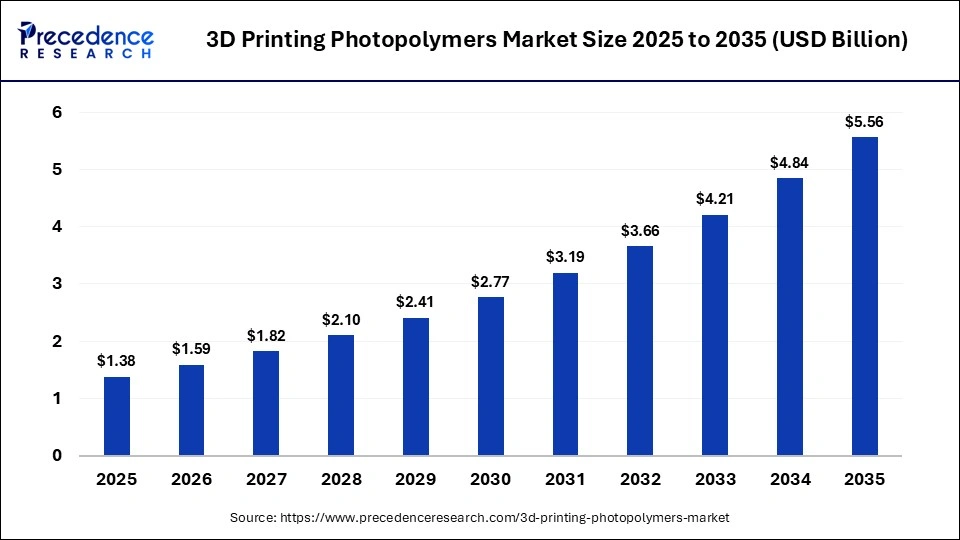
The growing preference for lightweight components, enhanced product customization, and digital manufacturing ecosystems is significantly transforming industrial production worldwide. Photopolymer-based 3D printing technologies are becoming indispensable across healthcare, automotive, aerospace, electronics, and consumer goods sectors due to their ability to deliver exceptional surface finish, dimensional accuracy, and complex geometrical structures.
3D Printing Photopolymers Market Key Points
- North America emerged as the dominant regional market by capturing 38.7% of global revenue in 2025, driven by strong adoption in healthcare, aerospace, and industrial prototyping.
- Asia Pacific is projected to witness the fastest growth at a CAGR of 15.5% between 2026 and 2035 due to manufacturing modernization and increasing investments in additive manufacturing.
- Standard photopolymers accounted for the largest revenue share of 44.1% in 2025 owing to their affordability and broad industrial compatibility.
- Stereolithography (SLA) technology dominated the market with a 54.5% share because of its high precision and reliable printing quality.
- Healthcare and dental applications represented 47.5% of total industry demand in 2025 as digital dentistry and customized medical devices gained traction globally.
- Dental and medical device applications are expected to emerge as one of the fastest-growing segments with a CAGR of 14.0% through 2035.
- Major industry participants including 3D Systems Corporation, Stratasys Ltd., BASF SE, Formlabs Inc., and Carbon, Inc. are heavily investing in advanced resin development and AI-integrated manufacturing systems.
Why is the 3D Printing Photopolymers Market Expanding So Rapidly?
The rapid expansion of the 3D printing photopolymers market is closely linked to the increasing shift toward precision-driven and digitally enabled manufacturing systems. Industries are under constant pressure to reduce production cycles, lower tooling costs, and accelerate product development timelines. Photopolymer-based additive manufacturing technologies effectively address these challenges by enabling manufacturers to produce highly detailed prototypes and functional components with minimal waste.
Another major growth driver is the healthcare sector’s accelerating adoption of patient-specific manufacturing. Dental aligners, crowns, surgical guides, orthopedic models, prosthetics, and customized medical devices increasingly rely on biocompatible photopolymer resins. The ability to create highly accurate, personalized healthcare solutions is fundamentally transforming modern treatment approaches and boosting resin demand globally.
Furthermore, continuous advancements in resin chemistry are improving mechanical strength, thermal resistance, flexibility, and biocompatibility, enabling photopolymers to move beyond prototyping into end-use manufacturing applications.
How is Artificial Intelligence Transforming the 3D Printing Photopolymers Industry?
Artificial intelligence is playing a transformative role across the entire additive manufacturing value chain. AI-powered printing systems are now capable of optimizing layer thickness, curing exposure, support structures, and print orientation in real time, dramatically improving print accuracy and minimizing defects. Computer vision-enabled quality inspection systems further enhance manufacturing efficiency by identifying errors during production before they become costly failures.
AI is also revolutionizing predictive maintenance for industrial 3D printers. Advanced algorithms can monitor UV lamp degradation, resin quality, and machine performance to reduce downtime and improve production continuity. This is particularly important for high-volume dental and healthcare production environments where consistency and speed are critical.
Beyond manufacturing optimization, AI is accelerating next-generation photopolymer development. Machine learning models can analyze resin behavior under varying stress and curing conditions to predict durability, flexibility, heat resistance, and biocompatibility before physical testing occurs. This significantly shortens research cycles and lowers development costs for advanced industrial and medical-grade materials.
Market Outlook: What Does the Future Hold for the Industry?
The future of the 3D printing photopolymers market appears highly promising as industries increasingly integrate digital manufacturing technologies into mainstream production workflows. Growing investments in Industry 4.0, smart manufacturing, and automation are expected to further expand the adoption of additive manufacturing systems worldwide.
The rising demand for sustainable and recyclable photopolymer formulations is also shaping future product innovation. Manufacturers are focusing on low-toxicity, bio-based, and recyclable resin technologies to align with evolving environmental regulations and sustainability goals.
Additionally, the increasing commercialization of high-speed printing systems and hybrid manufacturing platforms is expected to unlock new opportunities for mass customization, small-batch production, and decentralized manufacturing models.
3D Printing Photopolymers Market Revenue Snapshot
| Market Indicator | Value |
|---|---|
| Market Size in 2025 | USD 1.38 Billion |
| Market Size in 2026 | USD 1.59 Billion |
| Forecast Market Size by 2035 | USD 5.56 Billion |
| CAGR (2026–2035) | 14.96% |
| Dominating Region | North America |
| Fastest Growing Region | Asia Pacific |
3D Printing Photopolymers Market Segmental Outlook
Material/Resin Type Insights
The standard photopolymers segment accounted for 44.1% of the market share in 2025. Its dominance was driven by the extensive use of these materials in prototyping, conceptual modeling, and low-stress functional parts. Their affordability, compatibility with multiple printer brands, and availability in rigid, transparent, and colored resin options supported strong adoption among small- and medium-scale users. Continuous improvements in resin formulations, including enhanced dimensional stability and reduced brittleness, also improved printing reliability and productivity.
The biocompatible and medical-grade resins segment held a 13.7% market share in 2025 and emerged as one of the fastest-growing categories. Rising applications in dental products, orthopedic solutions, and customized healthcare devices significantly boosted demand. These advanced photopolymers are widely used for surgical guides, crowns, aligners, anatomical models, and medical device components. Improvements in cytocompatibility, wear resistance, and sterilization stability further expanded their clinical usage.
Technology Insights
The stereolithography (SLA) segment captured 54.5% of the market share in 2025 due to its ability to produce highly precise components with superior surface quality and dimensional accuracy. SLA technology supports a wide variety of resin materials, including engineering-grade and biocompatible resins, making it suitable for diverse industries. Advancements in resin chemistry, printing speed, and system reliability also strengthened its market position across dental clinics, service bureaus, and design studios.
The PolyJet/multi-jet printing segment accounted for 13.8% of the market in 2025. Its growth was supported by the capability to print multi-material and multi-color parts in a single build. The technology is increasingly used in medical modeling, advanced prototyping, and design validation because it enables realistic finishes, transparency effects, and flexible-rigid material combinations. Innovations in elastomeric and engineering-grade resins also accelerated adoption.
Application Insights
The prototyping and concept models segment dominated the 3D printing photopolymers market with a 46.2% share in 2025. Photopolymers are highly preferred for creating visually detailed and functional prototypes due to their fine resolution, smooth surface finish, and ability to replicate complex geometries. Industries such as automotive, consumer electronics, industrial manufacturing, and consumer goods rely heavily on these materials for design testing, fit analysis, and aesthetic evaluation before mass production.
The dental and medical devices segment represented 14.0% of the market share and is expected to witness significant growth. Increasing digitalization in dentistry and the growing demand for customized medical products are supporting adoption. Photopolymer materials are widely used for dental aligners, crowns, surgical guides, prosthetics, and anatomical models. Advancements in medical-grade resin chemistry, including improved biosafety and mechanical strength, continue to broaden application opportunities.
End-User Industry Insights
The healthcare and dental segment accounted for 47.5% of the market share in 2025. The increasing use of photopolymer-based 3D printing in clinical modeling, dental restoration, and personalized treatment planning strongly contributed to growth. The adoption of digital dentistry, orthodontics, and implantology procedures further accelerated material demand. Biocompatible and certified photopolymers also enabled safer clinical applications while reducing production costs and material wastage.
The automotive segment held a 14.2% share and is projected to grow at a significant CAGR over the forecast period. Automotive manufacturers are increasingly using SLA and DLP printing technologies to accelerate product development cycles. High-resolution photopolymers help improve design validation, fit testing, and engineering analysis while reducing development costs. Growing investments in electric vehicle platforms and additive manufacturing technologies are further supporting market expansion.
3D Printing Photopolymers Market Regional Outlook
North America dominated the global 3D printing photopolymers market with a 38.7% share in 2025. The region benefits from advanced additive manufacturing infrastructure, high R&D investments, and widespread industrial adoption. Strong demand from healthcare, aerospace, dental, and prototyping industries has fueled the use of precision photopolymer materials for customized parts and functional models.
The U.S. market was valued at USD 400.55 million in 2025 and is expected to reach nearly USD 1,624.55 million by 2035. Strong adoption across dental laboratories, aerospace prototyping, orthopedic modeling, and electronics manufacturing has positioned the country as a major growth contributor. Advancements in resin performance, automation, and AI-driven printing systems are further enhancing market opportunities.
Asia Pacific held a 15.5% market share and is witnessing the fastest growth due to expanding manufacturing capabilities, supportive government policies, and rising adoption of digital production technologies. Countries such as China, Japan, South Korea, and India are heavily investing in industrial automation, healthcare infrastructure, and electronics manufacturing, all of which rely on photopolymer-based 3D printing solutions.
China is rapidly expanding its 3D printing photopolymers industry through strong government-backed industrial digitalization programs and rising demand from healthcare, consumer electronics, and automotive sectors. Local manufacturers are increasing production of cost-effective SLA and DLP printers along with advanced resin technologies, supporting both prototyping and small-scale production.
Europe is experiencing steady growth due to strong adoption in healthcare, dental laboratories, and precision engineering industries. The region emphasizes material safety, regulatory compliance, and quality certification, which is accelerating the development of advanced biocompatible and engineering-grade photopolymers. Countries such as Germany, the UK, France, and Italy are investing heavily in additive manufacturing research and innovation.
The UK market is growing steadily due to increasing adoption in dental technology, aerospace prototyping, and medical modeling. Universities, research centers, and innovation programs are actively contributing to the development of high-performance and specialized photopolymer materials.
The Middle East & Africa market is expanding due to rising investments in healthcare infrastructure, industrial modernization, and digital manufacturing technologies. Countries including the UAE, Saudi Arabia, and South Africa are increasingly adopting photopolymer-based 3D printing for dental restorations, architecture, and customized components.
Latin America is witnessing rapid growth due to rising adoption in orthodontics, dental laboratories, educational institutions, and small-scale manufacturing. Countries such as Brazil, Mexico, Chile, and Colombia are investing in digital dentistry and medical modeling applications, creating strong demand for biocompatible photopolymer materials.
3D Printing Photopolymers Market Key Companies
3D Systems Corporation: SLA and Figure 4 photopolymers, including durable, flame-retardant, jewelry casting, and production-grade resins such as Accura and Figure 4 materials.
Stratasys Ltd.: Industrial photopolymer materials for its PolyJet and Origin platforms, including functional elastomers, medical-grade silicones, and other application-specific resins.
Henkel AG & Co. KGaA: LOCTITE-branded industrial photopolymer resins for SLA and vat polymerization, including high-performance open-material and production-use formulations.
Formlabs Inc.: Proprietary SLA resins across prototyping, engineering, dental, and medical applications, with a broad material library for Form printers.
BASF SE: Photopolymer resins through its additive manufacturing materials portfolio, typically positioned for industrial and functional applications.
Carbon, Inc.: UV-curable photopolymer resins for its Digital Light Synthesis platform, optimized for end-use parts, elastomers, and production manufacturing.
Materialise NV: 3D printing software and services, plus material-agnostic additive manufacturing support rather than a large standalone photopolymer resin portfolio.
Photocentric Ltd.: Photopolymer resins for LCD-based printing systems, often aimed at high-detail, high-throughput production and dental applications.
Bomar: Specialty photopolymer oligomers and resin components used as raw materials in UV-curable and 3D printing formulations.
Polysciences Inc.: Specialty chemicals and photopolymer resin ingredients used in resin formulation for additive manufacturing.
Ineos: Industrial chemicals and resin intermediates, including materials used in photopolymer and additive manufacturing formulations.
Röhm GmbH: Methacrylate-based materials and photopolymer raw materials used for additive manufacturing and industrial resin systems.
SOLTECH Ltd.: Photopolymer materials supplier with offerings for 3D printing resin applications.
Mohini Organics Pvt. Ltd.: Specialty chemicals and resin ingredients used in photopolymer manufacturing.
Fushun Donglian Anxin Chemical Co., Ltd.: Chemical and resin materials supplier involved in photopolymer raw materials for additive manufacturing.
Latest Industry Developments Reshaping the Market
In November 2025, Nexa3D partnered with BASF SE to introduce three advanced photopolymer materials for the NXE 400 stereolithography platform. These materials are designed for high-performance housings, packaging products, footwear components, and industrial enclosures.
In June 2024, UnionTech showcased next-generation additive manufacturing systems at Rapid+TCT 2024 in Los Angeles, highlighting advancements in industrial productivity, material versatility, and application-specific 3D printing solutions.
Segments Covered in the Report
By Material/Resin Type
- Standard Photopolymers
- Flexible Photopolymers
- High-Temperature Photopolymers
- Biocompatible/Medical-Grade Resins
- Casting Photopolymers
By Technology
- Stereolithography (SLA)
- Digital Light Processing (DLP)
- PolyJet/Multi-Jet
By Application
- Prototyping & Concept Models
- End-Use Parts & Functional Components
- Dental & Medical Devices
- Jewelry & Art
By End-User Industry
- Healthcare & Dental
- Automotive
- Aerospace & Defense
- Consumer Electronics & Goods
By Region
- North America
- Europe
- Asia-Pacific
- Latin America
- Middle East & Africa
Read Also: Hyaluronic Acid Raw Material Market Surges Toward USD 12.33 Billion by 2035
Get this report to explore global market size, share, CAGR, and trends, featuring detailed segmental analysis and an insightful competitive landscape overview @ https://www.precedenceresearch.com/sample/7300
You can place an order or ask any questions. Please feel free to contact us at sales@precedenceresearch.com |+1 804 441 9344
