
Inorganic Scintillators Market Size Expected to Reach USD 1.52 Billion by 2035
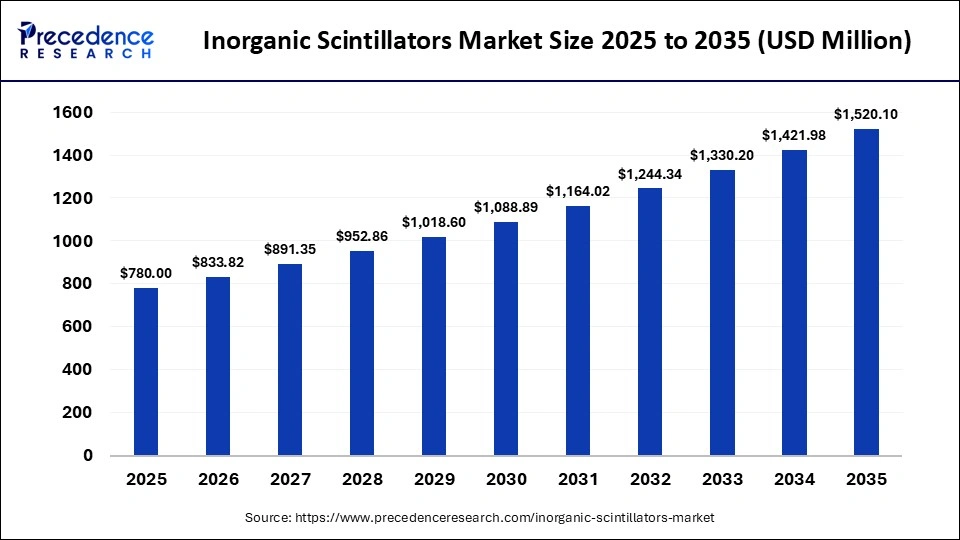
The global inorganic scintillators market size was valued at USD 780 million in 2025 and is expected to reach around USD 1.52 billion by 2035, expanding at a compound annual growth rate (CAGR) of 6.90% from 2026 to 2035. Key drivers behind this growth include the increasing use of inorganic scintillators in medical imaging, radiation detection, and homeland security. Additionally, advancements in high-performance materials for enhanced sensitivity and accuracy are fueling demand, making this market a critical segment in several industries, including healthcare, nuclear energy, and environmental monitoring.
Inorganic Scintillators Market Key Highlights
- Market Value: The global inorganic scintillators market size was valued at USD 780 million in 2025 and is forecast to reach USD 1.52 billion by 2035.
- CAGR: The market is projected to grow at a 6.90% CAGR from 2026 to 2035.
- Top Region: North America led the market with a 38% share in 2025, with Asia Pacific expected to expand at the fastest growth rate of 8.8%.
- Top Player: Sodium iodide (NaI) dominated the market with a 35% share in 2025, while lutetium-based scintillators (LSO/LYSO) are set to grow at the fastest rate, with an 8.5% CAGR.
Artificial Intelligence: Revolutionizing Scintillator Development
AI has begun playing a pivotal role in transforming the inorganic scintillators market. By harnessing machine learning techniques, AI accelerates the exploration of new chemical compositions and material designs, addressing computational and data-related challenges. AI-driven advancements are enabling the creation of more efficient, safer, and highly sensitive scintillators that align with the latest data-driven technologies. These developments are particularly important for next-generation medical imaging systems and radiation detectors.
Market Growth Drivers: What’s Fuelling the Inorganic Scintillators Market?
Several factors are contributing to the rapid expansion of the inorganic scintillators market:
- Rising Demand in Medical Imaging: As diagnostic imaging techniques like PET, SPECT, and CT scans gain widespread adoption, the need for high-performance scintillators is increasing. These materials play an essential role in converting radiation into visible light for accurate imaging, making them indispensable in healthcare diagnostics.
- Increased Focus on Radiation Detection and Homeland Security: Inorganic scintillators are critical in radiation detection systems used by governments and defense agencies for nuclear safety, border security, and radiological threat detection. As concerns over nuclear threats grow, so does the need for reliable scintillation detectors.
- Technological Advancements in Scintillator Materials: The ongoing development of advanced scintillator materials, including perovskite nanocrystals, is driving innovation in applications such as X-ray imaging, high-energy physics, and environmental monitoring.
Opportunities and Trends in the Inorganic Scintillators Market
What are the emerging opportunities in the inorganic scintillators market?
Wearable X-Ray Detection: The rise of wearable X-ray detection technologies leveraging inorganic scintillators is opening new markets in medical imaging and portable radiation detection.
Perovskite Nanocrystals: The growing use of perovskite nanocrystals in scintillators is expected to revolutionize X-ray imaging and improve the overall performance of scintillation materials.
Environmental Monitoring: Scintillators are increasingly being used for environmental monitoring, such as detecting water pollutants and airborne particulate matter, promoting greater environmental safety.
How will these opportunities drive the market forward?
These opportunities are expected to provide increased avenues for innovation, particularly in mobile, cost-effective, and highly sensitive radiation detection technologies. New applications will likely expand the reach of inorganic scintillators into industries like energy, environmental science, and even consumer products.
Also Read: Unsaturated Polyester Resin Market Size to Surpass USD 33.00 Billion by 2035
Inorganic Scintillators Market Key Metrics
| Report Attributes | Details |
| Market Size in 2025 | USD 780.00 Million |
| Market Size in 2026 | USD 833.82 Million |
| Market Size by 2035 | USD 1,520.10 Million |
| Market Growth Rate from 2026 to 2035 | CAGR of 6.90% |
| Dominating Region | North America |
| Fastest Growing Region | Asia Pacific |
| Base Year | 2025 |
| Forecast Period | 2026 to 2035 |
| Segments Covered | Material Type, Application, End-Use, Detection Technology, and Region |
| Regions Covered | North America, Europe, Asia-Pacific, Latin America, and Middle East & Africa |
Inorganic Scintillators Market Regional Analysis
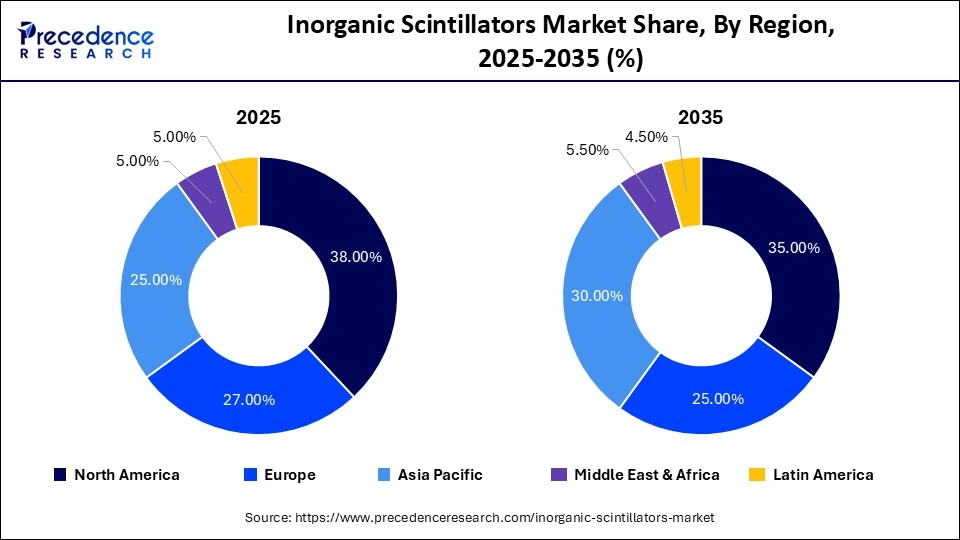
North America: Dominating the market with a 38% share in 2025, North America is expected to maintain its leadership due to robust healthcare infrastructure, strong research and development investments, and a supportive regulatory environment.
Asia Pacific: With a fast-growing CAGR of 8.8%, the Asia Pacific region is becoming a key player in the inorganic scintillators market. Expanding healthcare facilities and rising nuclear energy projects are driving this growth.
Europe: Holding a 27% share in 2025, Europe’s inorganic scintillators market is also growing steadily, supported by investments in nuclear safety and healthcare imaging systems.
Inorganic Scintillators Market Segmentation
By Material Type
Sodium Iodide (NaI) – Market Leader
Sodium iodide dominated the inorganic scintillators market in 2025 with a 35% share, primarily due to its cost-effectiveness, high light yield, and strong performance in radiation detection. Its high photon absorption efficiency makes it widely used in gamma cameras, PET scanners, and environmental monitoring systems.
Lutetium-based Scintillators (LSO/LYSO) – Fastest Growing
Holding a 20% share in 2025, lutetium-based scintillators are expected to grow at the fastest CAGR of 8.5%. Their high density, rapid decay time, and superior photon output make them ideal for advanced PET imaging, improving resolution and timing accuracy.
Cesium Iodide (CsI) – Durable and Efficient
Cesium iodide accounted for 20% of the market in 2025. Its durability, efficient gamma-ray detection, and application in digital imaging systems drive steady growth, supported by its excellent stopping power and mechanical strength.
Bismuth Germanate (BGO) – High-Energy Applications
BGO held around 15% market share in 2025, driven by its use in high-energy physics and medical imaging. Its high density and nonhygroscopic nature make it suitable for gamma radiation detection in demanding environments.
By Application
Medical Imaging – Dominant Segment
Medical imaging led the market with nearly 40% share in 2025 and is projected to grow at the fastest rate. The rising demand for PET, SPECT, and CT imaging systems, along with increasing chronic disease prevalence, is driving this segment.
Nuclear Power & Radiation Detection – Strong Demand
This segment held 25% market share in 2025. Growth is driven by the need for reliable radiation monitoring in nuclear facilities, especially in extreme environments requiring stable detection systems.
Homeland Security & Defense – Critical Use Case
Accounting for 15% of the market, this segment benefits from increasing use of scintillators in border security, airport screening, and threat detection systems.
High-Energy Physics Research – Innovation Driven
With a 10% share, this segment is fueled by research institutions using scintillators in particle detection and advanced experiments requiring fast response and precision.
By End-Use
Healthcare & Diagnostics – Leading Sector
This segment dominated with a 45% share in 2025 and is expected to grow the fastest. Scintillators are essential in PET and CT scanners, enabling accurate detection of radioactive tracers in medical diagnostics.
Energy & Nuclear Industry – Safety Focused
Holding a 20% share, this segment relies on scintillators for radiation monitoring and safety compliance in nuclear facilities and energy operations.
Defense & Security Agencies – Growing Adoption
With nearly 15% share, growth is driven by increased use of radiation detection systems in military and security applications.
Industrial Applications – Steady Growth
Industrial use accounted for about 10% of the market, driven by material testing, inspection, and radiation monitoring in industrial environments.
By Detection Technology
Photomultiplier Tube (PMT) Systems – Market Dominance
PMT-based systems led with a 55% share in 2025 due to their high sensitivity and widespread use across medical and industrial applications.
Silicon Photomultiplier (SiPM) Systems – Rapid Growth
SiPM systems held a 30% share and are projected to grow at the fastest CAGR of 9.5%, driven by compact size, high efficiency, and suitability for modern imaging technologies.
Hybrid Systems – Performance Optimization
With a 15% share, hybrid systems combine multiple detection technologies to enhance performance in specialized applications.
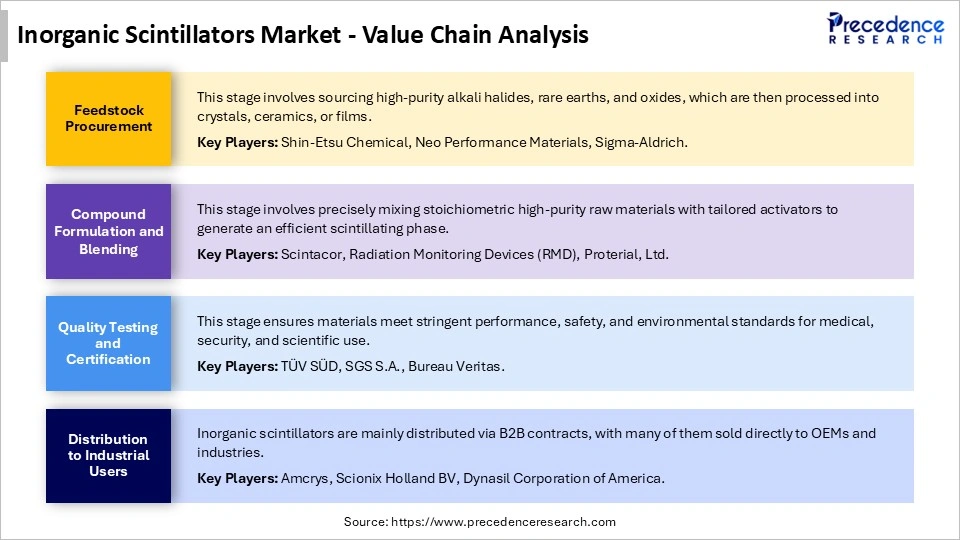
Inorganic Scintillators Market Value Chain Analysis
Recent Breakthroughs and Innovations
- Wearable X-Ray Detection: In 2025, a breakthrough study in flexible inorganic scintillator systems opened up new possibilities for wearable X-ray detection, which could significantly impact medical diagnostics and safety systems.
- 3D X-Ray Imaging: The development of organic-inorganic hybrid scintillators, enabling real-time dynamic and 3D X-ray imaging, marks a major step forward in medical imaging technologies.
Inorganic Scintillators Market Key Players
- Saint-Gobain Crystals
- Hamamatsu Photonics K.K.
- Hitachi Metals, Ltd.
- Amcrys-H Ltd.
- Rexon Components, Inc.
- Scionix Holland B.V.
- EPIC Crystal Company Limited
- Shanghai SICCAS High Technology Corporation
- Alpha Spectra, Inc.
- Dynasil Corporation of America
- Radiation Monitoring Devices, Inc.
- Korth Kristalle GmbH
- Zecotek Photonics Inc.
- Crytur, spol. s r.o.
- Detec Europe Ltd.
Segments Covered in the Report
By Material Type
- Sodium Iodide (NaI)
- Cesium Iodide (CsI)
- Bismuth Germanate (BGO)
- Lutetium-based Scintillators (LSO/LYSO)
- Other Advanced Inorganic Scintillators
By Application
- Medical Imaging (PET, SPECT, CT)
- Nuclear Power & Radiation Detection
- Homeland Security & Defense
- High Energy Physics Research
- Oil & Gas Exploration
By End-Use
- Healthcare & Diagnostics
- Energy & Nuclear Industry
- Defense & Security Agencies
- Research Institutes & Laboratories
- Industrial Applications
By Detection Technology
- Photomultiplier Tube (PMT)-based Systems
- Silicon Photomultiplier (SiPM)-based Systems
- Hybrid Detection Systems
By Region
- North America
- Latin America
- Europe
- Asia-pacific
- Middle and East Africa
Get this report to explore global market size, share, CAGR, and trends, featuring detailed segmental analysis and an insightful competitive landscape overview @ https://www.precedenceresearch.com/sample/8322
You can place an order or ask any questions. Please feel free to contact us at sales@precedenceresearch.com |+1 804 441 9344

- Persulfates Market Revenue and Trends Analysis 2026–2035 - June 16, 2026
- 2-Methoxy-2-Methylheptane Market Size Worth USD 132.10 Million by 2035 Amid Rising Demand for Sustainable Fuel Additives and High-Purity Chemical Intermediates - June 15, 2026
- Citronellol Market Size Forecasted to Reach USD 2.54 Billion by 2035 as Demand for Natural Fragrance Ingredients Accelerates Worldwide - June 12, 2026
