

Electrocoagulation Market Size to Surpass USD 13.94 Billion by 2035 Driven by increasing demands for efficient wastewater treatment solutions and stringent environmental regulations.
The global electrocoagulation market size was valued at USD 5.40 billion in 2025 and is projected surpass USD 13.94 billion by 2035, growing at a robust CAGR of 9.95% from 2026 to 2035.
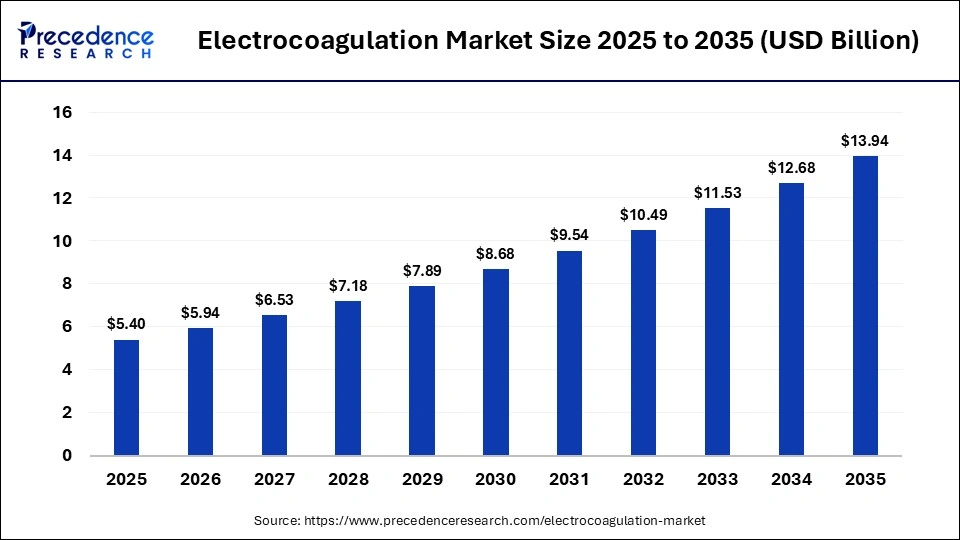
Electrocoagulation Market Key Insights
In 2025, North America led the global electrocoagulation market, accounting for 40% of the total share. Meanwhile, the Asia-Pacific region is poised to experience the highest growth rate (CAGR) during the forecast period
By contaminant type, inorganic contaminants held the largest market share in 2025. However, the biological contaminants segment is projected to grow at the fastest rate between 2026 and 2035.
In terms of application, wastewater treatment was the leading segment globally in 2025. The industrial effluent treatment sector, however, is expected to see the highest CAGR throughout the study period.
Regarding electrode material, the iron segment was dominant in 2025. Moving forward, the titanium segment is anticipated to witness significant expansion in the coming years.
The batch reactor segment captured the largest revenue share in 2025. However, the continuous flow reactor segment is expected to experience the fastest growth over the forecast period.
For current types, direct current (DC) contributed the largest share of market revenue in 2025. Nonetheless, alternating current (AC) is projected to gain the highest market share between 2026 and 2035.
Electrocoagulation Market Growth Drivers
As industries seek cost-effective alternatives for water purification, electrocoagulation, a chemical-free coagulation process that uses electricity, has emerged as a preferred choice. This method is particularly valued for its efficiency in removing contaminants such as suspended solids, oils, and heavy metals, making it ideal for wastewater treatment in municipal, industrial, and groundwater remediation applications.
Role of Artificial Intelligence in Electrocoagulation
Artificial intelligence (AI) is playing a transformative role in optimizing electrocoagulation processes. By integrating machine learning algorithms and real-time data analytics, AI helps in automating and optimizing water treatment parameters, such as voltage, current density, and load of contaminants. This real-time control not only improves treatment efficiency but also helps in predictive maintenance, ensuring that systems operate at peak performance with reduced energy consumption.
Opportunities and Trends in the Electrocoagulation Market
What opportunities exist in the electrocoagulation market?
The rising concerns about environmental pollution and stricter regulations around wastewater discharge provide significant opportunities for growth. Furthermore, sectors like oil & gas, food processing, and textiles are increasingly turning to electrocoagulation to meet their water treatment needs.
What trends are shaping the market?
The increasing demand for energy-efficient, eco-friendly solutions is driving the rise of electrocoagulation. AI-driven automation and the shift towards industrial effluent treatment are also significant trends to watch.
Electrocoagulation Market Metrics
| Report Coverage | Details |
| Market Size in 2025 | USD 5.40 Billion |
| Market Size in 2026 | USD 5.94 Billion |
| Market Size by 2035 | USD 13.94 Billion |
| Market Growth Rate from 2026 to 2035 | CAGR of 9.95% |
| Dominating Region | North America |
| Fastest Growing Region | Asia Pacific |
| Base Year | 2025 |
| Forecast Period | 2026 to 2035 |
| Segments Covered | Contaminant Type, Application, Electrode Material, Reactor Type, Current Type, and Region |
| Regions Covered | North America, Europe, Asia-Pacific, Latin America, and Middle East & Africa |
Electrocoagulation Market Segment Outlook
Contaminant Type Insights
Inorganic Contaminants Dominated the Market
The inorganic contaminants segment led the electrocoagulation market in 2025 due to its strong effectiveness in removing suspended solids, nitrates, phosphates, and chemical residues. These pollutants are commonly found in industrial effluents from mining, chemical, and manufacturing sectors. Electrocoagulation efficiently destabilizes and precipitates such contaminants with minimal chemical use, making it cost-effective and compliant with strict discharge regulations.
Biological Contaminants to Grow Rapidly
The biological contaminants segment is expected to grow at the fastest rate, driven by increasing concerns over toxic metals like arsenic, lead, cadmium, and chromium. Stricter environmental regulations and rising awareness of water toxicity are encouraging industries to adopt advanced treatment technologies such as electrocoagulation.
Application Insights
Wastewater Treatment Led the Market
Wastewater treatment held the largest market share in 2025, widely used across industries such as textile, oil & gas, food processing, and chemicals. Its cost-effectiveness, reduced sludge generation, and eco-friendly nature make it highly preferred. Increasing urbanization and stricter wastewater recycling regulations further support its dominance.
Industrial Effluent Treatment to Expand Significantly
The industrial effluent treatment segment is projected to grow rapidly due to rising industrial discharge and agricultural runoff. Electrocoagulation effectively removes contaminants like arsenic and fluoride, especially in groundwater. Increased investments in decentralized water treatment systems are further driving growth.
Electrode Material Insights
Iron Segment Dominated
Iron electrodes led the market in 2025 owing to their low cost, high efficiency, and wide applicability. They are highly effective in removing turbidity, organic matter, and heavy metals, making them suitable for large-scale wastewater treatment operations.
Titanium Segment to Witness Fast Growth
Titanium electrodes are expected to grow rapidly due to their superior corrosion resistance and longer lifespan. They perform well in harsh and saline wastewater conditions, offering stable and efficient operations despite higher initial costs.
Reactor Type Insights
Batch Reactors Held the Largest Share
Batch reactors dominated in 2025 due to their simplicity, flexibility, and suitability for small to medium-scale operations. Their low initial investment and ease of maintenance make them ideal for pilot projects and intermittent treatment.
Continuous Flow Reactors to Grow Rapidly
Continuous flow reactors are expected to expand significantly due to increasing demand for high-capacity industrial treatment. They enable continuous processing, improved efficiency, and scalability, especially when integrated with automation and smart monitoring systems.
Current Type Insights
Direct Current (DC) Dominated
The DC segment led the market in 2025 due to its stable and reliable performance. It ensures consistent coagulant generation and is widely compatible with commercial electrocoagulation systems.
Alternating Current (AC) to Grow Fastest
The AC segment is expected to grow rapidly as it reduces electrode passivation and enhances lifespan. It also offers potential energy efficiency benefits, with ongoing research focused on optimizing performance.
Also Read: MXene Market Size to Surpass USD 395.28 Billion by 2035
Electrocoagulation Market Regional Insights
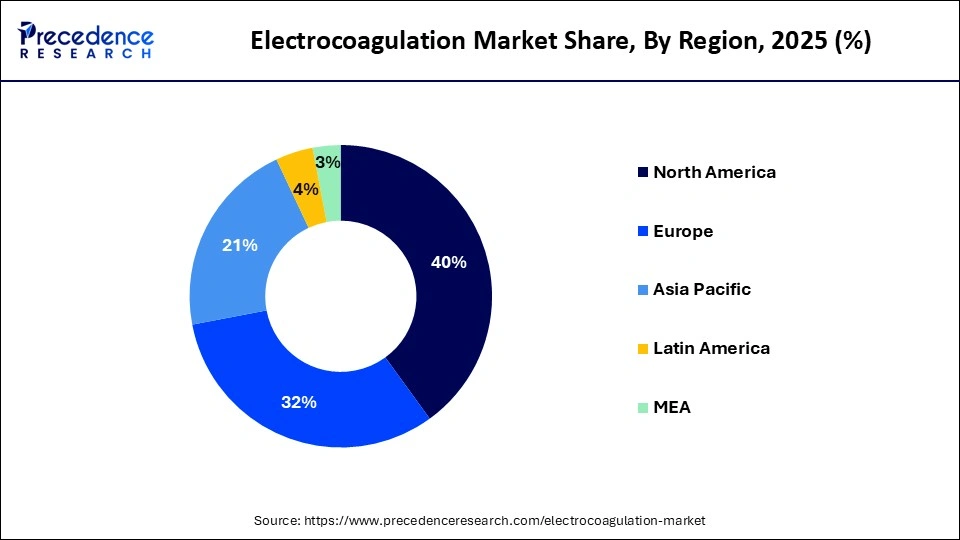
North America Led the Market
North America held the largest share in 2025 due to strict environmental regulations and advanced wastewater treatment infrastructure. Strong industrial demand, technological innovation, and government investments in water treatment modernization drive regional growth.
Asia-Pacific to Witness Fastest Growth
Asia-Pacific is projected to grow at the fastest rate due to rapid industrialization, urbanization, and increasing wastewater generation. Governments across countries like China and India are strengthening pollution control policies and investing in efficient treatment solutions.
Europe Shows Steady Growth
Europe is expected to grow steadily, supported by strict environmental directives and sustainability initiatives. Countries like Germany, France, and the UK are investing in advanced water treatment technologies and wastewater recycling programs, boosting market expansion.
Value Chain Analysis
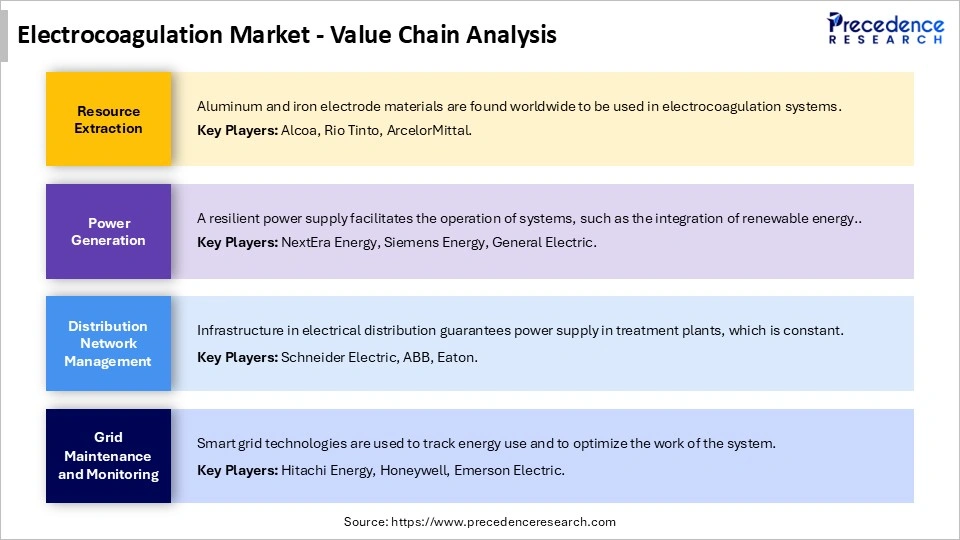
Key Companies in the Electrocoagulation Market
- Ecolab
- Veolia
- SUEZ
- Aqua-Aerobic Systems
- H2O Innovation
- Aqua-Chem
- Electrocoagulation Technologies
- Envirogen Technologies
- Hoganas
- WaterTectonics
- Water Vision
- Powell Water Systems
- Golder
- Genesis Water Technologies
- Nijhuis Industries
Segments Covered in the Report
By Contaminant Type
- Inorganic contaminants
- Metals
- Organic Contaminants
- Biological Contaminants
By Application
- Wastewater Treatment
- Industrial Effluent Treatment
- Drinking Water Treatment
- Groundwater Remediation
By Electrode Material
- Aluminum
- Iron
- Steel
- Titanium
- Carbon
By Reactor Type
- Batch Reactor
- Continuous Flow Reactor
- Electroflotation Reactor
- Slurry Reactor
By Current Type
- Direct Current (DC)
- Alternating Current (AC)
- Pulsed Current
By Region
- North America
- Europe
- Asia-Pacific
- Latin America
- Middle East & Africa
Get this report to explore global market size, share, CAGR, and trends, featuring detailed segmental analysis and an insightful competitive landscape overview @ https://www.precedenceresearch.com/sample/7847
You can place an order or ask any questions. Please feel free to contact us at sales@precedenceresearch.com |+1 804 441 9344
