

Chemical Hydrogen Market Size to Surpass USD 80.59 Billion by 2035 Driven by Rising Demand in Energy and Chemical Sectors
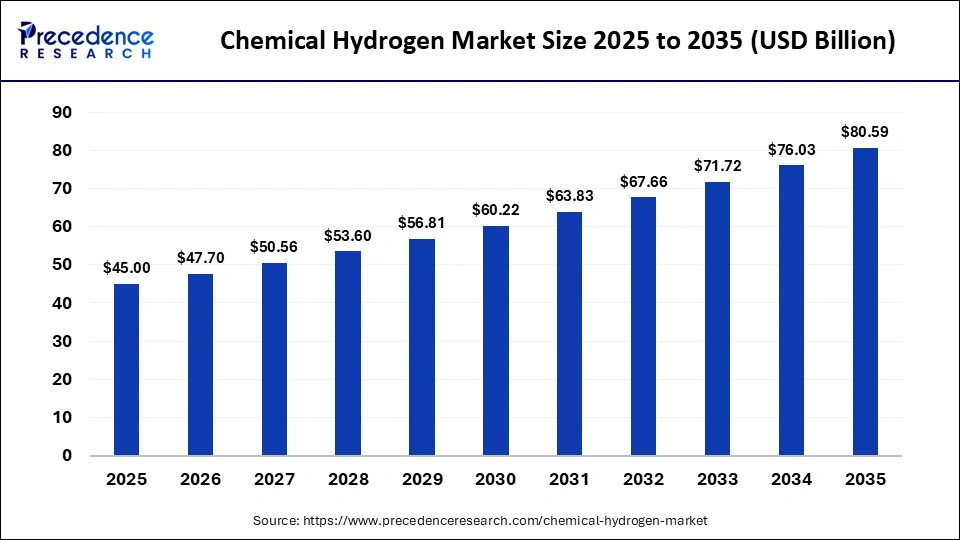
The global chemical hydrogen market size was valued at USD 45.00 billion in 2025 and is projected to surpass USD 80.59 billion by 2035. This growth, at a compound annual growth rate (CAGR) of 6.00% between 2026 and 2035, is propelled by the increasing demand for hydrogen in various industries, from energy storage to ammonia production. The drive toward cleaner, greener energy solutions and decarbonization efforts in critical sectors like refining and chemicals is significantly contributing to market expansion.
Chemical Hydrogen Market Key Points
- The global chemical hydrogen market size was valued at USD 45.00 billion in 2025 and is expected to grow to USD 80.59 billion by 2035.
- Asia Pacific dominated the market with a 42% share in 2025, while North America is expected to grow at the fastest rate of 6.5% CAGR.
- Grey hydrogen accounted for 68% of the market share in 2025.
- Ammonia production is the leading application, contributing to 42% of the market share in 2025.
- The chemical processing sector held the highest share of 78% in end-use applications in 2025.
Role of Artificial Intelligence in the Chemical Hydrogen Market
Artificial Intelligence (AI) is emerging as a game-changer in the chemical hydrogen market. By leveraging AI-powered systems, industries are able to optimize hydrogen production processes, enhance energy management, and improve electrolyzer performance. These innovations are accelerating the transition to sustainable and cost-effective hydrogen production, especially in areas like renewable-powered electrolysis.
AI’s role in this market is also evident in its ability to predict equipment failures and optimize real-time operations, providing a seamless integration with renewable energy sources for more efficient hydrogen production.
What is Fueling the Growth of the Chemical Hydrogen Market
The growth of the chemical hydrogen market is driven by several key factors, including:
- Demand in Chemical Synthesis: Hydrogen plays an essential role in the production of ammonia and methanol, which are critical components in fertilizers and industrial chemicals.
- Clean Energy Transition: With an increasing focus on decarbonization, hydrogen is becoming an integral part of clean energy solutions across various sectors.
- Fuel Refining Needs: The petroleum refining industry is also driving demand for hydrogen, particularly for desulfurization processes.
- Technological Advancements: Investments in blue and green hydrogen technologies are propelling the market forward, contributing to sustainability and emission reduction goals.
Government Initiatives Supporting the Chemical Hydrogen Market
| Government Initiatives | Country | Key Support for the Hydrogen Market |
| Hydrogen Strategy | European Union | Promotes green hydrogen production, infrastructure development, and investment incentives for decarbonization. |
| Hydrogen Energy Earthshot | United States | Aims to reduce clean hydrogen costs and accelerate large-scale production and adoption. |
| National Hydrogen Mission | India | Supports domestic green hydrogen production and builds hydrogen infrastructure to reduce fossil fuel dependence. |
| Made in China 2025 | China | Encourages advanced hydrogen technologies and strengthens domestic manufacturing capabilities. |
| Net Zero Strategy | United Kingdom | Promotes hydrogen as a key clean energy source to achieve long-term carbon neutrality goals. |
Opportunities and Trends in the Chemical Hydrogen Market
What trends are shaping the future of the chemical hydrogen market?
- Growth in Renewable Energy: Investments in renewable-powered electrolysis are leading to a rapid adoption of green hydrogen in key industries.
- Integration of Carbon Capture: The incorporation of carbon capture technologies in hydrogen production is gaining momentum to reduce CO2 emissions.
- Regulation-driven Demand: Stricter fuel regulations and environmental standards are accelerating the adoption of hydrogen, particularly in refining processes for cleaner fuels.
Chemical Hydrogen Market Attributes
| Report Metrics | Details |
| Market Size in 2025 | USD 45.00Billion |
| Market Size in 2026 | USD 47.70 Billion |
| Market Size by 2035 | USD 80.59 Billion |
| Market Growth Rate from 2026 to 2035 | CAGR of 6.00% |
| Dominating Region | Asia Pacific |
| Fastest Growing Region | North America |
| Base Year | 2025 |
| Forecast Period | 2026 to 2035 |
| Segments Covered | Production Type, Application , End Use, and region |
| Regions Covered | North America, Europe, Asia-Pacific, Latin America, and Middle East & Africa |
Chemical Hydrogen Market Regional Analysis
Asia Pacific Growth Outlook
The Asia Pacific market was valued at USD 20.70 billion in 2025 and is projected to reach USD 37.47 billion by 2035, growing at a CAGR of 6.11%. The region is expected to witness the fastest growth due to rapid industrialization and increasing hydrogen demand in energy and chemical sectors. Government support, expanding manufacturing activities, and investments in green hydrogen are accelerating market expansion.
India’s hydrogen market is expanding rapidly due to strong government initiatives promoting renewable energy and green hydrogen. Increasing focus on energy security, industrial decarbonization, and reducing import dependence is driving investments. Supportive policies and infrastructure development are further accelerating market growth.
North America Market Leadership
North America held the largest market share of 35% in 2025. This dominance is driven by advanced hydrogen production infrastructure, strong industrial capabilities, and supportive government policies. Significant investments in clean hydrogen projects and the presence of major oil and gas companies further strengthen the region’s position.
The United States leads the North American market due to its well-developed petrochemical and refining industries, which require large volumes of hydrogen. Abundant natural gas resources enable cost-effective grey hydrogen production. Ongoing investments in carbon capture and clean hydrogen technologies continue to reinforce market growth.
Chemical Hydrogen Market Segment Analysis
Production Type Insights
Grey hydrogen held the largest market share of 68% in 2025, primarily due to its cost-effective production through steam methane reforming (SMR) using natural gas. Its affordability compared to green and blue hydrogen makes it widely adopted across refineries, ammonia production, and other industrial applications. Additionally, its well-established technology, steady supply, and lower initial investment requirements make it the preferred choice for large-scale industrial use.
Blue hydrogen is projected to grow at the fastest CAGR of 5.2% in the coming years. This growth is driven by increasing demand for low-carbon hydrogen solutions. By integrating carbon capture and storage (CCS) technologies, blue hydrogen significantly reduces emissions while maintaining cost efficiency. Rising environmental regulations and sustainability goals are encouraging investments, positioning blue hydrogen as a transitional solution toward cleaner energy.
Application Insights
The ammonia production segment accounted for 42% of the market share in 2025, making it the dominant application. Hydrogen is a key input in ammonia synthesis, which is essential for fertilizer production. Growing global food demand and the need for higher agricultural productivity continue to drive consistent hydrogen consumption in this segment.
The methanol production segment is expected to grow at a CAGR of 5.4%. Hydrogen plays a vital role in methanol synthesis, which is widely used in fuels, chemicals, and industrial processes. Increasing demand for cleaner fuel alternatives and its use in producing formaldehyde, acetic acid, and plastics are key growth drivers. Environmental regulations are further supporting hydrogen-based methanol production.
End-Use Insights
The chemical processing segment dominated the market with a 78% share in 2025. Hydrogen is extensively used as a primary feedstock in petrochemical production. Established infrastructure, continuous demand from refineries and chemical plants, and the critical role of hydrogen in industrial processes contribute to this segment’s strong position.
The energy storage segment is expected to grow at the fastest CAGR of 5.6%. Hydrogen is increasingly being used as a clean energy storage solution, especially with the rising integration of renewable energy sources. It supports long-term energy storage and grid stability, with growth fueled by investments in decarbonization and renewable energy projects.
Also Read: MXene Market Size to Surpass USD 395.28 Billion by 2035
Chemical Hydrogen Market Key Players
Air Liquide offers comprehensive hydrogen solutions across the value chain, including production, storage, distribution, and use in industrial applications like refining and chemicals for decarbonization.
Linde plc provides end-to-end hydrogen and synthesis gas plants, featuring steam methane reforming (SMR), autothermal reforming (ATR), and carbon capture for low-carbon blue hydrogen, alongside green hydrogen via electrolysis.
Air Products and Chemicals, Inc. is a leading supplier of hydrogen and syngas, investing heavily in low-carbon projects like gasification and planning hydrogen to dominate 80% of its portfolio by 2035.
Technip Energies N.V. delivers blue hydrogen technologies such as ATR with carbon capture and proprietary recuperative reforming (TPR®), enabling large-scale production for refining, chemicals, and steel decarbonization.
RESONAC HOLDINGS CORPORATION produces low-carbon ammonia using hydrogen from chemical recycling of used plastics via gasification, targeting 100% plastic-derived hydrogen feedstock by 2030.
Reliance Industries Limited focuses on green hydrogen production from renewables and biomass gasification, aiming for 3 million tonnes per annum by 2032 at under $1/kg for industrial adoption.
Messer Group GmbH supplies grey hydrogen via on-site steam reforming and green hydrogen through water electrolysis (e.g., Silyzer 300 PEM) and biomethane reforming.
Cummins Inc. develops electrolyzers for green hydrogen production and fuel cell technologies, targeting $400 million in electrolyzer revenues by 2025.
Plug Power Inc. builds green hydrogen ecosystems with electrolyzers for production, plus liquefaction, storage, and distribution solutions.
INOX Air Products Ltd. manufactures and supplies industrial hydrogen, including green hydrogen plants using electrolysis powered by solar, with capacities up to 190 tons per annum under long-term agreements.
Iwatani Corporation leads in hydrogen supply with top market share in Japan, leveraging technologies for production and distribution.
Matheson Tri-Gas (Nippon Sanso Matheson) builds and operates large-scale hydrogen plants using multi-feed sources, supplying up to 285 tons/day for refineries.
HYDROGENICS / Nel Hydrogen specializes in electrolyzers (PEM and alkaline) for green hydrogen production from renewables.
Tokyo Gas Chemicals Co., Ltd. supplies pipeline hydrogen and produces it via AEM water electrolysis for industrial and refueling applications.
Adani Green Energy (via Adani New Industries Ltd.) develops integrated green hydrogen ecosystems, including electrolyzers and derivatives like ammonia and methanol, with end-to-end supply chain control.
Segments Covered in the Report
By Production Type
- Grey Hydrogen
- Blue Hydrogen
- Green Hydrogen
By Application
- Ammonia Production
- Methanol Production
- Petroleum Refining
- Others
By End-Use
- Chemical Processing
- Energy Storage
- Transportation
By Region
- North America
- Europe
- Asia-Pacific
- Latin America
- Middle East & Africa
Get this report to explore global market size, share, CAGR, and trends, featuring detailed segmental analysis and an insightful competitive landscape overview @ https://www.precedenceresearch.com/sample/7944
You can place an order or ask any questions, please feel free to contact us at sales@precedenceresearch.com |+1 804 441 9344