
Industrial Fine Grinding Mills Market Size to Reach USD 2.91 Billion by 2035 Driven by Technological Advancements
The market is expected to grow at a CAGR of 6.03% from 2026 to 2035, fueled by innovations in milling technology and increasing demand across industries such as mining, pharmaceuticals, and chemicals.
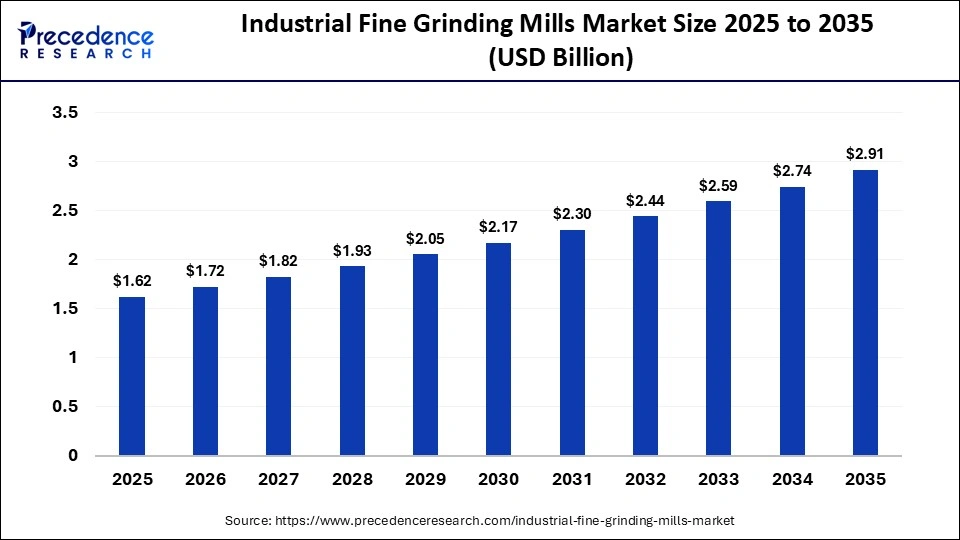
The Industrial Fine Grinding Mills market size is projected to grow from USD 1.62 billion in 2025 to approximately USD 2.91 billion by 2035, expanding at a robust CAGR of 6.03%. This growth is primarily driven by technological advancements in grinding technologies and increasing demand from key sectors like mining, chemicals, and pharmaceuticals. As these industries require finer particle sizes to enhance material performance, the demand for high-efficiency milling equipment is expected to continue its upward trajectory.
Industrial Fine Grinding Mills Market Key Points
- Market value in 2025: USD 1.62 billion
- Forecasted market value in 2035: USD 2.91 billion
- CAGR (2026-2035): 6.03%
- Leading region: Asia Pacific, accounting for 39% market share in 2025
- Key player in mill types: Ball Mills (37% market share)
- Fastest-growing segment: Stirred Media Mills by mill type
- Dominant end-use industry: Mining and Minerals (42% revenue share in 2025)
- Highest growth anticipated in the pharmaceuticals sector.
AI’s Role in the Market
Artificial Intelligence (AI) is significantly enhancing the industrial fine grinding mills market by integrating advanced data analytics, IoT sensors, and AI-driven processes. These innovations lead to improved energy efficiency, cost-effectiveness, and precision in material processing. AI-driven systems are increasingly used to monitor mill performance, optimize particle size distribution, and streamline production processes.
Furthermore, AI’s ability to predict maintenance needs and optimize throughput is crucial for maintaining efficiency in high-demand industries like pharmaceuticals, chemicals, and mining. This technology not only supports process optimization but also contributes to reducing operational costs, further driving market expansion.
Industrial Fine Grinding Mills Market Growth Factors:
- Technological advancements: Innovations like Industry 4.0 integration, AI, and IoT are enhancing grinding mill efficiency.
- Rising demand across industries: As sectors like mining, chemicals, and pharmaceuticals evolve, the demand for ultra-fine particles is increasing, thus driving the need for advanced milling solutions.
- Customization and specialization: The growing need for mills that cater to specific materials such as abrasive minerals and pharmaceutical products is expanding the market’s scope.
Industrial Fine Grinding Mills Market Opportunities and Trends
- How is the demand for fine grinding technology evolving in the mining sector?
The mining industry requires advanced grinding mills to process minerals effectively, and the demand for mills capable of achieving ultra-fine particle sizes is increasing. This is contributing to the growth of the market, particularly in regions with robust mining activities. - What are the emerging trends in the pharmaceutical industry’s grinding requirements?
The pharmaceutical sector is demanding more specialized grinding mills to improve the solubility and bioavailability of drugs. This trend is expected to accelerate with the introduction of AI-based mills that offer greater precision and efficiency in producing fine powders.
Industrial Fine Grinding Mills Market Segmentation
Mill Type Insights
Ball Mills Dominated the Market in 2025
Ball mills held a leading position in the global industrial fine grinding mills market in 2025, driven by their widespread use in cement and mining industries. Their ability to handle large volumes, maintain energy efficiency, and support bulk grinding applications significantly contributed to market growth. Additionally, technological advancements such as AI integration, IoT-enabled sensors, and predictive maintenance have enhanced operational efficiency. The shift from traditional steel balls to high-purity ceramic media has further improved wear resistance and reduced contamination in advanced applications.
Stirred Media Mills to Witness Fastest Growth
Stirred media mills are expected to grow at the fastest rate during the forecast period due to their ability to produce ultra-fine, sub-micron particles with high energy efficiency. These mills use a cylindrical shell with an internal rotor to agitate grinding media, enabling precise particle sizing. Their increasing adoption across industries such as ceramics, paints, pharmaceuticals, and mining is driving segment growth.
Particle Size Insights
Fine Grinding Segment Led in 2025
The fine grinding segment dominated the market in 2025, supported by its extensive application across industries like ceramics, cement, and pharmaceuticals. Fine particles enhance chemical reactivity, improve product quality, and enable better mineral liberation in mining. They also contribute to optimized energy usage and cost-efficient production processes, making them essential for multiple industrial applications.
Ultra-Fine Grinding to Grow Rapidly
The ultra-fine grinding segment is projected to register the highest CAGR in the coming years. These particles are crucial in pharmaceuticals, food processing, and advanced materials due to their superior solubility, reactivity, and texture enhancement. The ability to eliminate further grinding steps and customize particle size for specific needs is further accelerating demand.
End-Use Industry Insights
Mining and Minerals Segment Led in 2025
The mining and minerals segment accounted for the largest share in 2025, driven by the need for efficient ore beneficiation and mineral processing. Fine grinding mills enhance mineral recovery, improve particle liberation, and support downstream processing. They are widely used for grinding materials such as gold, copper, platinum, limestone, talc, and quartz, supporting high-volume industrial operations.
Pharmaceuticals Segment to Expand Rapidly
The pharmaceuticals segment is expected to witness the fastest growth due to increasing demand for ultra-fine, high-purity powders used in drug formulations. Advanced grinding technologies enable precise particle size control and compliance with strict quality standards. Rising investments in specialized mills for improving API efficacy are further fueling growth.
Industrial Fine Grinding Mills Market Regional Insights
Asia Pacific dominated the global market in 2025 and is projected to remain the fastest-growing region. Growth is driven by rapid industrialization, infrastructure development, and strong demand from mining, cement, and pharmaceutical industries. The increasing adoption of energy-efficient grinding technologies and continuous technological advancements further support regional expansion.
China is experiencing strong growth due to its expanding mining, cement, pharmaceutical, and chemical industries. The focus on energy-efficient and high-precision grinding solutions, along with rising demand for fine particles, is a key growth driver in the region.
North America is focusing on efficiency and sustainability, supported by Industry 4.0 adoption, automation, and smart monitoring systems. Increasing environmental regulations are encouraging the use of energy-efficient technologies while maintaining high-precision processing standards.
The U.S. market is evolving through digital transformation and specialized applications, particularly in electric vehicles and semiconductor manufacturing. Strategic collaborations and proactive risk management are helping companies maintain resilience and innovation.
Europe is shifting toward advanced automation, IoT integration, and sustainable grinding technologies to meet strict environmental regulations. Demand for ultra-fine particles in pharma, chemicals, and ceramics is driving the adoption of high-precision and energy-efficient systems.
Germany’s market is driven by demand from automotive and aerospace industries requiring high-precision grinding solutions. The integration of AI, predictive maintenance, and Industry 4.0 technologies is enhancing efficiency and maintaining strict quality standards.
Also Read: Oil and Gas Defoaming Separator Market Size Projected to Reach USD 14.26 Billion by 2035
Value Chain Analysis of the Industrial Fine Grinding Mills Market
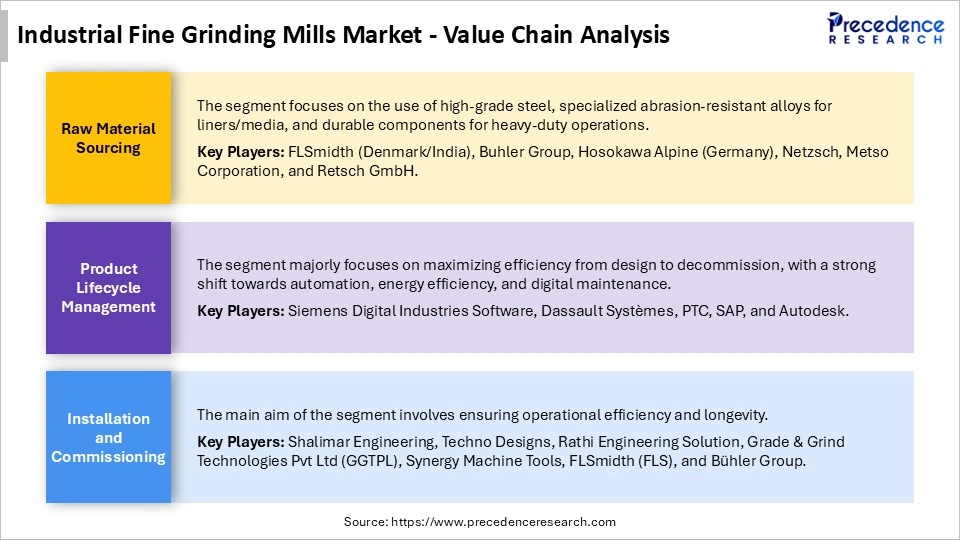
Industrial Fine Grinding Mills Market Key Players
- Metso Outotec offers stirred mills like Vertimill®, Stirred Media Detritor, and HIGmill™ for fine and ultra-fine grinding in secondary, tertiary, regrind, and lime slaking applications, emphasizing energy efficiency and compact design.
- FLSmidth provides a range of grinding solutions including FT Series Mills (ball, rod, pebble), High Pressure Grinding Rolls (HPGR), SAG/AG Mills, and vertical fine grinding mills like the FLS Tower Mill (FTM) and VXPmill for wet and dry grinding, focusing on high throughput and energy savings.
- Hosokawa Alpine supplies mills for coarse to ultra-fine grinding, including pre-crushers, granulators, shredders, and classifying systems tailored to various feed materials and fineness levels.
- Additional Key Offerings
NETZSCH Group delivers fine impact mills, classifying mills, jet mills, fine-cutting mills, and high-efficiency classifiers like SpheRho® for chemistry, minerals, ceramics, pharma, and food, achieving high fineness with low energy use. - Bühler Group offers horizontal hammer mills for efficient size reduction of dry materials like feeds and grains, handling coarse to fine grinding down to 50-400 micrometers.
- ThyssenKrupp Industrial Solutions (Polysius) provides ball mills for cement and slag grinding, often with high-efficiency separators for fine cements.
- Schenck Process features Raymond® Ultra Fine Mills for air-swept vertical ring-roller grinding to produce powders as fine as 50% passing 2 microns for coatings and fillers.
- Weir Group markets vertical stirred grinding mills through alliance with Swiss Tower Mills for coarse to fine applications, enhancing energy efficiency with HPGR integration.
- Gebr. Pfeiffer supplies MPS mills for raw meal, coal, and PPC grinding to fineness levels like 12% R 90 µm or 3500 Blaine.
- Loesche GmbH specializes in vertical roller mills for dry-grinding coal, cement raw materials, slag, minerals, and ores with throughputs from 2 to 1000 t/h.
- Christian Pfeiffer Maschinenfabrik offers grinding and separating plants for minerals down to <5 µm, including complete systems for mining and wet grinding.
- Eirich Group provides mixers and machines for fine grinding alongside mixing, granulating, and drying for ceramics, refractories, and battery compounds.
- Williams Patent Crusher & Pulverizer features Impact Dryer Mills for simultaneous grinding and drying of materials like gypsum, clays, and coal to fine powders.
- Union Process, Inc. specializes in attrition mills for fine grinding of high-value minerals to sub-micron sizes with low power and good temperature control.
- Retsch GmbH offers mills like the TWISTER for analytical fine grinding of feeds, forage, cereals, and food to high fineness.
- Sweco provides Vibro-Energy Grinding Mills for wet and dry grinding to 1/2 micron or less, with capacities from small batches to production scale.
- CPM Holdings, Inc. includes hammermills, roller mills, and cracking mills for grinding in pelleting processes across industries.
- Bradken manufactures grinding mill components like chutes, liners, and feed boxes with wear-resistant materials for mineral processing mills.
- Shanghai Zenith Machinery (Zenith) offers ultrafine grinding mills like XZM for powder production in carbon black, coal, lime, and fluorspar applications.
- FL Smidth MAAG Gear focuses on gear systems for grinding mills rather than mills themselves, supporting drives in FLSmidth’s grinding equipment.
Segments Covered in the Report
By Mill Type
- Ball Mills
- Jet Mills
- Hammer Mills
- Attrition Mills
- Roller Mills
- Stirred Media Mills
By Particle Size
- Fine Grinding
- Ultra-Fine Grinding
By End-Use Industry
- Mining and Minerals
- Chemicals
- Pharmaceuticals
- Food and Beverages
- Cement and Construction
- Paints
- Coatings and Pigments
By Region
- North America
- Latin America
- Europe
- Asia-pacific
- Middle and East Africa
Get this report to explore global market size, share, CAGR, and trends, featuring detailed segmental analysis and an insightful competitive landscape overview @ https://www.precedenceresearch.com/sample/8061
You can place an order or ask any questions. Please feel free to contact us at sales@precedenceresearch.com |+1 804 441 9344