
Additive Binder Jets Market Size Worth USD 7.50 Billion by 2035
The global additive binder jets market size is projected to be worth USD 7.50 billion by 2035, increasing from USD 1.70 billion in 2025, growing at a compounded annual growth rate (CAGR) of 16.00% from 2026 to 2035. This growth is largely fueled by increasing adoption across industries like automotive, aerospace, and industrial sectors, driven by the demand for efficient, customizable, and cost-effective manufacturing solutions.
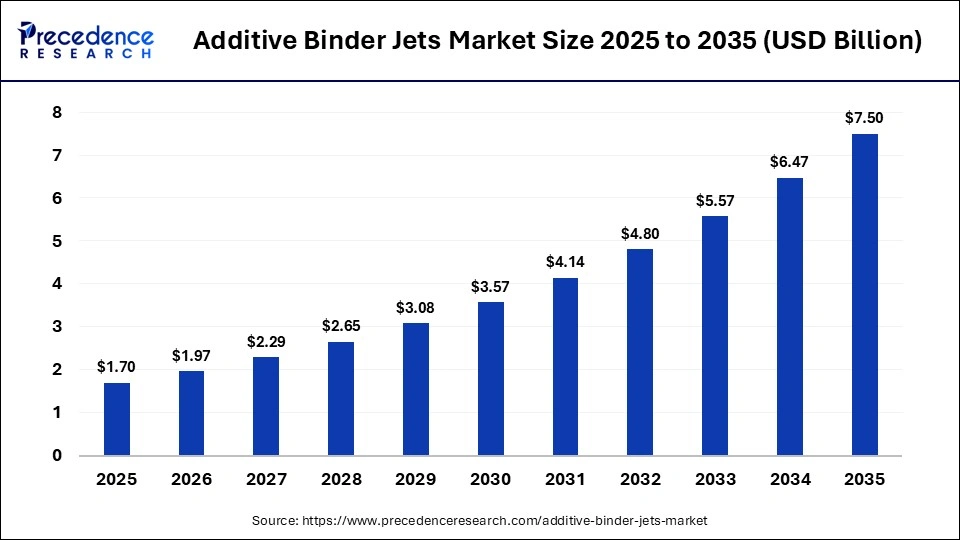
Additive Binder Jets Market Key Points
- Market Value (2025): USD 1.70 billion
- Forecasted Market Value (2035): USD 7.50 billion
- CAGR (2026-2035): 16.00%
- Top Region: North America, with a market share of 40% in 2025
- Leading Material Segment: Metal powders, accounting for 45% of the market in 2025
- Machine Size Dominance: Medium machine size, holding 43% of the market share in 2025
- End-Use Industry Leader: Industrial sector, commanding a 50% market share in 2025
What Are Additive Binder Jets?
Additive Binder Jets is an innovative 3D printing technology where liquid binders selectively bond powder particles layer by layer to create intricate parts. This process is gaining momentum due to its efficiency, scalability, and minimal tooling needs, making it a preferred choice for industries such as aerospace, automotive, and manufacturing. The key growth drivers for this market include the demand for lightweight components, customized parts, and enhanced manufacturing capabilities.
How Are Technological Advancements Influencing the Additive Binder Jets Market?
Technological innovations are a game-changer in the Additive Binder Jets market. The integration of Artificial Intelligence (AI) is optimizing the entire production process, particularly in defect detection, risk predictions, and quality inspection. AI-driven machine learning helps spot defects in metal parts while predictive maintenance ensures smoother operations. Innovations in high-performance powders and advanced binder formulations further improve the efficiency of the binder jetting process, particularly for complex geometries in aerospace and automotive applications.
AI also plays a crucial role in improving the speed and precision of additive manufacturing, reducing waste, and lowering production costs. Real-time monitoring and automated processes contribute to the reliability of the technology, making it more appealing to manufacturers looking for cost-effective, high-quality solutions.
Additive Binder Jets Market Regional Analysis
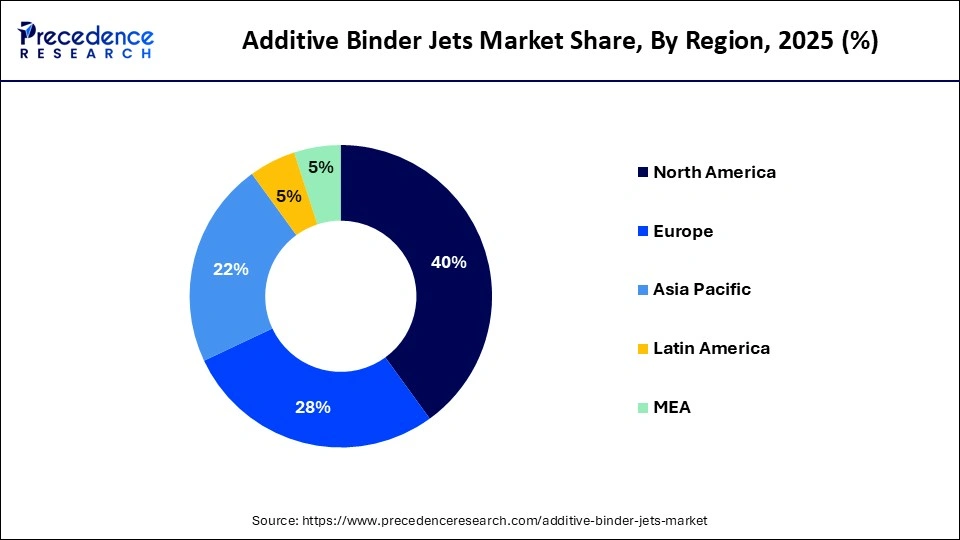
North America Dominance (2025)
North America held the largest share of 40% in 2025, supported by strong government initiatives and investments in advanced manufacturing and 3D printing technologies. The region benefits from growing demand in automotive production and increasing adoption in personalized medical devices such as implants and prosthetics.
United States Market Growth
The U.S. leads the regional market, driven by applications across energy, automotive, and healthcare sectors. Companies like ExxonMobil use binder jetting for specialized tools, while organizations like NASA support research in advanced materials. The technology is also gaining traction in electric vehicles and medical implants.
Asia Pacific Growth
Fastest-Growing Region
Asia Pacific is projected to grow at the fastest CAGR of 16.5%. Growth is fueled by rapid industrialization, increased investments in advanced manufacturing, and a large consumer base. Countries such as China, Japan, India, and South Korea are actively adopting binder jetting across multiple industries.
China Market Expansion
China’s growth is driven by strong government support and modernization initiatives. Companies like Geely are leveraging binder jetting for electric vehicle components. Increased R&D investments and academic collaborations are further accelerating adoption.
Europe Market Trends
Steady Growth in Europe
Europe is experiencing notable growth due to strict environmental regulations and demand for sustainable manufacturing. The need for customized components is also driving adoption across industries.
Key Developments in Aerospace
Organizations such as European Space Agency and companies like Airbus Defence and Space are advancing binder jetting applications for satellite components. Additionally, MTU Aero Engines is researching turbine blade manufacturing using advanced materials.
United Kingdom Market
Rising Adoption in the UK
The UK market is growing steadily, with increasing adoption in aerospace, automotive, and consumer goods industries. Binder jetting is valued for its ability to produce high-quality components efficiently while reducing material waste. Continued innovation and a focus on sustainability are expected to support long-term growth.
Additive Binder Jets Market Growth Factors
The market is experiencing robust growth driven by several factors:
- Technological Advancements: Innovations in AI, machine learning, and automated process controls are enhancing the performance of additive binder jetting technologies.
- Increased Demand for Customization: As industries look for more flexible manufacturing solutions, the ability to produce highly customized and complex parts at scale is a major driver.
- Cost Efficiency: With reduced waste, quicker turnaround times, and lower tooling costs, additive binder jets offer manufacturers a compelling economic advantage.
- Environmental Considerations: As industries seek to adopt greener manufacturing processes, binder jetting’s reduced waste and energy consumption are proving to be a favorable choice.
Opportunities and Trends in the Additive Binder Jets Market
What are the key opportunities in the Additive Binder Jets market?
- Expanding Aerospace Applications: The aerospace sector is increasingly adopting additive binder jets for creating lightweight, high-performance components. The ability to produce complex geometries efficiently is driving demand.
- Automotive Sector Growth: As the automotive industry pushes for faster prototyping and production of customized parts, binder jetting is becoming a valuable tool for manufacturers.
- Growth in Powder Materials: The rising use of metal and ceramic powders in additive manufacturing creates a steady growth trajectory for the material segment.
Also Read: Splicing Tape Market Size to Reach USD 3.29 Billion by 2035
Additive Binder Jets Market Scope
| Report Coverage | Details |
| Market Size in 2025 | USD 1.70 Billion |
| Market Size in 2026 | USD 1.97 Billion |
| Market Size by 2035 | USD 7.50 Billion |
| Market Growth Rate from 2026 to 2035 | CAGR of 16.00% |
| Dominating Region | North America |
| Fastest Growing Region | Asia Pacific |
| Base Year | 2025 |
| Forecast Period | 2026 to 2035 |
| Segments Covered | Material, Machine Size, End Use, Sales Channel Direct OEM, and Region |
| Regions Covered | North America, Europe, Asia-Pacific, Latin America, and Middle East & Africa |
Additive Binder Jets Market Segment Insights
Material Insights
Metal Powders Segment Dominance (2025)
The metal powders segment led the additive binder jets market, accounting for around 45% share in 2025. This dominance is driven by strong demand from aerospace and automotive industries, where materials such as stainless steel, aluminum, and titanium are widely used. Metal powders offer high precision, durability, and the ability to produce lightweight yet complex components, making them ideal for advanced manufacturing.
Fastest Growth of Composites & Ceramics
The composites and ceramics segment is expected to grow at the fastest CAGR of 14.7%. These materials provide excellent strength-to-weight ratio, thermal stability, and wear resistance, making them highly suitable for demanding applications. Advancements in powder formulations and sintering technologies are further enhancing their performance, while binder jetting enables complex and customized designs not achievable through traditional methods.
Machine Size Insights
Medium Segment Leadership (2025)
The medium-sized machine segment dominated the market with a 43% share in 2025 and is projected to grow at a CAGR of 14.5%. These machines strike a balance between scalability and flexibility, making them ideal for a wide range of applications across automotive, aerospace, and industrial sectors.
Why Medium Machines Are Preferred
Medium binder jet systems offer reduced lead times, consistent quality, and efficient production capabilities. They are particularly suited for prototyping, small-batch production, and functional part manufacturing, providing faster output than large systems and more versatility than smaller units.
End-Use Insights
Industrial Segment Dominance (2025)
The industrial segment held the largest share of 50% in 2025. This is due to the ability of binder jetting technology to produce lightweight, durable, and complex components that meet modern industrial requirements. The process supports precision manufacturing, material efficiency, and faster production cycles, making it highly attractive for industrial users.
Aerospace Segment Growth
The aerospace segment is expected to grow significantly during the forecast period. Increasing demand for lightweight, high-strength components is driving adoption. Binder jetting enables the production of complex parts such as brackets, ducts, and turbine components, improving fuel efficiency and performance.
Sales Channel Insights
Direct OEM Segment Leadership (2025)
The direct OEM segment led the market with a 57% share in 2025. OEMs provide customized solutions, direct technical support, and ensure compliance with industry standards. Their role in rapid prototyping and production of complex components helps reduce development time and costs.
Growth of Integrators
The integrators segment is expected to grow at the fastest rate. Integrators offer complete solutions, including hardware, software, materials, and post-processing services. This simplifies adoption for manufacturers, especially SMEs, while providing training, optimization, and technical support.
Additive Binder Jets Market – Value Chain Analysis
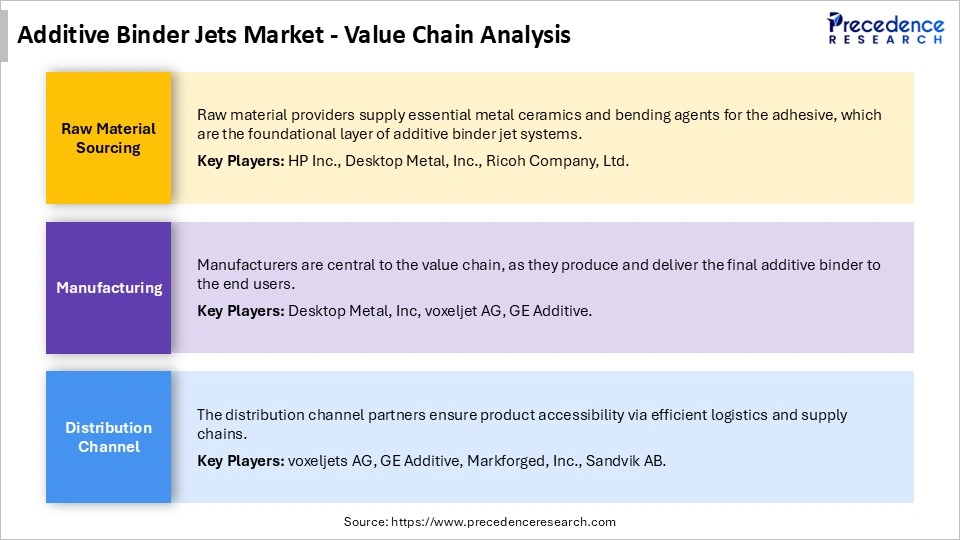
Additive Binder Jets Market Key Players
- HP Inc.
- Desktop Metal, Inc
- ExOne
- voxeljets AG
- GE Additive
- Digital Metal AB
- Ricoh Company, Ltd.
- Toshiba Corporation
- Stratasys Ltd.
- 3D Systems Corporation
- Markforged, Inc.
- Sandvik AB
- Renishaw plc
- EOS GmbH
- Mimaki Engineering Co., Ltd
Segments Covered in the Report
By Material
- Metal Powders
- Composites/Ceramics
- Sand
- Others
By Machine Size
- Medium
- Small
- Large
- Other
By End Use
- Industrial
- Aerospace
- Automotive
- Other
By Sales Channel Direct OEM
- Distributors
- Integrators
- Other
By Region
- North America
- Europe
- Asia-Pacific
- Latin America
- Middle East & Africa
Get this report to explore global market size, share, CAGR, and trends, featuring detailed segmental analysis and an insightful competitive landscape overview @ https://www.precedenceresearch.com/sample/7821
You can place an order or ask any questions. Please feel free to contact us at sales@precedenceresearch.com |+1 804 441 9344